'%20d='m0%200%2016%2011h61%2061%2061%2061%2060L47%2037h61%2061%2060%2061L16%2063h61%2061%2061%2061%2060L47%2089h61%2061%2060%2061L16%20115h61%2061%2061%2061%2060L47%20141h61%2061%2060%2061L16%20166h61%2061%2061%2061%2060L47%20192h61%2061%2060%2061L16%20218h61%2061%2061%2061%2060z'/%3e%3c/svg%3e)
About
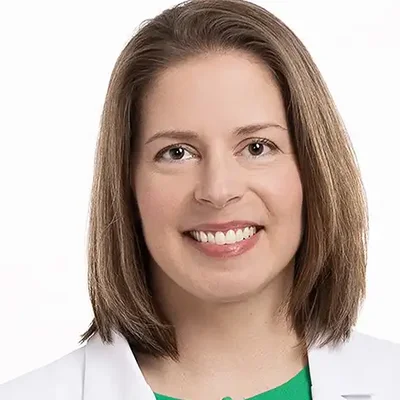
Jennifer Shannon took the long way into reproductive endocrinology, and it is the part of her training patients ask about. After residency at UT Southwestern she spent six years in general obstetrics and gynecology practice in Washington State — delivering babies, running a clinic, and sitting on her hospital’s quality committee, where she wrote and revised obstetric standard operating procedures and emergency checklists, and worked with the March of Dimes perinatal committee. Then she went back to UT Southwestern for the REI fellowship, finishing in 2022. Most reproductive endocrinologists have never managed a third-trimester complication on a Tuesday night. She did it for six years, which changes how she handles an IVF pregnancy after the transfer.
Her fellowship work concentrated on three areas: preimplantation genetic testing, ovarian tissue cryopreservation, and surgery for Mullerian anomalies — congenital uterine shapes such as a septum or a bicornuate uterus that interfere with implantation and maintenance of pregnancy. Those are the technical edges of a fertility practice: a PGT cycle has to be designed around how many embryos a patient can realistically produce, a tissue bank has to be arranged before chemotherapy starts, and a uterine septum has to be resected before anyone counts a transfer as failed.
She graduated summa cum laude in biochemistry from the University of Minnesota and took her MD at the same school, and she now sees new patients at the Plano office on West Parker Road, the practice’s northern location with its own IVF laboratory since 2021. Biochemistry is not a decorative degree here: embryo genetic screening and ovarian metabolism are both, at bottom, biochemical problems.
Clinical Expertise
- PGT-A and PGT-M: embryo chromosome screening and single-gene disease testing, with counseling on what a biopsy result can and cannot settle, especially in patients with few embryos
- Repeated implantation failure: working through embryo genetics, uterine cavity, and protocol changes as one investigation rather than three
- Ovarian tissue cryopreservation: banking ovarian tissue when a cancer patient has no time for a stimulation cycle
- Mullerian anomalies: diagnosis by imaging and hysteroscopy, and hysteroscopic correction of a septum before transfer
- Diminished ovarian reserve: dose and trigger strategy for low responders, with an honest cycle-count conversation
- Obstetric management after ART: early pregnancy care informed by six years of general ob/gyn practice
Why Choose Dr. Jennifer Shannon
Six years of real-world ob/gyn before the subspecialty. She wrote obstetric emergency protocols for a hospital quality committee. Patients who conceive at 40 with a history of fibroids are getting advice from someone who has managed the delivery side of that.
Three hard niches on one CV. PGT, tissue banking and uterine anomaly surgery are usually split among different physicians in a small practice. She trained in all three in the same fellowship, at UT Southwestern.
A biochemistry degree earned summa cum laude, followed by an MD at the same institution — the scientific base underneath a genetics-heavy practice.
Professional Affiliations
Board-certified reproductive endocrinologist, subspecialty-trained in reproductive endocrinology and infertility at UT Southwestern Medical Center, where she also completed residency; MD and summa cum laude BS in biochemistry from the University of Minnesota. Member of the American Society for Reproductive Medicine. Prior service on a Washington State hospital quality committee writing obstetric and emergency protocols, and participation in the March of Dimes perinatal quality committee.
Suitable For
- Patients with two or more failed transfers, where embryo genetics is the next question
- Families with a known single-gene condition, considering PGT-M
- Cancer patients choosing between egg, embryo and ovarian tissue banking, on a treatment timetable
- Women with a congenital uterine anomaly, or a septum found during an infertility workup