'%20d='m0%200%2016%2011h61%2061%2061%2061%2060L47%2037h61%2061%2060%2061L16%2063h61%2061%2061%2061%2060L47%2089h61%2061%2060%2061L16%20115h61%2061%2061%2061%2060L47%20141h61%2061%2060%2061L16%20166h61%2061%2061%2061%2060L47%20192h61%2061%2060%2061L16%20218h61%2061%2061%2061%2060z'/%3e%3c/svg%3e)
About
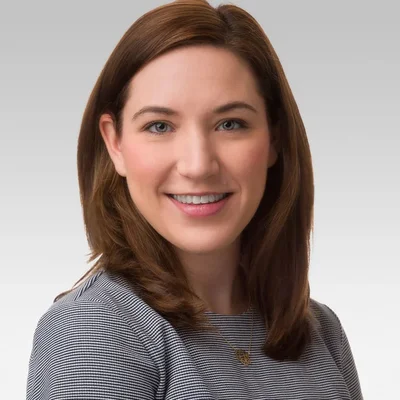
“I feel so privileged to have the opportunity to work with patients during some of the most vulnerable times in their lives in the pursuit of building a family.” That is Jessica Walter’s own description of the job, and it is the reason her consultations start with testing rather than treatment.
The résumé behind it runs through two coasts. Harvard College in 2009, Harvard Medical School in 2014, then Chicago: OB/GYN residency at the McGaw Medical Center of Northwestern University, completed 2018. Philadelphia again for a reproductive endocrinology and infertility fellowship at the University of Pennsylvania in 2021, then back to the Northwestern faculty as an assistant professor. She has spent five years as an attending in a field where the same year can change what a protocol looks like.
Her day-to-day is the unglamorous middle of fertility care — the patients who are not famous cases, just a cycle: injections for eight to fourteen days, morning monitoring ultrasounds and bloodwork, a trigger shot, retrieval thirty-six to thirty-eight hours later.
Clinical Expertise
- IVF cycle management — protocol selection off ovarian reserve numbers, stimulation monitoring, trigger timing and transfer
- ICSI — direct sperm injection for male-factor or low-fertilization histories
- PGT-A — embryo genetic screening before transfer, biopsied in the center’s own lab
- Ovulation disorders — anovulation and irregular cycles worked up against thyroid, prolactin and androgen panels before anyone reaches for stimulation drugs
- Unexplained infertility — the sequencing decision: timed intercourse, several rounds of IUI with oral or injectable stimulation, or a move to IVF
- Baseline evaluation — antral follicle count, AMH, FSH and day-3 estradiol, hysterosalpingogram or saline sonohysterogram, semen analysis, carrier screening
Why Choose Dr. Jessica Walter
She works the funnel honestly. The center publishes its own process expectations: about 75% of retrieved eggs mature, roughly 70% of those fertilize, and 25-50% of fertilized embryos end up suitable for transfer. A physician who walks a patient through those numbers before cycle one is more useful than one who quotes a success rate afterward.
Two Ivies and a Chicago residency. Harvard for college and medical school, Penn for fellowship, Northwestern for residency — the training covers the eastern academic centers and the Midwest clinic where she now practices, which matters for patients transferring care from an employer plan or another state.
First-consultation patients get her attention. Her stated focus is supporting people at their most vulnerable point, and new evaluations are where most decisions get made or derailed: how much reserve is left, whether the tubes are open, whether IUI is a reasonable detour.
Teaching rank, clinical schedule. She holds an assistant professorship at Northwestern’s Feinberg School of Medicine while carrying her own patient panel — the arrangement that keeps a physician current on protocol changes instead of a decade behind them.
Professional Affiliations
American Society for Reproductive Medicine. Walter is board-certified in Obstetrics and Gynecology and subspecialty-trained in Reproductive Endocrinology and Infertility, with residency credit from the McGaw Medical Center of Northwestern University and fellowship training at the University of Pennsylvania. She consults across a four-site practice — Chicago, Geneva, Highland Park and Oakbrook Terrace — with an in-house IVF and andrology laboratory under lab director Joan Riley, PhD, HCLD, and with pharmacy and psychological support built into IVF registration rather than bolted on afterward.
Suitable For
- Patients walking into a first fertility visit, who need the evaluation ordered correctly rather than a treatment sold to them
- Women with irregular or absent periods — PCOS-pattern anovulation, hypothalamic cycle suppression, thyroid and prolactin problems
- Couples diagnosed with unexplained infertility, where the real question is how many IUIs to try before IVF, and what each costs in time
- Patients who want hormone panels explained — why AMH is not the same as fertility, why a day-3 FSH has to be read alongside estradiol
- Monitoring-intensive cycles, where showing up for early morning scans and bloodwork is the treatment