'%20d='m0%200%2016%2011h61%2061%2061%2061%2060L47%2037h61%2061%2060%2061L16%2063h61%2061%2061%2061%2060L47%2089h61%2061%2060%2061L16%20115h61%2061%2061%2061%2060L47%20141h61%2061%2060%2061L16%20166h61%2061%2061%2061%2060L47%20192h61%2061%2060%2061L16%20218h61%2061%2061%2061%2060z'/%3e%3c/svg%3e)
About
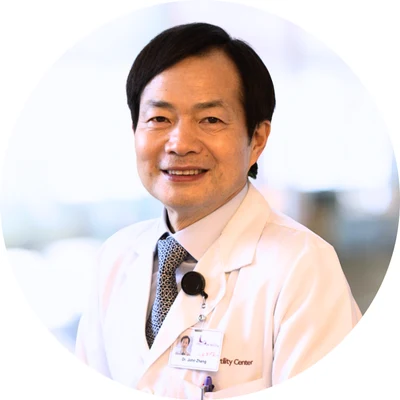
New Hope’s own profile for Dr. John Zhang opens with a date: he has led the practice since 2004. He is the founder and medical director of New Hope Fertility Center in New York City, and he still sees patients there. That founding date should be read as the clinic’s claim rather than a registration record, because the clinic’s pages do not agree with each other - the site footer says more than 15,000 babies were born there since 2006, the copyright line starts at 2007, and the Park Avenue page dates that facility to October 2010. His profile carries 2004, and this page reports it the same way, as a self-reported year.
His training runs across three countries. He took his medical degree at Zhejiang University School of Medicine in China in 1984, an MSc in male fertility at the University of Birmingham in 1985, and a PhD in in vitro fertilization at the University of Cambridge in 1991, with a thesis on the in vitro maturation and fertilization of mammalian oocytes, after a British Postgraduate Scholarship in 1989. He then did post-doctoral work at Georgetown University from 1991 to 1993 and coordinated the Rockefeller Foundation research programme linking Georgetown and Peking University from 1993 to 1997, before returning to clinical training in New York: obstetrics and gynecology residency at New York University School of Medicine, completed 1997, and a reproductive endocrinology and infertility fellowship there in 2001, which his profile lists him as the first fellow in that division.
The clinic’s profile gives his degree string two ways - “John Zhang, MD, PhD, MSc” on the page itself and “John Zhang, MD, MSc, PhD” in the site’s underlying record. This page uses the form printed on the profile. He consults in English and in Chinese (Mandarin), and outside New York his profile lists two consultancy posts in China: reproductive nuclear transfer and stem cell research at Sun Yat-sen University in Guangzhou, and the Fertility Centre of Wenzhou Medical College in Zhejiang.
Clinical Expertise
- Mini-IVF and mild stimulation: his profile credits him with pioneering Mini-IVF in the United States - fewer drugs, closer to a natural cycle. The clinic’s own Mini-IVF page puts stimulation at 5-7 days against the 10-12 days it describes for conventional IVF, 5-7 monitoring visits, 3-8 eggs retrieved, 70-90% less medication and 30-50% lower cost than a conventional cycle. Those are the clinic’s published figures with no denominator, no age band and no reporting year attached, and they have not been reconciled against a registry; they are reported here as the clinic’s claims, not as verified outcomes.
- Natural Cycle IVF: treatment with minimal or no stimulation medication, named alongside Mini-IVF as his representative approach on his profile.
- Advanced maternal age and decreased ovarian reserve: both appear by name in his specialization list. The clinic adds a “One Good Egg” policy on its success-rate pages, stating that it does not decline patients on the basis of age, FSH level or follicle count; that too is the clinic’s self-description.
- In vitro fertilization, egg donation and embryo genetic testing: conventional IVF, egg donation programs and PGT are all listed on his profile.
- Recurrent pregnancy loss and complex infertility: recurrent pregnancy loss plus multiple failed IVF cycles are separate entries in his specialization list.
- Fertility preservation and egg freezing: listed on his profile, and long-term cryopreservation of oocytes appears in his current research interests.
- Male factor infertility: his master’s degree was in male fertility, and male factor infertility is on his specialization list.
Why Choose Dr. John Zhang
The mild-stimulation route is his own. Few clinic founders are also the person who pushed the low-medication approach they market. His profile says he “played a key role in the development of Natural Cycle IVF and Mini-IVF” and is widely recognized for pioneering Mini-IVF in the United States, with the stated aim of reducing physical burden while maintaining clinical rigor. For a patient whose main concern is drug load rather than maximum egg number, that is the practice built around the question - subject to the caveat above that the supporting percentages are the clinic’s own numbers.
Mitochondrial replacement: a first birth, and a lab result from 2003. His profile states that in 2016 his team produced the world’s first baby born using spindle transfer, a mitochondrial replacement technique, for a family affected by Leigh syndrome, a severe genetic-neurological disorder caused by mitochondrial DNA mutations; the mutated mitochondria were replaced while the mother’s nuclear DNA was preserved, and the healthy baby boy was born in April 2016. The paper “Live birth derived from oocyte spindle transfer to prevent mitochondrial disease” (2016) is on his publication list. His profile also describes him as among the first researchers to work with pronuclear transfer: with Sun Yat-Sen University of Medical Science in 2003, reporting a 70% fertilization rate. That 70% is a laboratory fertilization figure from research cycles, not a pregnancy or live birth rate, and it should not be read as a clinical outcome.
Recognized outside the clinic, with dates. Nature’s Ten: Ten People That Mattered (2016); Foreign Policy Global Thinkers Award nominee (2016); The Times Science Power List (2020); one of New York’s Top Doctors (2013); RESOLVE Hope Award for Achievement (2013); ASRM/Organon Research Award (2002-2004). All are listed on his profile; none of them is a measure of per-cycle success rates.
Mandarin consultations, and a laboratory credential. His profile states his languages as English and Chinese (Mandarin), which matters for history-taking and protocol explanation with Chinese-speaking patients; the clinic’s donor-program FAQ separately routes Chinese-speaking patients to a coordinator who works in that language. He is also a Certified High Complexity Laboratory Director, so the embryology laboratory sits within his own credentialed scope.
He still publishes and still consults. His listed current research interests are non-embryonic stem cell research, long-term cryopreservation of oocytes, oocyte reconstruction by nuclear transfer, advanced assisted reproductive technologies and minimally invasive IVF protocols. His earlier publications cluster in gamete biology: horse follicular oocytes matured in vitro (1990), stallion sperm acrosome reaction (1990) and structural and functional changes in stallion spermatozoa (1991), zona-opening of hamster oocytes (1994), and the effect of antisperm antibody on human sperm motility (1989).
Professional Affiliations
His profile separates two credentials that clinics often blur, and this page keeps the distinction: board-certified in Obstetrics and Gynecology by the American Board of Obstetrics and Gynecology, and board-eligible as a reproductive endocrinologist and infertility specialist. The clinic’s own wording is “Board-Eligible Reproductive Endocrinologist and Infertility Specialist”; it does not claim board certification in the REI subspecialty for him, and no such claim is made here. He is additionally a Certified High Complexity Laboratory Director. His profile lists no state medical license entry - unlike the profile of his colleague Dr. Khaled Zeitoun, who shows active New York and Texas licenses - so this page makes no licensing statement about him.
Memberships: American Society for Reproductive Medicine, American College of Obstetricians and Gynecologists, British Fertility Society, and founder and member of the Life Science Society at the University of Cambridge. His China consultancies at Sun Yat-sen University (Guangzhou) and the Fertility Centre of Wenzhou Medical College are listed on his profile under international affiliations.
One more thing a patient should know before arriving: this physician’s case mix shows up in the clinic’s registry numbers. On CDC NASS 2022 - the only registry row available for this clinic, since it does not appear in SART’s CORS extract - New Hope’s cumulative live birth per intended egg retrieval sits below the national row in all four age bands, 17.3% against 49.7% under 35 and 1.1% against 7.7% over 40. The clinic’s own explanation is that it accepts older and higher-FSH patients and that 55.2% of its 2022 cycles were in women over 40, against 20.0% nationally. The clinic also states plainly that its published success data “often skews downwards.” The full comparison, with denominators, is on the clinic page; none of it is a quality ranking, and a below-national row is not proof of poor care either.
Suitable For
- Older patients, including those turned away elsewhere: advanced maternal age is the first specialty item on his profile, and the clinic’s One Good Egg policy is explicitly written around age and FSH-based refusals. Expect the registry numbers above to be part of the conversation, not hidden from it.
- Decreased ovarian reserve or high FSH: mild stimulation and natural-cycle work are aimed at this group, where the goal is egg quality over egg count.
- Patients who want the fewest injections compatible with a real attempt: Mini-IVF, natural-cycle IVF and the clinic’s Needle-Free protocol are all built on that preference.
- Chinese-speaking families: consultations can be held in Mandarin with the founder himself, and the practice maintains a Chinese-language service line.
- Complex or repeated-failure histories: recurrent pregnancy loss and multiple failed IVF cycles are named specialties, and he remains directly involved in patient care rather than delegating it.