'%20d='m0%200%2016%2011h61%2061%2061%2061%2060L47%2037h61%2061%2060%2061L16%2063h61%2061%2061%2061%2060L47%2089h61%2061%2060%2061L16%20115h61%2061%2061%2061%2060L47%20141h61%2061%2060%2061L16%20166h61%2061%2061%2061%2060L47%20192h61%2061%2060%2061L16%20218h61%2061%2061%2061%2060z'/%3e%3c/svg%3e)
About
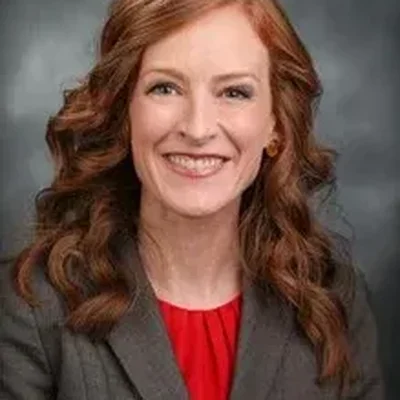
Julia T. Woodward, PhD has built her career on one research question: what actually happens, psychologically, to people who become parents for the first time after 40? It is an unusually practical question for an unusually common situation, and it shapes both her academic appointment at Duke — professor in the Department of Psychiatry and Behavioral Sciences and the Department of Obstetrics and Gynecology since 2025 — and the patient care she provides at Duke Fertility Center.
She trained inside the system she now teaches in: a health psychology residency at Duke University Medical Center (2003-2004), a PhD in clinical health psychology from the University of Kansas (2004), then additional research training at Duke in pain prevention and treatment (2004-2005). She has worked in reproductive mental health since 2004 — 21 years of it — which means she has followed infertility counseling from a niche add-on to a standard part of fertility care.
Patients meet her inside the clinic rather than across town. Behavioral health is built into Duke Fertility Center’s model — a psychologist sits on the standard care team from the first appointment — and the center’s psychological services run individual and partner counseling, support groups, decision counseling and coping-skills classes for IVF patients. Woodward adds a second language to that menu: she provides care in Spanish as well as English.
Clinical Expertise
- Coping with infertility: Assessment and treatment for the anxiety and low mood that track through cycles, waiting and negative tests
- Later-age family building: The psychology of becoming a parent after 40 is her named research focus, not an occasional case
- Individual and partner counseling: Delivered inside the fertility program, where decisions and emotions are treated as part of the medical plan
- Bilingual psychological care: Full sessions in English or Spanish
Why Choose Dr. Woodward
The researcher and the clinician are the same person. Few fertility psychologists in the country both study how people fare becoming parents past 40 and sit in a fertility clinic seeing those exact patients; Duke gave her a joint professorship in psychiatry and ob-gyn in 2025 because of that range.
Twenty-one years in one specialty. Continuous practice in reproductive mental health since 2004 — the pattern recognition that only comes from thousands of cycles’ worth of the same hard conversations.
Spanish-language care without a translator. For Hispanic patients in the Raleigh-Durham area, a bilingual psychologist embedded in the fertility team removes an entire layer of friction.
Rated by patients where it counts. Duke Health shows a 4.82 out of 5 patient rating.
Professional Affiliations
Woodward has held her dual professorship at Duke University — Psychiatry and Behavioral Sciences, and Obstetrics and Gynecology — since 2025, and has practiced in reproductive mental health since completing her clinical health psychology doctorate at the University of Kansas in 2004, with residency and research training at Duke University Medical Center. She works within Duke Fertility Center, a member clinic of the Society for Assisted Reproductive Technology.
Suitable For
- Patients 40-plus building or expanding families: Her research population is literally this group
- Anxiety or depression tracking through treatment: Grief after miscarriage or a failed cycle, decision fatigue, dread of the next monitoring scan — the center’s counseling program handles these, and she leads in them
- Spanish-speaking patients: Care delivered in Spanish, start to finish
- Partners who want to be in the room: Individual and partner counseling is part of the program she practices within