'%20d='m0%200%2016%2011h61%2061%2061%2061%2060L47%2037h61%2061%2060%2061L16%2063h61%2061%2061%2061%2060L47%2089h61%2061%2060%2061L16%20115h61%2061%2061%2061%2060L47%20141h61%2061%2060%2061L16%20166h61%2061%2061%2061%2060L47%20192h61%2061%2060%2061L16%20218h61%2061%2061%2061%2060z'/%3e%3c/svg%3e)
About
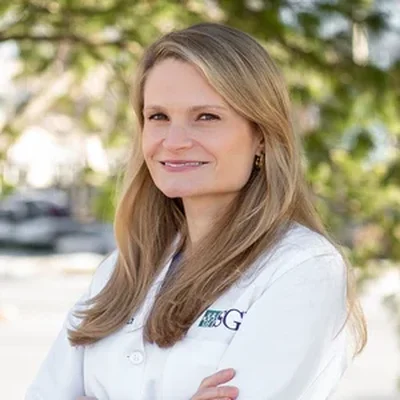
Most fertility clinics publish research on protocols and on embryo grading. Dr. Kathryn C. Humm has published on a question that rarely gets put in writing: whether IVF outcomes differ by a patient’s race and ethnicity. It is the kind of work that only makes sense if you are looking at your own results rather than at a marketing deck, and it sits alongside her published abstracts and papers on preimplantation genetic testing and on IVF outcomes generally. Her research record and her CREST scholarship from the American Society for Reproductive Medicine (2015) point the same direction — she reads outcome data skeptically, which is the useful skill when you are deciding whether a clinic’s quoted number applies to you.
Her training is a single Boston chain: Yale for undergraduate, Vanderbilt University School of Medicine for her MD, then obstetrics and gynecology residency at Beth Israel Deaconess Medical Center with Harvard Medical School, where she was elected Administrative Chief Resident (2011) and won the Chief Resident Prize for Excellence in Teaching. The REI fellowship followed at Beth Israel Deaconess and Boston IVF — a fellowship attached to one of the country’s higher-volume IVF programs.
Board certified in obstetrics and gynecology and in reproductive endocrinology and infertility, Humm spent seven years after fellowship at George Washington University School of Medicine in Washington, treating infertility patients and teaching OB/GYN residents, before joining Shady Grove Fertility. A physician who has taught residents for seven years tends to explain the reasoning rather than only the instruction. She now practices at the Rockville office and at the Sibley Hospital campus in D.C.
Clinical Expertise
- Preimplantation genetic testing (PGT-A and PGT-M): a named publication area — who benefits from embryo biopsy, what an aneuploid result means, and what testing does not fix
- IVF outcomes and prognosis: reading cycle data against national results instead of quoting the best band
- IVF cycle management: stimulation design, monitoring and transfer planning for patients over 35 and for diminished reserve
- IUI: the lower-tech step that is worth trying first in the right diagnosis
- Resident education: seven years teaching obstetrics and gynecology residents at George Washington University
Why Choose Dr. Kathryn C. Humm
She has studied disparities in IVF results, not just averages. Publication on the influence of race and ethnicity on IVF outcomes is unusual, and it means she has confronted the gap between a clinic’s headline number and an individual patient’s likely result.
ASRM CREST scholar (2015). The society’s research scholarship track, aimed at clinicians who intend to keep doing research while practicing.
Beth Israel Deaconess and Boston IVF fellowship, elective Administrative Chief Resident. The chief resident title was voted, not scheduled, and the teaching prize came with it.
Seven years of academic practice at George Washington University — infertility treatment plus resident teaching, before joining a private practice that reports to SART and the CDC.
Washingtonian named her a top doctor in ten of the eleven years from 2016 through 2026, then inducted her into its Hall of Fame in 2026.
Patient review: “I went through IVF with Dr. Humm. I felt heard, comforted, and comfortable the whole way.”
Professional Affiliations
American Society for Reproductive Medicine (CREST scholar, 2015); American College of Obstetricians and Gynecologists; Society for Reproductive Endocrinology and Infertility. Board certified in obstetrics and gynecology and in reproductive endocrinology and infertility. Honors: Washingtonian Magazine Top Doctor Hall of Fame (2026); Washingtonian Magazine Top Doctor (2016, 2017, 2019-2026); Administrative Chief Resident, Beth Israel Deaconess Medical Center (2011); Chief Resident Prize for Excellence in Teaching, Harvard Medical School (2011).
Suitable For
- Patients weighing whether to biopsy embryos: PGT is a decision with costs and error bars, and it is her published subject
- Patients over 35, or with a short timeline, where prognosis has to be estimated honestly before money is spent
- Anyone rebuilding a plan after failed transfers, including patients who want the numbers behind a recommendation
- Patients who want IUI considered before IVF, in diagnoses where the cheaper step is defensible
- Note on scheduling: she practices at both Rockville, MD and the Sibley Hospital campus in Washington, D.C. — confirm which office your monitoring appointments will be in, since stimulation cycles require frequent visits