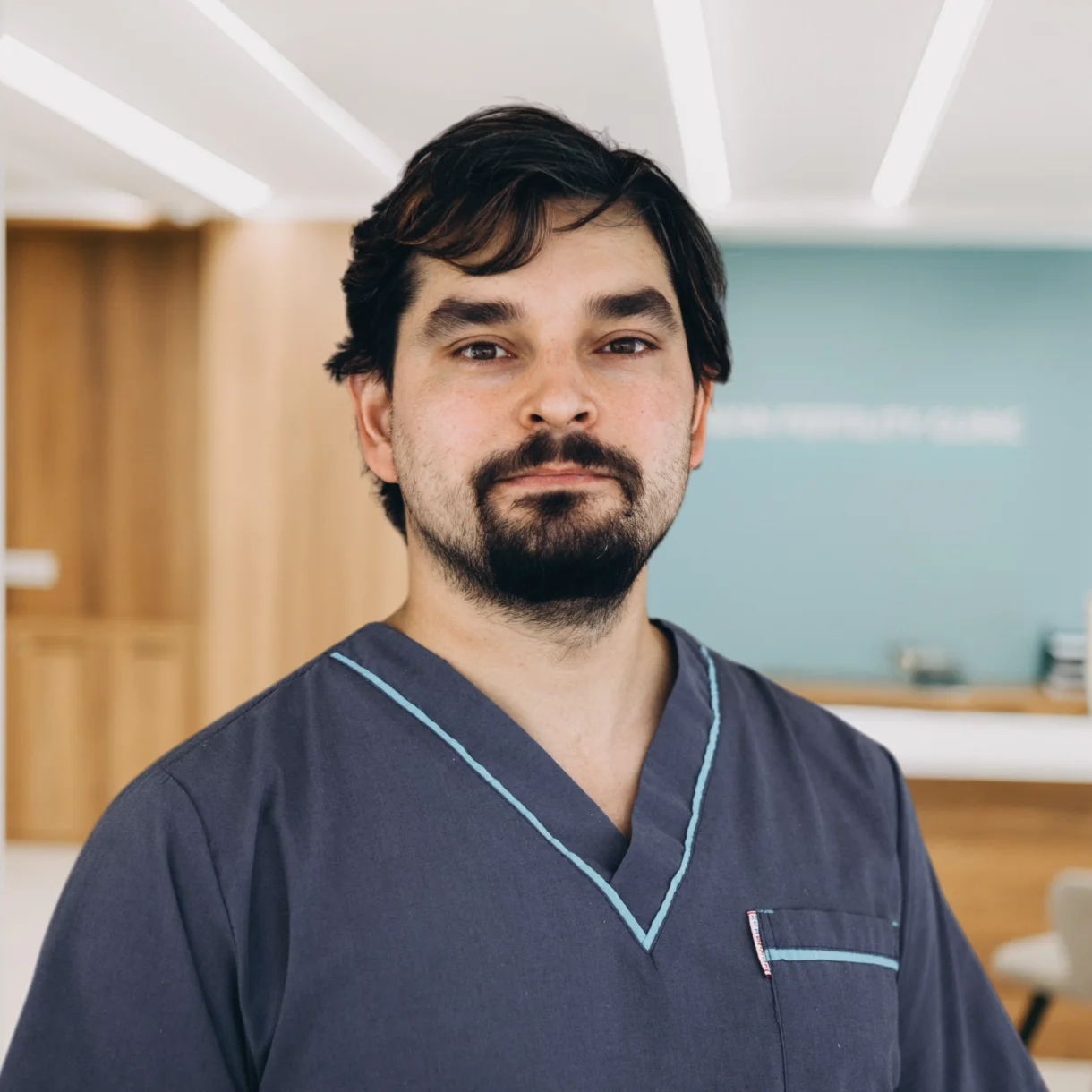

About
In 2020 Kazarinov Veniamin gave a conference talk titled “Round cells, what they tell for embryologist.” Round-headed sperm — globozoospermia — are a rare and specific abnormality: the acrosome fails to form, so the sperm cannot penetrate an egg no matter how many are present, and a standard IVF cycle with them produces total fertilization failure. Almost nobody without a male-factor laboratory bench speaks about it in public. That single lecture tells you more about where his attention goes than a list of procedures would: the microscopic cases that make a cycle fail before anyone can explain why.
His formal standing matches that niche. He holds the ESHRE certificate in clinical embryology, awarded in 2019 after the society’s own training track, and he has been an ESHRE member since 2017 — attending the society’s congresses in Geneva in 2017, Barcelona in 2018 and Vienna in 2019 — alongside Russian Association of Human Reproduction membership from 2016. Before that: an MSc in Biology from Novosibirsk State University completed 2008-2015, an embryology qualification from Lomonosov Moscow State University in 2015, advanced training at the European Medical Center in Moscow in 2016 covering gynecology, embryology and oncology, and postgraduate work from 2016 to 2020 at the Institute of Chemical Biology and Fundamental Medicine of the Russian Academy of Sciences’ Siberian Branch, in cell biology, cytology and histology.
He publishes rather than only performs. His 2017 Moscow work concerned micromanipulation of oocyte fertilization; his 2018 ESHRE contribution examined blastocyst development in culture systems supplemented with recombinant growth factors — a question about whether the culture medium itself can improve what reaches day 5. Since then he has taken manufacturer-led advanced training with CooperSurgical in laboratory quality control (2021), embryo biopsy and PGT (2022) and vitrification (2024), each of which is a repeatable technical audit rather than a conference visit.
Clinical Expertise
- ICSI, IMSI and PICSI: Injection under standard and high-magnification optics, and hyaluronan-binding selection, used where morphology, count or prior fertilization failure demand a finer filter.
- Work with difficult samples: Handling epididymal and testicular aspirates, and specimens with very low sperm numbers, where every available sperm has to be accounted for.
- Trophectoderm biopsy and PGT support: Blastocyst biopsy for genetic testing, with advanced training specifically in biopsy and PGT in 2022.
- Vitrification and warming: Oocyte and embryo freezing, retrained under a CooperSurgical program in 2024.
- Andrology laboratory testing: Semen analysis, MAR test for antisperm antibodies, hyaluronan binding assay, and DNA fragmentation testing.
- Culture system design: His published work on recombinant growth factor supplementation is a culture-media question, and culture conditions determine how many embryos reach day 5.
- Laboratory quality control: Formal 2021 training in QC, the function that turns a laboratory’s results into comparable numbers over time.
Why Choose Kazarinov Veniamin
A certificate that has to be earned. The ESHRE clinical embryologist credential is assessed, not granted on employment. On a Georgian roster where few laboratories can show one, it is the closest thing to external verification of technique.
He has a research record in the two things that fail silently. Fertilization micromanipulation and blastocyst culture are the two stages where a cycle is lost without anyone telling the patient. He has published on both.
He speaks about the rare male-factor cases. A physician who gives a lecture on globozoospermia is one who has met it. For a couple told their previous IVF produced no fertilization at all, that is the diagnosis that should have been made the first time.
Training runs forward, not backward. His most recent documented courses are 2021, 2022 and 2024 — quality control, biopsy, vitrification. The pattern is of a laboratory scientist re-certifying his own methods under external programs.
Postgraduate grounding in cell biology. Two decades of biology training culminating in Academy of Sciences postgraduate work in cytology and histology is a different preparation from a short commercial embryology course.
Professional Affiliations
ESHRE certificate in clinical embryology (2019); member of ESHRE since 2017 and of the Russian Association of Human Reproduction since 2016. MSc Biology, Novosibirsk State University (2008-2015); embryology qualification, Lomonosov Moscow State University (2015); postgraduate studies in cell biology, cytology and histology at the Institute of Chemical Biology and Fundamental Medicine, Siberian Branch of the Russian Academy of Sciences (2016-2020). Advanced training: European Medical Center, Moscow (2016); with Birol Aydin (2020); CooperSurgical programs in quality control (2021), biopsy and PGT (2022), and vitrification (2024). Publications on micromanipulation of oocyte fertilization (Moscow, 2017) and blastocyst development with recombinant growth factors (ESHRE, 2018).
Suitable For
- Couples with severe male factor infertility, where count, motility or morphology require IMSI-level selection or handling of aspirated sperm.
- Patients whose previous IVF cycle showed total fertilization failure, the outcome his specific research and lecture topics address.
- Any cycle entering PGT-A or PGT-M, where blastocyst biopsy quality determines whether a genetic result is even obtainable.
- Egg or embryo freezers for whom post-thaw survival is the whole question, and whose laboratory is re-audited on vitrification as recently as 2024.
- Patients asking how a laboratory is checked, since formal quality control training is a documented part of his record rather than an assurance.