'%20d='m0%200%2016%2011h61%2061%2061%2061%2060L47%2037h61%2061%2060%2061L16%2063h61%2061%2061%2061%2060L47%2089h61%2061%2060%2061L16%20115h61%2061%2061%2061%2060L47%20141h61%2061%2060%2061L16%20166h61%2061%2061%2061%2060L47%20192h61%2061%2060%2061L16%20218h61%2061%2061%2061%2060z'/%3e%3c/svg%3e)
About
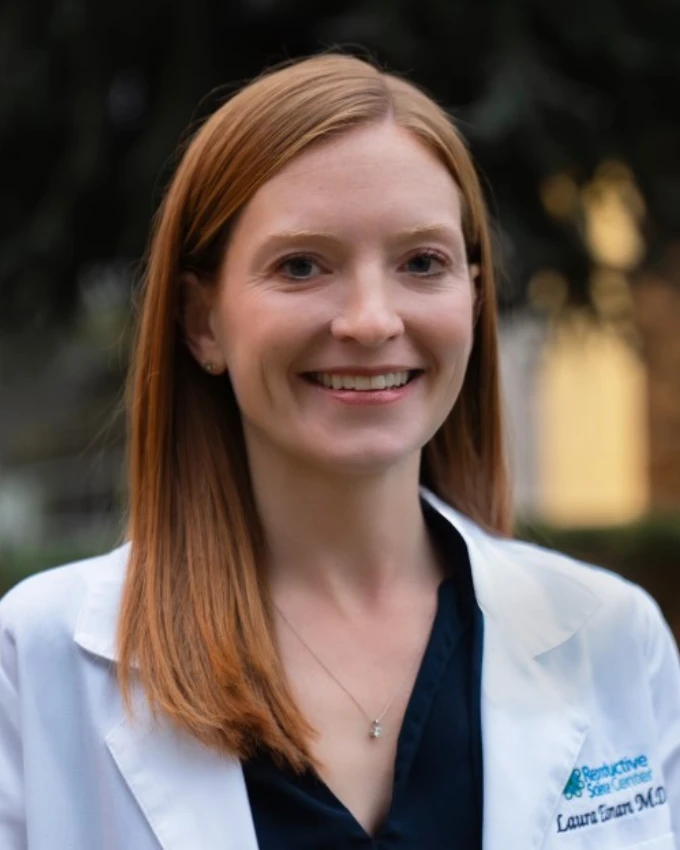
Most infertility workups start with the egg. Laura Eisman’s named focus starts further down the tract: whether the uterus can carry and implant. Uterine factor infertility — cavity shape, lining, fibroids and adhesions — is what she lists as her particular interest, alongside fertility preservation and care for LGBTQIA+ patients, and it is the throughline of her practice at RSC’s San Ramon and Oakland offices.
She trained on opposite coasts. Her obstetrics and gynecology residency was at Abington Hospital-Jefferson Health in Pennsylvania; the reproductive endocrinology and infertility fellowship took her to Cedars-Sinai Medical Center in Los Angeles. She is board-certified in both specialties, which is the pair of credentials that lets a physician manage a cycle from stimulation through transfer rather than handing the patient off mid-course.
Her practice biography emphasizes the explanatory side of the job — walking patients through each step, matching the plan to what the patient actually wants — rather than a research record, and none is published for her in the sources reviewed here. Patients choosing between the two Bay Area RSC addresses will find her at both.
Clinical Expertise
- Uterine factor infertility: assessment of the cavity and lining as the barrier — the variable that determines whether a good embryo implants
- Fertility preservation: egg and embryo freezing for patients facing medical treatment or planning later pregnancy
- LGBTQIA+ family building: pathway design for same-sex couples and single patients, including the donor gamete and gestational carrier routes RSC lists as services
- IVF cycle management: full-cycle care from stimulation through transfer, covered by her dual OB/GYN and REI certification
- Cavity problems routed to surgery: where a uterine factor needs an operation, RSC’s service list includes corrective and hysteroscopic infertility surgery, with the practice’s Surgical Director as the on-site surgeon
Why Choose Dr. Laura Eisman
She works the part of the equation other clinics assume is fine. A transfer can fail with a chromosomally normal embryo and a perfectly judged protocol, because the problem is the cavity it lands in. A physician who names uterine factor infertility as her focus is a physician who looks at the uterus before ordering another attempt.
Two offices, one physician. San Ramon and Oakland sessions mean an early monitoring appointment or a procedure day can be scheduled where it fits your calendar rather than where the physician happens to be that week.
Both ends of the credential. Residency training in general obstetrics and gynecology at Abington-Jefferson plus a reproductive endocrinology fellowship at Cedars-Sinai, with board certification in both — the pairing that covers the laboratory side of a cycle and the uterine side of a pregnancy.
Professional Affiliations
Board certified in Obstetrics and Gynecology and in Reproductive Endocrinology and Infertility by the American Board of Obstetrics and Gynecology. Reproductive endocrinologist at Reproductive Science Center of the San Francisco Bay Area, practicing at the San Ramon and Oakland offices. Fellowship training at Cedars-Sinai Medical Center, Los Angeles; residency at Abington Hospital-Jefferson Health. No society memberships, publications or editorial roles are published for her in the sources reviewed for this page.
Suitable For
- Patients told their embryos are good but transfers keep failing: the cavity and lining question is her named focus
- Egg and embryo freezers: fertility preservation appears in every version of her published profile, for both medical and personal indications
- LGBTQIA+ patients and same-sex couples: listed as an area of particular interest, with RSC’s donor and gestational carrier services as the practical routes
- Anyone starting from zero: her profile leads on explaining each step of treatment, which is the part that decides whether a first cycle feels manageable or improvised
- Patients splitting time between the East Bay and Tri-Valley: two offices, one physician