'%20d='m0%200%2016%2011h61%2061%2061%2061%2060L47%2037h61%2061%2060%2061L16%2063h61%2061%2061%2061%2060L47%2089h61%2061%2060%2061L16%20115h61%2061%2061%2061%2060L47%20141h61%2061%2060%2061L16%20166h61%2061%2061%2061%2060L47%20192h61%2061%2060%2061L16%20218h61%2061%2061%2061%2060z'/%3e%3c/svg%3e)
About
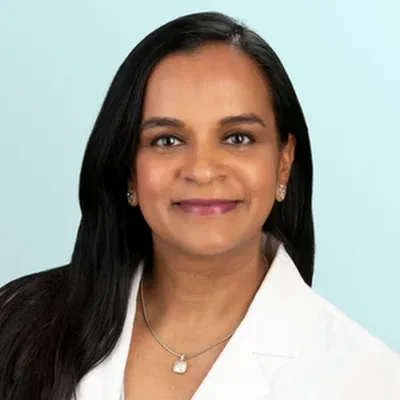
As a fellow, Laxmi Kondapalli held an NIH training grant in reproductive epidemiology and used it to build a prospective cohort study with a question most clinics avoid: what happens to children conceived by assisted reproduction later in childhood. She followed metabolic and developmental outcomes in ART-conceived children alongside naturally conceived ones — work that required a master’s-level research education to design, which she completed at the University of Pennsylvania as a Master of Science in Clinical Epidemiology.
The other half of her research background is oncology-adjacent. After residency at Northwestern University she did postdoctoral research in reproductive biology there, studying how cancer treatment damages ovarian function — the mechanism behind the referral she now takes most often, a newly diagnosed patient asking whether eggs or embryos can be frozen before treatment starts. She earned her MD at the University of Vermont College of Medicine and completed REI fellowship at Penn, joining CCRM Colorado in 2016.
Her clinical focus stays on preservation and on the patients where the timeline is imposed by something other than infertility: oncofertility, diminished ovarian reserve, and low-yield stimulation, where mild or mini protocols trade egg number for quality of life and lower medication load. Recognition runs in both directions — Castle Connolly lists her as a Top Doctor, 5280 lists her among Colorado top doctors, and Northwestern awarded her the Michael Newton Award for clinical excellence in obstetrics and gynecology. She is board certified in reproductive endocrinology and infertility through the American Board of Obstetrics and Gynecology.
Clinical Expertise
- Oncofertility and medical fertility preservation: urgent egg, embryo and sperm freezing before chemotherapy or radiation, with the ovarian-damage biology worked out in a postdoctoral research position
- Elective egg freezing: ovarian reserve assessment and stimulation planning for patients delaying family building
- Diminished ovarian reserve: mild and mini-stimulation approaches where high-dose protocols buy little
- ART outcomes counseling: prospective data on child metabolic and developmental outcomes, from the study she ran as a fellow
- IVF with PGT-A: cycle management with embryo screening through the practice’s genetics laboratory
- Recurrent pregnancy loss and endometriosis-related infertility: evaluation before treatment decisions
Why Choose Dr. Laxmi Kondapalli
She reads epidemiology for a living. An MSCE plus an NIH training grant is a research credential, not an honorific, and it shows in how risk numbers get explained to patients.
Preservation is her center of gravity. Postdoctoral work on cancer treatment’s effect on the ovary, then a clinical practice built on protecting fertility in exactly that situation.
Recognized by her training department. A Castle Connolly Top Doctor listing, and a Northwestern clinical-excellence prize chosen inside her own residency department.
She answers the children question. Few physicians can point to prospective outcome data they collected themselves on ART-conceived kids.
Professional Affiliations
American Board of Obstetrics and Gynecology certification in reproductive endocrinology and infertility. University of Pennsylvania clinical epidemiology training supported by an NIH reproductive epidemiology training grant. Awards: Castle Connolly Top Doctor; 5280 magazine Top Doctor in Colorado; Michael Newton Award for clinical excellence, Northwestern University obstetrics and gynecology. Peer-reviewed publications on fertility preservation, ART outcomes and stimulation response.
Suitable For
- A new cancer diagnosis and a treatment clock: the preservation pathway she trained in and practices
- Low ovarian reserve or a prior poor response: mild protocols rather than repeated high-dose attempts
- Parents-to-be asking about long-term child health after IVF: prospective data she helped generate
- Endometriosis and recurrent loss patients wanting the evidence laid out before escalation
- Elective egg freezing with a research-trained view of what AMH and antral counts predict