'%20d='m0%200%2016%2011h61%2061%2061%2061%2060L47%2037h61%2061%2060%2061L16%2063h61%2061%2061%2061%2060L47%2089h61%2061%2060%2061L16%20115h61%2061%2061%2061%2060L47%20141h61%2061%2060%2061L16%20166h61%2061%2061%2061%2060L47%20192h61%2061%2060%2061L16%20218h61%2061%2061%2061%2060z'/%3e%3c/svg%3e)
About
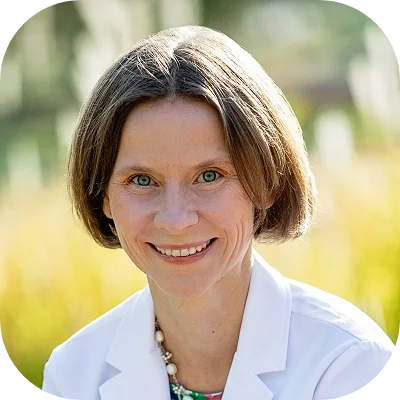
Malgorzata Skaznik-Wikiel came to this country for a laboratory, not a clinic. She arrived from Poland in 2004 to pursue a research fellowship at Harvard Medical School’s Vincent Center for Reproductive Biology, planning to go home after a year or two, and stayed because of what the American research environment made possible: “the access to research resources and the opportunities to generate translational research kept me here.” Her own bridge from bench to bedside runs through the technology patients now take for granted — she points out that “advancements like vitrification would not have happened without a robust research effort in the U.S.”
That history shapes her clinical lane. Her long-standing research interest is ovarian function and fertility preservation, and she joined Conceptions in June 2023 explicitly to keep working on women’s health in those areas, saying she chose the practice because “they understand that science drives success in our field.” She completed her medical degree at the Medical University of Warsaw, her obstetrics and gynecology residency through Case Western Reserve University at MetroHealth Medical Center and the Cleveland Clinic, and her reproductive endocrinology and infertility fellowship at the University of Colorado.
The second half of her practice is genetic risk. She has watched the consultation mix shift: patients with no fertility problem at all arriving to ask about IVF with single-gene screening because they carry a condition they do not want to pass on, and others requesting carrier screening before they even try to conceive. She describes a patient with significant hearing loss since birth, no injury or infection to explain it, testing that found a causal mutation, and a partner who turned out not to carry it — which is her argument for why the workup is a genetics question as often as a fertility one. “It’s not just about getting patients pregnant; I want my patients to have healthy babies.”
She grew up in Poland, was influenced by her grandmother, a nurse, and says she was describing medical school at 13 or 14. “Being a physician is not a job, it’s an identity for me.” She sees patients in English and Polish.
Clinical Expertise
- Fertility preservation and egg freezing: ovarian function assessment and cryopreservation planning, including before chemotherapy or radiation, with stored material held on the practice’s automated, continuously monitored ivfOS cryostorage system
- PGT-M for single-gene conditions and PGT-A for chromosome number, plus pre-conception carrier screening for patients with no infertility diagnosis
- Diminished ovarian reserve and IVF, handled from a researcher’s angle: what the hormones and ultrasound say about remaining function, and what that changes about timing
- Translational research habits applied to protocol choice — she states the position that strong science has to be connected to patient support, not substituted for it
- Third-party options when own-egg paths close: she names donor egg as part of the modern set of ways to build a family
Why Choose Dr. Malgorzata Skaznik-Wikiel
She is the research-trained physician on this roster. A Harvard reproductive biology fellowship, then years of work on ovarian function, is a different formation from fellowship-plus-clinic volume alone, and it is why she is the natural consult for preservation decisions where the biology is uncertain.
She handles the genetics consultation, not just the cycle. Carrier screening, single-gene risk and PGT-M indications are cases she describes unprompted, in a practice where the patient population asking for them is growing.
She trained through Colorado’s own program. Her REI fellowship was at the University of Colorado, and her residency ran through Case Western Reserve University with MetroHealth and the Cleveland Clinic — two systems with high training volumes.
Care in a second language. Polish-language consultation is available with her, which matters for families in the region and for patients reading consent forms in a language they think in.
Professional Affiliations
American Society for Reproductive Medicine; Society for Reproductive Endocrinology and Infertility; American College of Obstetricians and Gynecologists (Fellow). The practice reports its outcomes to SART under one clinic registration and holds a Colorado gamete license, the permit covering egg freezing and donor gamete handling.
Her profile documents a University of Colorado REI fellowship and ACOG fellowship; the material reviewed does not quote an individual REI certificate number.
Suitable For
- Families with a known hereditary condition: Tay-Sachs, BRCA1 or BRCA2 and similar single-gene risks, where PGT-M is the intervention
- Patients considering carrier screening before trying to conceive, including those with no infertility diagnosis at all
- Egg freezing, especially with low ovarian reserve or a medical deadline: the research background is directly in this lane
- Cancer patients starting treatment soon: preservation options sequenced against chemotherapy or radiation timing
- Polish-speaking patients who want clinical nuance in their first language