'%20d='m0%200%2016%2011h61%2061%2061%2061%2060L47%2037h61%2061%2060%2061L16%2063h61%2061%2061%2061%2060L47%2089h61%2061%2060%2061L16%20115h61%2061%2061%2061%2060L47%20141h61%2061%2060%2061L16%20166h61%2061%2061%2061%2060L47%20192h61%2061%2060%2061L16%20218h61%2061%2061%2061%2060z'/%3e%3c/svg%3e)
About
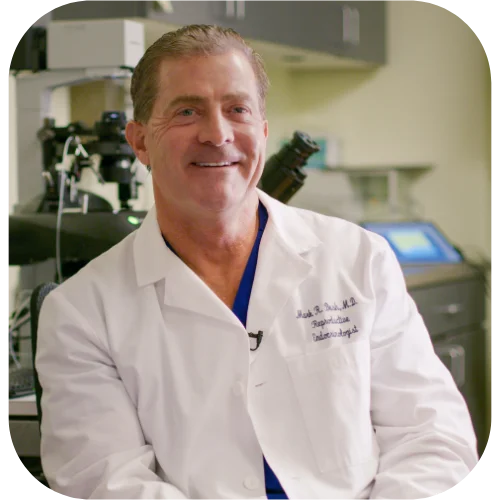
Mark Bush left academic medicine for Colorado in 2004 and rebuilt the laboratory around himself. Day-5 blastocyst culture arrived at Conceptions in 2006; chromosome and genetic assessment of embryos followed in 2009. Those two dates are the clearest explanation for why this practice reports results above the national averages — the lab techniques that now drive those numbers were adopted here early rather than adopted here recently.
Bush trained for that intersection. He took a biology degree at UC Berkeley with high honors and honors research in molecular biology, then his medical degree at Georgetown University, obstetrics and gynecology residency at William Beaumont and Texas Tech, and a three-year reproductive endocrinology and infertility fellowship at Duke University. He has been a division director of a reproductive endocrinology program, a clinical assistant professor and an associate professor at US medical schools, and he holds fellowship in both the American College of Obstetricians and Gynecologists and the American College of Surgeons. He describes the pull toward the subspecialty as molecular biology plus surgery — one field for reading and fixing genetic problems, the other for creating life.
He has been a physician for more than 30 years, and his account of what a first visit should accomplish is deliberately narrow: work out why a patient is not pregnant, then present options. He has said plainly that couples afraid of being pushed into expensive therapy should hear that a consultation at Conceptions is not a sales call. His standing complaint about the field is the volume of infertility misinformation patients arrive with, which is why he says he and his colleagues personally review a patient’s history before every consultation rather than reading it in the room.
Clinical Expertise
- IVF with individualized stimulation: protocols the practice describes as proven over many years and revised continually, with antagonist and agonist regimens, gonadotropin stimulation, hCG trigger and luteal progesterone support chosen from test results and history
- ICSI (intracytoplasmic sperm injection): single-sperm injection for male factor infertility or a prior cycle that failed to fertilize
- PGT-A, PGT-M and PGT-SR: embryo biopsy at the blastocyst stage, an area he brought into the practice in 2009
- Elective single embryo transfer with frozen transfer: the practice has advocated SET for over a decade, paired with PGT-A and vitrification
- Extended embryo culture to day 5: the lab capability he built first, used to select fewer embryos with higher implantation potential
- Fertility preservation and third-party reproduction within a network that now includes clinical trial access through The RMA Network
Why Choose Dr. Mark Bush
He built the things that determine your cycle. Culture length, biopsy timing, whether to freeze and transfer later — the lab programs at Conceptions were established under his tenure, and the practice’s outcomes are downstream of them.
Two fellowships, not one. FACOG puts him inside the obstetrics and gynecology establishment; FACS is a surgeon’s credential, uncommon in a reproductive clinic and relevant if your plan involves operative evaluation.
Academic pedigree he still uses. Division director and professor roles before private practice, and his stated operating principle is that employees work for the patient rather than for the protocol — the practice’s doctors, lab and monitoring teams, in his description, work with autonomy under a shared vision.
He argues for moving to IVF sooner when it is the cheaper path. The practice cites the FASTT trial (Reindollar et al., Fertility and Sterility, 2008) on repeated ovulation induction and IUI cycles costing more time and money than earlier IVF. That conversation is one a physician with 30 years of both patterns is credible having.
Professional Affiliations
American Society for Reproductive Medicine; Society for Reproductive Endocrinology and Infertility; American College of Obstetricians and Gynecologists (Fellow); American College of Surgeons (Fellow). The practice’s own footer carries ASRM, SREI, CAP and Better Business Bureau marks alongside its Colorado gamete license, and community support runs to Colorado Fertility Advocates and the Colorado LGBTQ Chamber of Commerce.
Note on certification, for completeness: the material reviewed documents his OB/GYN board certification and fellowship credentials and his Duke REI fellowship, but does not quote an individual REI certificate number. Ask the office if you need that verified.
Suitable For
- Patients comparing clinics on laboratory practice rather than brochures: the physician who set up this center’s day-5 culture and embryo testing
- Repeat IVF failures and complex cases: history reviewed by the physician before the consultation, not during it
- Anyone deciding between more IUI cycles and moving to IVF: a stated research interest in that trade-off
- Patients who want PGT-A with single embryo transfer: an over-decade advocate of SET as the safer obstetric path
- People who want a second opinion without a treatment pitch: his explicit position that a consultation exists to explain and offer options