'%20d='m0%200%2016%2011h61%2061%2061%2061%2060L47%2037h61%2061%2060%2061L16%2063h61%2061%2061%2061%2060L47%2089h61%2061%2060%2061L16%20115h61%2061%2061%2061%2060L47%20141h61%2061%2060%2061L16%20166h61%2061%2061%2061%2060L47%20192h61%2061%2060%2061L16%20218h61%2061%2061%2061%2060z'/%3e%3c/svg%3e)
About
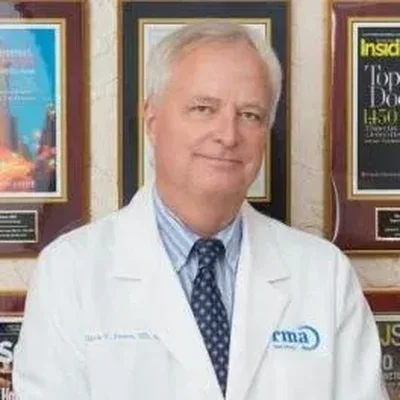
Dr. Mark Sauer runs an academic department and sees RMA patients. He is Chair of the Department of Obstetrics, Gynecology and Reproductive Sciences at Rutgers-Robert Wood Johnson Medical School, a professor there since 2017, and he joined RMA New Jersey in early July 2019 through a collaborative agreement with RWJ — a move RMA described at the time as strengthening its ongoing collaboration with RWJ Barnabas Health. He sees patients in Basking Ridge on Tuesdays.
That dual arrangement means a patient in his Basking Ridge chair is being evaluated by someone whose other job is setting standards for a medical school’s obstetrics and reproductive science faculty.
His training: Washington University in St. Louis for the undergraduate degree, University of Illinois at Chicago for the MD, internship and obstetrics and gynecology residency, then a reproductive endocrinology and infertility fellowship at UCLA. After becoming a physician he went back for a second degree — a Master of Science in Bioethics from Columbia University — and lists ethics in reproductive medicine as a research area alongside third-party reproduction and oncofertility.
Clinical Expertise
- Third-party reproduction: donor eggs, donor sperm, donor embryos and the arrangements around them — his first-listed research interest, and the area of IVF where the medical steps are the least complicated part
- Oncofertility and cancer survivorship: fertility preservation for patients about to undergo gonadotoxic treatment, and reproductive care for survivors; his second named research area
- Reproductive endocrinology and infertility: diagnosis and cycle management as a UCLA-fellowship-trained REI specialist
- Ethics in reproductive medicine: consent, parentage, disclosure to donor-conceived children, and embryo disposition — a graduate discipline for him, not an opinion
- Second opinions on difficult cases: an invited speaker nationally and internationally in both reproductive medicine and gynecology, with more than 200 published abstracts
Why Choose Dr. Mark Sauer
He chairs a medical school department in the field he practices. Department chairs in obstetrics and reproductive sciences are generally appointed on the strength of long-standing academic work. His read on a case comes with that reference frame attached, which is a different vantage than a single practice’s protocol.
The bioethics master’s is load-bearing in third-party reproduction. Donor programs raise questions a reproductive endocrinologist cannot resolve with a hormone panel: who is a parent, when disclosure to a child happens, how surplus embryos get disposed of, and what informed consent means when the person deciding is frightened. Most REI physicians never take a formal course in that. He holds a graduate degree in it from Columbia and lists it as a research area.
His two research populations have the tightest clocks. Third-party reproduction involves legal and family-structure steps on top of medical ones. Fertility preservation in cancer has to fit between a diagnosis and a first chemotherapy cycle, sometimes in days. Both are areas where a general practice’s default of “let’s think about it” is not available.
The volume of published work is documented, and he says where he thinks the value is. RMA records well over 200 abstracts across those research topics. His own stated view is that “the heart of reproductive medicine lies in the embryology laboratory,” and that he is proud to be part of RMA’s center for excellence — a physician who puts the lab, not the medication protocol, at the center of outcomes is asking the question patients should be asking about a clinic.
Professional Affiliations
Fellow of the American College of Obstetricians and Gynecologists (FACOG). Professor and Chair, Department of Obstetrics, Gynecology and Reproductive Sciences, Rutgers-Robert Wood Johnson Medical School. Reproductive endocrinology and infertility fellowship at UCLA; MD, internship and residency at the University of Illinois at Chicago; MS in Bioethics, Columbia University. Invited speaker at national and international meetings, with more than 200 published abstracts.
Suitable For
- Donor egg, donor sperm or donor embryo programs: his first-listed research area, covering matching, parentage and disclosure decisions alongside the medical sequence
- Cancer patients needing preservation now: when the oncology calendar sets the deadline and the window is a few days, experience with oncofertility is the relevant background
- Complex family structures and consent questions: single parents by choice, same-sex couples, gestational carriers, or families disagreeing about disclosure — where his graduate ethics training is a usable resource
- Cases where previous clinics have disagreed on diagnosis: a physician positioned in both an academic department and a high-cycle-count network is reading the case against a wider reference set
- Patients vetting clinics on embryology: he will discuss laboratory capability as a first-order determinant of outcome, which is the argument to bring to a clinic tour