'%20d='m0%200%2016%2011h61%2061%2061%2061%2060L47%2037h61%2061%2060%2061L16%2063h61%2061%2061%2061%2060L47%2089h61%2061%2060%2061L16%20115h61%2061%2061%2061%2060L47%20141h61%2061%2060%2061L16%20166h61%2061%2061%2061%2060L47%20192h61%2061%2060%2061L16%20218h61%2061%2061%2061%2060z'/%3e%3c/svg%3e)
About
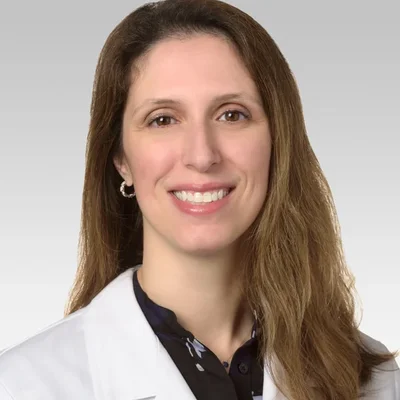
A cancer diagnosis sets the clock: chemotherapy starts when the oncologist says it starts, and an IVF stimulation takes about two weeks. Squeezing a preservation cycle into that window — without delaying treatment — is the part of reproductive medicine Mary Ellen Pavone, MD built her practice around. Her stated focus is fertility preservation and oncofertility, alongside PCOS research.
She is also a Northwestern product in the most literal sense. Undergraduate work in philosophy and biology at Boston University, MD there in 2003, Ob/Gyn residency at Johns Hopkins, then back to Chicago in 2010 for both an REI fellowship and a master’s in clinical investigation, in the same year. She is a professor at Feinberg and one of twelve physicians at the Center for Fertility and Reproductive Medicine.
The institution she works for is part of why that subfield exists. Northwestern is where the term “oncofertility” was coined, in 2006, and the center runs preservation with its own patient navigator — including fertility preservation for children, which it provides free of charge. Randomized study designs, protocol timing and the question of what actually preserves fertility versus what merely delays treatment are the stock-in-trade of the clinical investigation training she holds, and of the center’s NIH- and Gates-funded research programs.
Her own description of the job is short: “I strive to provide top-quality care with compassion and caring for patients facing reproductive issues.”
Clinical Expertise
- Fertility preservation before gonadotoxic therapy: random-start and modified stimulation protocols for egg or embryo freezing, timed to an oncology start date
- Oncofertility coordination: working alongside oncology teams so preservation does not push back treatment
- Oocyte and embryo cryopreservation, including vitrified embryo transfer in a later cycle
- Pediatric and adolescent preservation, including ovarian tissue approaches handled as experimental, with informed consent
- PCOS: ovulatory dysfunction, metabolic features, and stimulation strategies for patients who hyper-respond or fail to respond predictably
- IVF, ICSI and PGT-A cycle management for patients with complex or previously failed cycles
Why Choose Dr. Mary Ellen Pavone
Preservation is her lane, not an add-on. Fertility preservation and oncofertility are the interests listed on her faculty profile, in the institution that named the field.
Two degrees in one year at Northwestern. An REI fellowship and a master’s in clinical investigation, both completed in 2010 — the research-methods half of that training is what lets her read a protocol paper and tell you whether it applies to you.
Johns Hopkins residency, one of the most demanding Ob/Gyn programs in the country, before subspecialty training.
She sees the whole infertility book. Egg freezing for a 38-year-old planning later, PCOS patients struggling to ovulate, and complex IVF cycles all sit in the same practice as cancer preservation — which is useful when the reason for freezing is not cancer.
Professional Affiliations
Certified in Reproductive Endocrinology and Infertility by the American Board of Obstetrics and Gynecology. Professor, Department of Obstetrics and Gynecology, Northwestern University Feinberg School of Medicine, where she also holds a master’s in clinical investigation. Practices in a SART member clinic that reports preservation and ART cycles to SART and the CDC, and participates in the academic reproductive medicine community, including the American Society for Reproductive Medicine.
Suitable For
- Patients with a new cancer diagnosis who want eggs or embryos frozen before treatment begins, and need the cycle fitted into a narrow window
- Parents of children facing gonadotoxic therapy, in a program that provides pediatric preservation at no charge
- PCOS patients whose cycles have been unpredictable, whether for ovulation induction or IVF
- Elective egg freezers who want a high-volume academic lab rather than a standalone clinic
- Anyone with a complicated IVF history — poor response, hyper-response, or failed cycles — who needs the protocol rebuilt rather than repeated