'%20d='m0%200%2016%2011h61%2061%2061%2061%2060L47%2037h61%2061%2060%2061L16%2063h61%2061%2061%2061%2060L47%2089h61%2061%2060%2061L16%20115h61%2061%2061%2061%2060L47%20141h61%2061%2060%2061L16%20166h61%2061%2061%2061%2060L47%20192h61%2061%2060%2061L16%20218h61%2061%2061%2061%2060z'/%3e%3c/svg%3e)
About
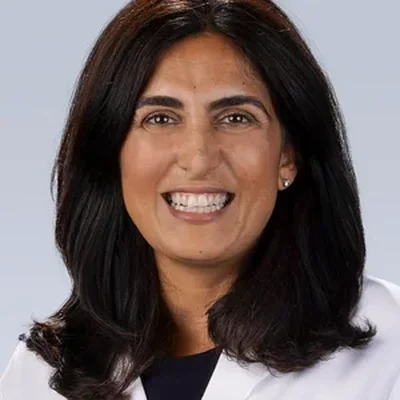
Monica Mainigi holds the job that decides who else gets to be a fertility specialist at Penn: she directs the reproductive endocrinology and infertility fellowship program, recruiting and supervising the trainees who now practice alongside her. That role usually goes to a physician trusted with the division’s standards, and it shapes how she practices — fellows present cases with her, so a consultation includes whoever is in training that year.
Her laboratory work is unusually concrete for a question as abstract as implantation. She studies human endometrial tissue grown in organ-on-a-chip systems, microfluidic devices that keep living uterine cells responding to hormones outside the body, which lets her test how the lining prepares to accept an embryo in ways a uterus does not permit. Other NIH-supported threads include placental epigenetics and how maternal infection, including SARS-CoV-2 during pregnancy, affects mother and fetus. Clinically that research maps onto the patients she sees most: women whose embryos transfer well and fail to implant.
The rest of her practice is preservation and rare disease. She works in Penn’s adult Turner syndrome program, where ovarian failure often begins before a patient is old enough to have thought about children, and she is attached to the Penn LGBTQ Health Program and the Penn PCOS Program. NYU School of Medicine for her MD, then all clinical training at Penn — residency at the Hospital of the University of Pennsylvania, REI fellowship in 2008, certification in obstetrics and gynecology in 2007. She consults in English and Hindi.
Clinical Expertise
- Implantation failure and endometrial receptivity — cavity assessment, hormonal support and timing of transfer, informed by her own lab work on how the lining responds
- Fertility preservation — egg, embryo and ovarian tissue freezing, coordinated around oncology treatment dates
- Turner syndrome and premature ovarian insufficiency — reproductive care across a lifespan in which ovarian function may disappear in the teens
- IVF and ICSI cycle management — stimulation through transfer, with fellows participating in the plan
- Recurrent pregnancy loss — evaluation including placental and genetic contributions
- LGBTQ+ family building — donor sperm, reciprocal and donor-gamete pathways, and gestational carrier referral
- PCOS and ovulatory dysfunction — induction strategy and metabolic counseling
Why Choose Dr. Mainigi
She picks and trains the division’s specialists. A fellowship director’s patients get the full teaching-round treatment: the case is discussed, challenged and worked up by the trainees who will run cycles elsewhere in a few years.
Her lab is aimed at your question. Organ-on-a-chip endometrium research exists because implantation failure has no good human model. Patients with repeated losses of good embryos are seeing the physician trying to build one.
Rare-disease experience. Turner syndrome clinic work means a 19-year-old with streak ovaries is not a novelty in her schedule.
Continuity from bench to consent form. Placental epigenetics and maternal infection research feed how she discusses prognosis with patients who conceive after fertility treatment.
Hindi-language consultation for Philadelphia’s South Asian patients, who often describe symptoms better in a second language.
Professional Affiliations
American Society for Reproductive Medicine; Fellow of the American College of Obstetricians and Gynecologists; Society for Reproductive Endocrinology and Infertility; Society for the Study of Reproduction; Society for Reproductive Investigation; NASPAG. Board-certified in Obstetrics and Gynecology (2007), REI fellowship trained at Penn in 2008, with NIH research funding supporting her endometrial and placental studies.
Suitable For
Patients who have transferred good-quality embryos more than once without a pregnancy, and want the uterus investigated rather than the schedule repeated.
Anyone about to start chemotherapy or pelvic radiation where the freezing decision is measured in days.
Turner syndrome patients and their parents, from adolescent ovarian surveillance through adult fertility care.
LGBTQ+ patients whose pathway involves donated gametes or a carrier, and who want a physician already working inside Penn’s LGBTQ health program.
PCOS patients who need ovulation induction plus honest metabolic counseling.
Patients who prefer a Hindi-speaking visit.