'%20d='m0%200%2016%2011h61%2061%2061%2061%2060L47%2037h61%2061%2060%2061L16%2063h61%2061%2061%2061%2060L47%2089h61%2061%2060%2061L16%20115h61%2061%2061%2061%2060L47%20141h61%2061%2060%2061L16%20166h61%2061%2061%2061%2060L47%20192h61%2061%2060%2061L16%20218h61%2061%2061%2061%2060z'/%3e%3c/svg%3e)
About
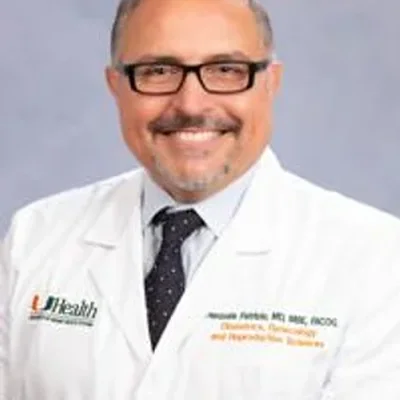
In 1988 he co-pioneered microsurgical epididymal sperm aspiration — MESA — the operation that let men born without a vas deferens father biological children. Decades later Patrizio runs the division that took that technique from a research bench into routine practice: he is Professor and Chief of the Division of Reproductive Endocrinology and Infertility at the University of Miami Miller School of Medicine, the division’s fellowship program director, and the physician named as Medical Director on this Doral clinic’s SART reporting record.
His two best-known findings both sit in the male infertility workup that patients go through today. He established that congenital absence of the vas deferens is a mild form of cystic fibrosis, which is why a man with no vas gets genetic testing rather than only a surgical opinion. He also showed that some male infertility comes from deletions on the Y chromosome, a finding his faculty biography credits with opening the door to genetic assessment as a standard part of evaluating infertile men.
Before Miami he spent 18 years at Yale University, directing the fertility center and IVF program at Yale School of Medicine. He is one of the few US fertility specialists who see men and women in the same practice, and works with the Miller School’s urologists, oncologists, pediatricians, geneticists and other specialists on individual cases. Two credentials shape how he practices beyond the exam room: he is certified as a High Complexity Laboratory Director, which puts him on the hook for the embryology lab’s quality, and he holds a master’s degree in bioethics, which shows up in the service lines he has been asked to build — gamete donation, gestational surrogacy, LGBTQ+ services and preservation for transgender patients.
Clinical Expertise
- Fertility preservation: egg, sperm and embryo freezing, ovarian tissue freezing, and the whole-ovary cryopreservation method via multi-thermal gradient that he developed for young women facing systemic cancer
- Oncofertility: preservation planning fitted around chemotherapy and radiation timing; he co-authored the first ASCO guidelines on fertility preservation in cancer
- Male infertility: azoospermia and obstructive causes, congenital absence of the vas deferens, Y-chromosome deletions, and surgical sperm retrieval in the center’s listed program — TESA, PESA, TESE, MESA and microdissection TESE — coordinated with the school’s urology faculty
- IVF and ICSI: he leads the division whose clinic lists IVF, ICSI, IUI, frozen embryo transfer, PGT and hormone testing, and he directed an IVF program for 18 years before Miami
- Third-party reproduction and LGBTQ+ family building: gamete donation and gestational surrogacy services, named in his biography as service lines he oversees and expands
- Reproductive endocrinology: the division’s published condition list covers diminished ovarian reserve, premature ovarian failure, PCOS, ovulatory dysfunction, endometriosis, pelvic adhesions and tubal disease
His research record, as published by the Miller School: one ART atlas textbook, five further books, more than 90 book chapters and over 200 peer-reviewed original manuscripts.
Why Choose Dr. Patrizio
The diagnostics changed because of his work. If you are an infertile man being offered chromosome analysis, Y-deletion testing or cystic fibrosis testing at this clinic, you are receiving the clinical pathway his own findings helped create. That is a different kind of reassurance from a satisfaction score.
Preservation runs on guidelines he wrote. For a patient starting chemotherapy next month, the question is whether anyone in the building knows the compression timeline. He co-authored ASCO’s first fertility preservation guidelines, co-founded the International Society for Fertility Preservation and led the ASRM group that works on it.
He sees both halves of a couple. One physician taking male and female history in the same visit removes the relay between two practices — his biography counts him among the few US specialists who do this, and he works directly with the school’s urologists, oncologists, geneticists and pediatricians.
Laboratory accountability. High Complexity Laboratory Director certification is a laboratory role, not an honorific: he carries responsibility for the embryology lab’s standards, which is where culture, ICSI and vitrification actually happen.
Training-program authority. As the division’s fellowship program director he runs an ACGME-accredited REI program teaching residents, clinical fellows and postdoctoral researchers. Fellows and faculty are working the same cases, and the division publishes clinical and basic-science research alongside care.
Professional Affiliations
Board certified in Reproductive Endocrinology and Infertility and in Obstetrics and Gynecology by the American Board of Obstetrics and Gynecology; certified as a High Complexity Laboratory Director (HCLD); master’s degree in bioethics (MBE). Life fellow of the International Academy of Human Reproduction, an international group of 36 members limited to experts and teachers of reproductive medicine. Co-founder and former president of the International Society for Fertility Preservation. Immediate past chair of the American Society for Reproductive Medicine’s Fertility Preservation Group. Associate editor of Reproductive BioMedicine Online and of the American Journal of Obstetrics & Gynecology, and on the editorial board of the Journal of Assisted Reproduction and Genetics. Professor and Chief of the Division of Reproductive Endocrinology and Infertility in the Tamer Family Department of Obstetrics, Gynecology & Reproductive Sciences, University of Miami Miller School of Medicine; medical director on the SART record for UHealth Center for Reproductive Medicine (ClinicPKID 2257).
Suitable For
- Patients about to start cancer treatment who need eggs, sperm, embryos or ovarian tissue banked before therapy begins, on a schedule that has to fit the oncology calendar
- Transgender patients planning preservation before medical or surgical transition — a named service line in his division
- Men with azoospermia or no vas deferens, where genetic testing and a retrieval decision come together in the same visit
- Couples using donor eggs, donor sperm or a gestational carrier, including the medical and coordination work third-party cycles require
- LGBTQ+ patients and partners building a family, where gamete sourcing and who carries the pregnancy are planned medically and legally
- Women with diminished ovarian reserve or premature ovarian failure, where protocol choice, not effort, drives the outcome
- Anyone with repeated failures elsewhere: the division’s own statement is that its multidisciplinary team is equipped for complex cases, and its bench includes research faculty who read the primary literature rather than the summaries