'%20d='m0%200%2016%2011h61%2061%2061%2061%2060L47%2037h61%2061%2060%2061L16%2063h61%2061%2061%2061%2060L47%2089h61%2061%2060%2061L16%20115h61%2061%2061%2061%2060L47%20141h61%2061%2060%2061L16%20166h61%2061%2061%2061%2060L47%20192h61%2061%2060%2061L16%20218h61%2061%2061%2061%2060z'/%3e%3c/svg%3e)
About
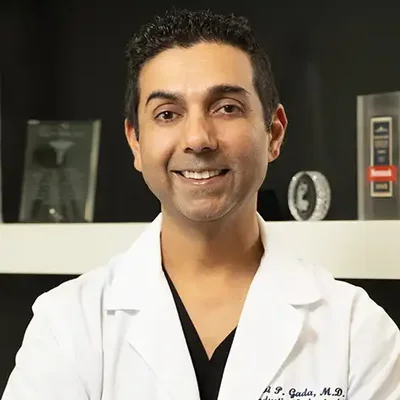
Ravi P. Gada joined Dallas-Fort Worth Fertility Associates in 2012 to open its Southlake office, and that office has been his practice base ever since. It makes him the group’s physician for Tarrant County and the western suburbs, which is a scheduling fact as much as a geographic one: a stimulated IVF cycle means repeated morning ultrasound and bloodwork visits, and for a patient living in Southlake, Grapevine, Keller or north Fort Worth, being monitored down the street instead of across the metro is the difference between finishing a cycle and abandoning one.
Gada’s training was done almost entirely at Mayo Clinic, where he completed ob/gyn residency and then the reproductive endocrinology and infertility fellowship with a concurrent master’s degree in biomedical sciences — Mayo’s program where he trained is ranked by U.S. News in obstetrics and gynecology and endocrinology. He left as the program’s outstanding resident researcher and outstanding resident in laparoscopic surgery, and he has published on improving IVF quality and cycle outcomes at national meetings. Before Mayo he studied biochemistry at the University of Texas at Austin and took an MD and an MBA simultaneously at Texas Tech University. He is board-certified in both obstetrics and gynecology and in REI, and is a Fellow of the American College of Obstetricians and Gynecologists.
The personal history is part of why he works in this field: Gada and his wife went through infertility themselves and had two children through IVF and frozen embryo transfer. He has also served on advisory panels for fertility medication manufacturers and appeared as a guest reproductive expert on national television, which is a less common line on a Dallas physician’s CV.
Clinical Expertise
- IVF and ICSI: protocol selection and full cycle management, from stimulation through transfer, including cycles where previous attempts have failed
- PGT: embryo chromosome screening for recurrent implantation failure, genetic risk, or when embryos are limited and one transfer has to count
- Reproductive surgery: laparoscopic and hysteroscopic treatment of endometriosis, fibroids, tubal disease and intrauterine adhesions, done by the physician who trained as Mayo’s outstanding laparoscopic resident
- Endometriosis: staged management from suppressive medication through excision to IVF, with the sequencing argued from the patient’s age and reserve
- PCOS: metabolic and ovulatory management, avoiding both under-treatment and ovarian hyperstimulation
- Male factor infertility: evaluation of the male partner inside the same visit series as the woman’s workup
Why Choose Dr. Ravi P. Gada
He built the practice where he works. Southlake is his office, opened in 2012 and staffed around him. Patients in the western Dallas suburbs get an IVF program without a commute into Dallas proper.
Mayo residency plus Mayo fellowship, with the operative awards attached. Outstanding resident researcher and outstanding laparoscopic surgery resident are program-level honors, and they pair badly with the stereotype of the endocrinologist who never operates.
Dual certification, and a master’s degree alongside it. ABOG certified in ob/gyn and REI, with a biomedical sciences master’s completed during fellowship, and published work on IVF quality improvement.
He has been the patient. Gada and his wife conceived their two children through IVF and frozen transfer after their own infertility diagnosis. That is a different kind of credential, and it changes how a failed cycle gets discussed.
Professional Affiliations
Fellow of the American College of Obstetricians and Gynecologists, and board-certified by the American Board of Obstetrics and Gynecology in obstetrics and gynecology and in reproductive endocrinology and infertility. Member of the American Society for Reproductive Medicine, and a contributor of quality-improvement research on IVF outcomes at national meetings. Served on advisory panels for major fertility medication manufacturers; guest reproductive medicine expert on national television.
Suitable For
- Patients west of Dallas, who want retrieval, monitoring and transfer in one suburban location
- IVF patients considering PGT after repeated failed transfers or with a known genetic risk
- Endometriosis and fibroid patients whose surgery should be planned by someone who will then run the cycle
- Couples with a male factor diagnosis, handled jointly rather than as two separate referrals