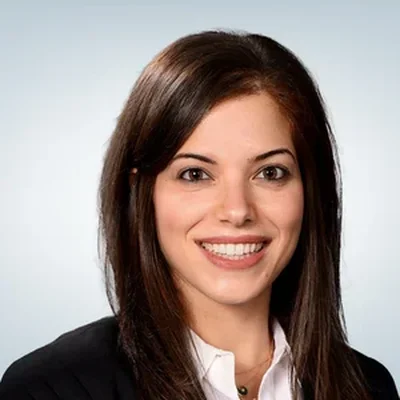

About
Before she was a resident, Dr. Riwa Sabbagh spent two years in the Reproductive Endocrinology Unit at Massachusetts General Hospital looking for the genes that cause hypogonadotropic hypogonadism — the condition where the brain fails to send the signals that start an ovarian cycle, and where infertility is a symptom of a wiring defect rather than a problem in the ovary. That work became a 2022 paper in Genetics in Medicine identifying the RhoGAP genes ARHGAP35 and ARHGAP5 as implicated in GnRH neuron development. Very few practicing fertility specialists have a discovery paper on the hormone axis they now prescribe against.
The research line kept running through training. At Baylor College of Medicine she did prenatal genetic testing and worked in the embryology lab on mouse embryo morphology; her published papers range from cell-free DNA screening and fetal precision medicine to a 2023 Fertility and Sterility analysis with Dr. Alan Penzias asking whether the biological efficiency of IVF — from retrieved oocyte to live birth — is actually improving. Her current interests are human embryo characterization, fertility preservation, and optimizing care for patients with a thin endometrial lining, the last being the least-solved problem in transfer medicine. She won the Society for Reproductive Endocrinology and Infertility Young Investigator Award in 2022.
She graduated with distinction in biology from the American University of Beirut and took her medical degree there, then completed the four-year OB/GYN residency at Baylor and her REI fellowship at Boston IVF with Beth Israel Deaconess and Harvard Medical School — the same Boston program Dr. Penzias directs. She stayed at Boston IVF as a full-time physician and is double board-certified in OB/GYN and REI. A native of Lebanon, she is fluent in Arabic and French and proficient in Spanish, which she has said changes what she can do in a consult. She sees patients in person at the Concord fertility center and by telehealth throughout Massachusetts.
Clinical Expertise
- Thin endometrial lining: Named as an active research and clinical interest — the recurring-transfer-failure problem where lining thickness and pattern decide the cycle
- Human embryo characterization: Work on what embryo appearance and development actually predict, which bears directly on transfer and PGT decisions
- Fertility preservation: Egg, embryo and sperm freezing, medical and elective
- Reproductive endocrinology: The hypothalamic-pituitary-ovarian axis is her published research background, not just her prescribing territory
- IVF and ICSI: Cycle management with an embryology-lab perspective on fertilization and culture
- Female infertility evaluation: Diagnostic sequencing from ovulation through the uterus
Why Choose Dr. Riwa Sabbagh
A gene-discovery paper behind the prescriptions. Most REI specialists learn the endocrine axis from textbooks; she spent two years at Mass General searching for what breaks it, and the results were published in a genetics journal.
A national young-investigator award. The SREI award in 2022 is given by the reproductive endocrinology society itself, at the early-career stage when habits are still forming.
She stayed in the program she trained in. Fellowship at Boston IVF/BIDMC/Harvard then a full-time physician role there — continuity with the same embryology team she learned embryo assessment on.
Four languages in the consult room. Arabic, French, Spanish and English, which for many patients means the consent conversation, the medication schedule and the bad news happen without an interpreter between them.
She published on whether IVF is getting better. The 2023 Fertility and Sterility efficiency analysis is the kind of question a patient should want their doctor to have read closely.
Professional Affiliations
Member of the American Society for Reproductive Medicine and the American College of Obstetricians and Gynecologists; double board-certified in OB/GYN and Reproductive Endocrinology and Infertility. SREI Young Investigator Award (2022). Presentations at ASRM, the American College of Medical Genetics and the Society for Reproductive Investigation.
Suitable For
- Transfers that fail with a lining that will not thicken: Thin endometrium is her stated optimization interest, not a footnote
- Patients deciding on egg or embryo freezing now: Preservation is on her active research list
- Arabic, French or Spanish-speaking households: A direct clinical history in the patient’s own language
- Couples asking how an embryo gets chosen: Embryo characterization is her published research area
- Concord, Lexington and central Massachusetts patients: In-person care at the Concord center, telehealth statewide