'%20d='m0%200%2016%2011h61%2061%2061%2061%2060L47%2037h61%2061%2060%2061L16%2063h61%2061%2061%2061%2060L47%2089h61%2061%2060%2061L16%20115h61%2061%2061%2061%2060L47%20141h61%2061%2060%2061L16%20166h61%2061%2061%2061%2060L47%20192h61%2061%2060%2061L16%20218h61%2061%2061%2061%2060z'/%3e%3c/svg%3e)
About
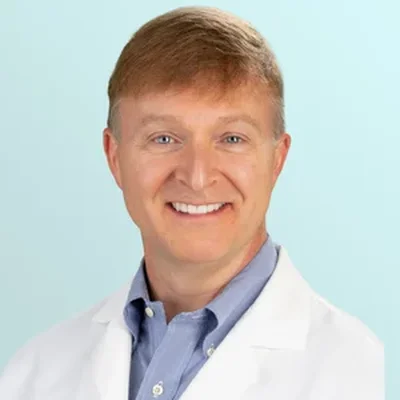
Robert Gustofson trained in reproductive endocrinology and infertility at the National Institutes of Health, the federal research center where clinical protocols get designed and tested rather than adopted, and he has practiced at CCRM’s Colorado offices since 2006 — 19 years. His published work sits on two questions that decide most cycles: how to stimulate an ovary so it yields usable eggs without overstimulating it, and what endometriosis does to that process.
He is board certified in reproductive endocrinology and infertility by the American Board of Obstetrics and Gynecology, and he holds certification on the da Vinci robotic surgical system — which means the laparoscopic and hysteroscopic work that often has to happen before a transfer attempt is inside his own practice rather than a referral across town. Before the NIH fellowship he completed his MD at the University of Florida and his OB-GYN residency at the University of North Carolina Hospitals.
At national meetings he has presented on ovarian hyperstimulation syndrome and on the clinical predictors of ART success, and his name appears on peer-reviewed papers covering novel stimulation protocols and endometriosis. In the clinic those interests translate into two patient groups he sees constantly: women who over-respond, where the goal is safety and a usable cohort, and women who under-respond, where the goal is a protocol nobody has tried on them yet. He is listed as accepting new patients and holds a Castle Connolly Top Doctor designation.
Clinical Expertise
- Stimulation protocol design: individualized gonadotropin strategies for both over-responders, such as patients with PCOS, and under-responders with diminished reserve — the subject of his published work
- OHSS prevention and management: a stated presentation and research topic; the reason protocol choice matters more than medication dose alone
- Robotic and minimally invasive gynecologic surgery: da Vinci system certification, alongside hysteroscopic and laparoscopic treatment of uterine and pelvic pathology
- Endometriosis-related infertility: surgical assessment and stimulation strategy evaluated together
- IVF with ICSI and PGT-A: cycle management from monitoring through transfer, plus genetic screening of embryos
- Male factor infertility: evaluation and treatment paired with ART, one of his listed specialty areas
Why Choose Dr. Robert Gustofson
NIH fellowship training. Protocol work done inside the National Institutes of Health is a different formation from a community-program fellowship, and it shows in how he handles patients who have already failed standard doses.
He operates. Robotic and laparoscopic certification means the surgical fix and the IVF plan come from one physician instead of two opinions that have to be reconciled.
Nineteen years at the same practice. Continuous CCRM Colorado tenure since 2006, with access to the network’s in-house genetics laboratory for the embryos he screens.
Published where it counts. Novel stimulation protocols, OHSS, and predictors of ART success — the variables a patient cannot see but a cycle turns on.
Professional Affiliations
American Board of Obstetrics and Gynecology certification in reproductive endocrinology and infertility; da Vinci Robotic System surgical certification. Research presentations at national reproductive medicine meetings on OHSS and predictors of ART success. Castle Connolly Top Doctor. Training: University of Florida MD, University of North Carolina Hospitals residency, National Institutes of Health fellowship.
Suitable For
- Patients told their lining, tubes or endometriomas need surgery first
- High responders with PCOS who want the lowest realistic OHSS risk
- Low responders looking for a protocol that is not the standard one
- Couples with both female and male factor issues in the same chart
- Anyone comparing clinics on laboratory and genetic-testing capability