'%20d='m0%200%2016%2011h61%2061%2061%2061%2060L47%2037h61%2061%2060%2061L16%2063h61%2061%2061%2061%2060L47%2089h61%2061%2060%2061L16%20115h61%2061%2061%2061%2060L47%20141h61%2061%2060%2061L16%20166h61%2061%2061%2061%2060L47%20192h61%2061%2060%2061L16%20218h61%2061%2061%2061%2060z'/%3e%3c/svg%3e)
About
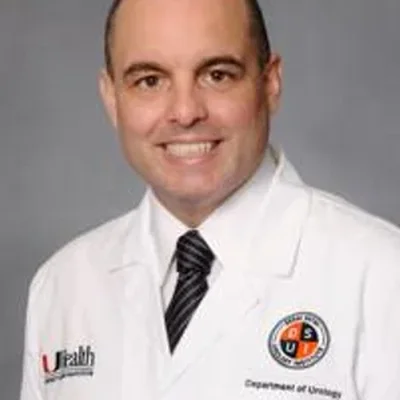
The official Miller School faculty record for Rodrigo L. Pagani, MD is short: department Desai Sethi Urology Institute, role Assistant Professor of Clinical, and three entries filed under Education, each carrying a year — 1996 at Universidade Estadual de Londrina (MD, Physician & Surgeon), 2000 at Hospital Evangelico de Londrina (MD, Urology), and 2002 at Baylor College of Medicine Medical Center (MD, Male Genitourinary Reconstructive Surgery and Prosthetics). The same roster card appears in the urology department’s faculty list. That page files all three items under the single heading “Education” without distinguishing residency from fellowship, so this profile follows the source wording and assigns no training level.
The distinction that matters for a fertility patient is where Pagani sits in the institution. The Miller School home is the urology institute, not the reproductive endocrinology and infertility (REI) division — the division’s published faculty list names two physicians only, division chief Pasquale Patrizio and George Attia. Pagani connects to the UHealth Center for Reproductive Medicine through the male-fertility line instead: the center’s own male fertility page lists surgical sperm retrieval and vasectomy reversal among available treatments, and the REI division chief’s official biography describes Patrizio as one of the few U.S. fertility specialists to see both men and women and as working closely with the Miller School’s urologists, oncologists, pediatricians and geneticists. In other words, the urology bench behind this center’s male-factor options is staffed from the institute Pagani belongs to; the sources do not document a shared clinic schedule.
What the record does not contain is worth stating before a patient reads too much into a title. Pagani’s faculty page has no “Licensures and Certifications” section — the same website carries that section for both Patrizio and Attia, so the omission is a gap in the published record rather than a template difference. This page therefore lists no board certification and does not describe this physician as a reproductive endocrinologist. No biography text, sub-specialty clinic interests, publication count, language list or society membership is published, and the center’s own doctor profile page sits behind a bot-blocking layer that returned no content during research, so nothing is guessed to fill the space.
Clinical Expertise
Everything in this list is the center’s published male fertility menu, not a personal scope claim: the center describes its treatment options at program level and does not divide specific procedures among individual physicians. Pagani’s documented specialty — urology with a reconstructive and prosthetics direction — is the surgical discipline these options sit in.
- Male infertility evaluation — the center’s published exam includes a physical exam, a complete review of medical and reproductive history, and semen analysis covering sperm count, shape, volume and mobility. Samples must be tested within an hour of collection, and the center asks for two separate samples six weeks apart because results vary between samples.
- Extended diagnostics — hormone testing (the center names FSH, LH, thyroid stimulating hormone, estradiol, total and free testosterone and prolactin) and genetic testing (chromosome analysis, Y-chromosome deletion testing and cystic fibrosis testing), plus sperm-specific tests such as vital staining, anti-sperm antibodies, peroxidase staining, semen culture and sperm DNA testing.
- Surgical sperm retrieval — the center lists testicular sperm aspiration (TESA), percutaneous epididymal sperm aspiration (PESA), testicular sperm extraction (TESE), microepididymal sperm aspiration (MESA), microdissection TESE (microTESE) and testicle biopsy through a small incision. Technique choice, per the center’s own description, turns on whether the procedure can go through the skin or needs an incision, how much tissue is required and how it is obtained, the location (testicle, epididymis or vas deferens) and whether microsurgical instruments are needed.
- Options after vasectomy — two routes are published: reversal surgery, either vasovasostomy to reconnect the two cut ends of the vas deferens or vasoepidymostomy to connect the vas deferens to the epididymis when blockage prevents a vasovasostomy, with the type decided during the operation; or sperm aspiration combined with IVF. The center states that the recommendation weighs time since the vasectomy, number of children wanted, how quickly the couple wants to conceive, whether natural conception is the goal, partner age and cost, and notes that aspiration may suit a female partner older than 37 or a couple in a hurry — at the price of a more invasive procedure on the partner’s side.
- Connection to the IVF laboratory — the center’s page explains that sperm can be obtained from the testicles for use in IVF when sperm are being produced but are absent from the ejaculate, and that retrieved sperm can be used immediately or frozen.
- Conditions named on the center’s page — oligospermia, defined against the WHO threshold of fewer than 15 million sperm per milliliter and graded mild (10-15 million per mL), moderate (5-10) and severe (0-5); asthenospermia (motility); azoospermia, obstructive or nonobstructive, which the center says affects an estimated 1% of all men; teratospermia (morphology); varicocele, present in roughly 15% of adult men; and genetic causes including Klinefelter’s syndrome, Y chromosome infertility and congenital absence of the vas deferens.
- Male genitourinary reconstructive surgery and prosthetics — the verbatim wording of the 2002 education entry, and the specialty positioning of the institute Pagani is listed in.
Why Choose Dr. Pagani
Microsurgical and reconstructive depth on the male side. The options this center publishes for severe male factor are operations, and choosing between them turns on anatomy: whether the skin route suffices or an incision is needed, how much tissue the case demands, where it comes from (testicle, epididymis or vas deferens) and whether microsurgical instruments are required. Pagani’s documented direction — male genitourinary reconstructive surgery and prosthetics — is that surgical discipline, sitting on the male-operative end of a program whose published menu otherwise runs through stimulation, retrieval, fertilization and embryo transfer.
An academic appointment with a checkable record. Assistant Professor of Clinical in the Desai Sethi Urology Institute is a listed faculty position at the Miller School, and the three education years behind it are published verbatim. This page leans on that documented spine and nothing more: no procedure volume, no outcome figures and no certification statements appear in official sources for this physician, and none are implied.
A single system for couples where both partners need treatment. The center states that male infertility is the sole cause in approximately 30% of cases and a co-contributor in an estimated further 20%, which means many couples here need a urology opinion alongside an IVF plan rather than instead of one. The division chief’s published biography names collaboration with the Miller School’s urologists among other specialties, so the male side has a specialty interface inside the same institution instead of requiring an outside surgical referral.
Read the limits honestly. Choosing Pagani means choosing the urology institute’s male-reconstructive bench for the surgical steps; the stimulation, retrieval and transfer decisions of an IVF cycle stay with the REI physicians the division lists. This profile is deliberately thin because the official record is thin.
Professional Affiliations
University of Miami Miller School of Medicine — Desai Sethi Urology Institute, Assistant Professor of Clinical, also listed on that department’s faculty roster. Our sources record no society memberships, no offices and no board certifications for this physician: the faculty page carries no “Licensures and Certifications” section, and no membership list is published anywhere in the material reviewed. The Miller School publications section on the faculty page carries an automated-consolidation disclaimer and returned no citable list, so no publication count appears on this page either.
Suitable For
- Couples told the male side is the problem, where the center’s published evaluation pathway runs from history, physical exam and semen analysis to hormonal and genetic testing before any procedure is discussed
- Azoospermia needing sperm retrieval, obstructive or nonobstructive, across the center’s published aspiration, extraction and biopsy options, with sperm used fresh or frozen for ICSI cycles
- Family building after a vasectomy, where reversal surgery and aspiration-with-IVF are both on the table and the fit depends on time since surgery, partner age, desired family size and whether natural conception is the goal
- Male genitourinary reconstructive or prosthetic concerns, the documented specialty direction of the institute Pagani is listed in
- Patients wanting the urology opinion inside the same health system as their fertility treatment rather than as a separate outside referral