'%20d='m0%200%2016%2011h61%2061%2061%2061%2060L47%2037h61%2061%2060%2061L16%2063h61%2061%2061%2061%2060L47%2089h61%2061%2060%2061L16%20115h61%2061%2061%2061%2060L47%20141h61%2061%2060%2061L16%20166h61%2061%2061%2061%2060L47%20192h61%2061%2060%2061L16%20218h61%2061%2061%2061%2060z'/%3e%3c/svg%3e)
About
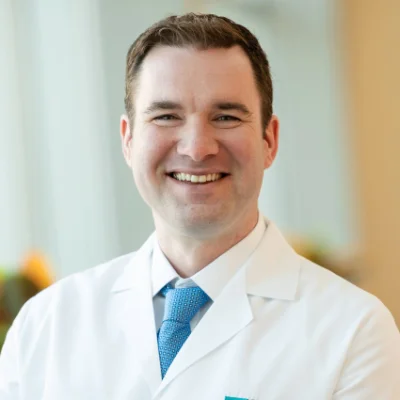
The sutures Russell Hayden, M.D. works with are finer than a human hair, and he handles them through up to 25-fold magnification. He describes that as “demanding surgery that requires a perfectionist attitude,” and he traces the tolerance for it to growing up in a family of tradesmen.
Start with the label, because it is the one most easily misread: his board certification, as the practice lists it, is in Urology. Hayden is “a urologist with a sub-specialty in male infertility and microsurgery.” He is not a reproductive endocrinologist. He does not run ovarian stimulation, and he is not the physician who performs an egg retrieval or an embryo transfer. His work is the other half of a couple’s evaluation - the diagnosis, the surgical options and the semen parameters that decide whether a couple needs IUI, IVF, or a procedure first.
His training path is the engineering route into the operating room. Graduate study in biomedical engineering at Johns Hopkins University is where, in his account, his drive to work in a field “where technology, precision, and creative problem solving align” showed up. He took his medical degree from Harvard University, stayed in Massachusetts for residencies in general surgery and urology at Massachusetts General Hospital in Boston, then completed a fellowship in reproductive medicine and microsurgery at Weill Cornell Medicine in New York. He was originally trained as an electrical engineer, and still builds small robots and other toys with his two sons in his garage. He joined Shady Grove Fertility’s Center for Male Fertility in 2021.
He also says the field is young and moving: “our understanding of male subfertility is continuously growing as new research surfaces,” which makes “lifelong learning and repeated engagement with the research literature” part of the job rather than a credential. The case he returns to in that spirit is a long-term patient, a young man with a high spinal cord injury from a motor vehicle accident and full tetraplegia, who married the partner he had met before the accident and conceived a child without assisted reproduction. Hayden tells it as evidence of how wide male fertility medicine is, and as a reminder that “the patient’s shoes” step comes before the procedure list - the reason he names for joining the practice, which he says prioritizes “premier patient outcomes, rather than the number of procedures per patient.”
Clinical Expertise
- Male infertility: the sub-specialty the practice states for him, covering semen analysis interpretation, hormonal and genetic workup, and the varicocele-and-obstruction territory that decides whether treatment is medical, surgical or assisted reproduction
- Microsurgery: his stated technical strength - tissue handled at magnifications up to 25-fold with sutures finer than a human hair, the operative style that reconstructive male fertility surgery depends on
- Azoospermia: named among his areas of practice, and a subject he has presented on. The specific surgical sperm retrieval techniques he performs are not itemized on his profile, so this page does not name them for him.
- Vasectomy reversal: named among his areas of practice, and a vasectomy reversal sits squarely in the microsurgery described above
- Scholarship in adjacent andrology and urology topics: the practice states that he has published papers, written chapters and presented on topics including vestibular prostheses, azoospermia and metastatic prostate cancer. His profile’s publication list itself has not been populated by the practice.
- Coordinated care with the reproductive endocrinology team: male factor findings are what change an IVF plan - ICSI decisions, retrieval timing, whether to bank sperm before a cycle - and he works inside a practice whose IVF laboratory, andrology laboratory and endocrine laboratory sit at the same Pennsylvania site
Why Choose Dr. Hayden
An engineer who became a microsurgeon. Biomedical engineering graduate work at Johns Hopkins, an M.D. from Harvard, two residencies at Massachusetts General, then a reproductive medicine and microsurgery fellowship at Weill Cornell. That is not a common combination in a fertility practice, and it is the reason he is comfortable being asked which technique he uses and why.
He is candid about the technical bar. Rather than describing microsurgery as an asset, he describes its difficulty: magnification, hair-fine sutures, a demand for perfectionism, and he attributes his post-operative results to accepting that constraint. Patients comparing surgeons on a technical question have something concrete to weigh here.
Outcomes before volume, and he says it is why he joined. “Shady Grove Fertility prioritizes premier patient outcomes, rather than the number of procedures per patient. This is an oddity in contemporary medical systems.” For a patient being counseled toward a procedure, whether the practice is measuring itself on procedure count is a real question.
He holds membership on both sides of his field. Urology (American Urological Association) and reproductive medicine (American Society for Reproductive Medicine), plus the Society for Male Reproduction and Urology, the Society for the Study of Male Reproduction and the New York Academy of Sciences - the two literatures a male infertility case actually draws on.
Recognition across several lists. Philadelphia Magazine Top Doctor (2026), Castle Connolly Top Doctor (2025, 2026), Suburban Life Magazine Top Physician (2024, 2025), and an AAGL best abstract award in the reproductive medicine category. One thing our sources cannot give you: his profile’s patient testimonial section returns no patient stories, and the practice does not list publication years, so no review score or paper count is used here to argue his case.
Professional Affiliations
Board certified in Urology, as labeled at the top of his practice profile; fellowship-trained in reproductive medicine and microsurgery at Weill Cornell Medicine. The practice does not publish the years of his residency or fellowship training or certification. He is a member of the American Urological Association, the American Society for Reproductive Medicine, the Society for Male Reproduction and Urology, the Society for the Study of Male Reproduction and the New York Academy of Sciences. He is not certified in Reproductive Endocrinology and Infertility, and this page and the clinic page describe him as a urologist accordingly.
Suitable For
- Couples whose infertility has a male component, where the abnormal semen analysis is the starting problem rather than an afterthought
- Azoospermia, particularly where a surgical retrieval has to be scheduled against a partner’s stimulation cycle and an embryology laboratory’s availability
- Reversal of a prior vasectomy, a microsurgical procedure and one of his stated areas
- Complex or non-routine male cases - neurologic injury, prior cancer treatment, congenital or endocrine causes - where an individualized plan matters more than a protocol
- A second opinion on whether surgery or IVF is the faster route to pregnancy, which is the question a urologist and a reproductive endocrinologist should answer together
- Men who want one physician for consultation and operation, in a practice whose office page states that surgical procedures are performed in-house or at its Towson, MD location
Two points of scope belong with his profile. First, where he actually sees patients is inconsistent on the practice’s own page: the location bar lists six Pennsylvania offices (York, Warrington, Philadelphia, Mechanicsburg, Lancaster, Chesterbrook), while his biography says he currently sees patients at the Chesterbrook, PA and Towson, MD offices “as well as additional SGF Pennsylvania locations.” The practice does not reconcile the two, so confirm the bookable office when you schedule. Second, the Center for Male Fertility is a group-level service, not something this one Chesterbrook office offers alone; and the SART 2023 figures on the clinic page - reported for the Pennsylvania network under ClinicPKID 2029 / SART number 0317, which aggregates several offices - count IVF and other assisted reproduction cycles, not male surgery. No Chesterbrook-only outcome data for either exists in our sources, and nothing about a man’s procedure is represented by those percentages.