'%20d='m0%200%2016%2011h61%2061%2061%2061%2060L47%2037h61%2061%2060%2061L16%2063h61%2061%2061%2061%2060L47%2089h61%2061%2060%2061L16%20115h61%2061%2061%2061%2060L47%20141h61%2061%2060%2061L16%20166h61%2061%2061%2061%2060L47%20192h61%2061%2060%2061L16%20218h61%2061%2061%2061%2060z'/%3e%3c/svg%3e)
About
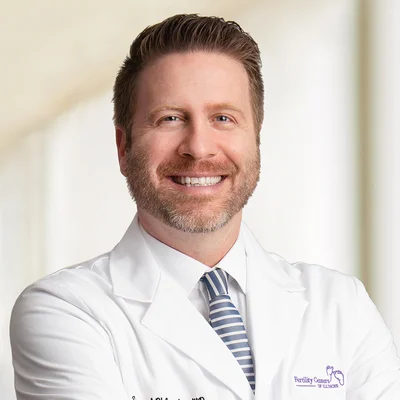
Half of an infertility diagnosis is not a gynecology problem, and on FCI’s clinical roster one physician is not a reproductive endocrinologist. Dr. Samuel Ohlander is a urologist whose subspecialty is andrology — which he defines as male infertility, male sexual health and male hormonal management. It is a small corner of urology; he reached it by adding a fellowship year in male reproductive medicine and surgery at Baylor College of Medicine on top of six years of urology residency.
Every other piece of his training happened in Chicago. He earned his medical degree at the University of Illinois at Chicago College of Medicine, completed general surgery intern and resident training there, and did his urology residency there as well. He remains on the UIC faculty as an Associate Professor of Urology, involved in the medical school curriculum, teaching and counseling, and is a product of Illinois public schools from grade school through medical school. He describes public speaking as probably his greatest fear and does it anyway, lecturing students and physicians in other specialties several times a year.
What he writes may be the most useful signal for a male infertility patient. In 2021 he co-authored the Male Infertility chapter in Campbell’s Urology, Infertility in the Male (volume 66) with Craig Stuart Niederberger and Rodrigo Lessi Pagani — the reference textbooks in male reproductive medicine, which means his name is attached to how the field defines medical management of the condition.
He is direct about his own preference, and it runs against what you might expect from a surgeon. He says he probably enjoys surgical management of infertility the most — vasectomy reversals, varicocele repairs, even vasectomies — but gets the most satisfaction from medically managing a patient and helping them create a family without surgery. At FCI he sees patients at the Chicago, Hinsdale, Glenview and Mokena campuses. He was named a Castle Connolly Top Doctor in 2026, and earlier received UIC’s Surgical Intern of the Year and Faculty Rising Star honors and the Society for the Study of Male Reproduction Traveling Scholar award.
Clinical Expertise
- Medical management of male infertility: Hormonal and drug-based treatment to improve semen parameters and achieve pregnancy without an operation — the chapter he wrote, and the outcome he says he finds most satisfying.
- Microsurgical vasectomy reversal: Reconnecting the vas deferens after a prior vasectomy, so a couple can conceive naturally instead of moving straight to surgical sperm retrieval plus IVF.
- Varicocele repair: Microsurgical correction of dilated scrotal veins that degrade semen quality, weighed against continuing to try naturally.
- Vasectomy: Counseling and the procedure itself for men who have finished building their families, including a clear conversation about what is and is not reversible.
- Low testosterone and hormonal management: Diagnosis and treatment of androgen deficiency in men who may still want children — the decision point where exogenous testosterone can suppress sperm production, and a specialist should be the one making the call.
- Male fertility preservation: Assessment and arrangements for freezing sperm before treatment that can damage the gonads, and optimizing the male factor before a couple enters an IVF or ICSI cycle.
Why Choose Dr. Ohlander
An andrology fellowship is a rare add-on. Urology residency in the United States runs six years; he then spent an additional year at Baylor College of Medicine in male reproductive medicine and surgery. Few urologists complete that step, and it is the training that makes microsurgical reversal and varicocele repair routine rather than occasional.
He wrote the textbook chapter on the subject. His contribution to the male infertility chapter in Campbell’s Urology, Infertility in the Male (2021) is a peer-vetted statement of how medical management is practiced. Ask him about a treatment plan and you are asking someone who defined part of it in print.
He tries not to operate. His own words: he loves being a surgeon and loves having a problem he can fix with his hands, but the most satisfaction comes from helping a patient create a family without surgery. For a man being handed a surgical option early, that instinct is worth something — in cost, anesthesia risk and recovery time.
He is a teacher, which shows in how he consults. As Associate Professor of Urology at the University of Illinois he works in the medical school curriculum and counsels students. He describes his primary approach as educating: explain what your own tests show, what it means, what options exist, then make a plan together that you are comfortable executing.
He understands the confidentiality problem in male infertility. He notes that many men will not discuss these topics with anyone, including their partner, and that trust has to be established fast because referral windows into andrology are narrow. He explicitly works to make the room one where a patient does not have to avoid the subject.
He covers the whole male pathway. Medical therapy, hormonal management, reversal, varicocele repair and vasectomy are all in his stated scope, so the comparison between “reverse it” and “retrieve and do IVF” can be made by one physician who does both.
Professional Affiliations
Board-certified in Urology; fellowship in male reproductive medicine and surgery, Baylor College of Medicine. Associate Professor of Urology, University of Illinois, with ongoing work in the UIC medical school curriculum, education and counseling. Publications include the Male Infertility chapter in Campbell’s Urology, Infertility in the Male (2021, vol. 66, 1428-1452.e13). Honors: Castle Connolly Top Doctor (2026), University of Illinois at Chicago Surgical Intern of the Year, UIC College of Medicine Faculty Rising Star, and Society for the Study of Male Reproduction and Urology Traveling Scholar. Practice privileges at the University of Illinois at Chicago and the 900 North Michigan ambulatory surgery suite.
Suitable For
- Couples told the problem is the male factor: Andrology is his entire subspecialty, from semen parameter abnormalities through hormonal imbalance to correctable surgical causes.
- Men who had a vasectomy and now want another child: Microsurgical reversal is a named specialty and one of the operations he says he most enjoys.
- Varicocele with declining semen quality: He performs varicocele repair and can compare it honestly against going straight to retrieval and IVF.
- Low testosterone in a man who still wants to conceive: Hormonal management is part of his subspecialty definition, and the fertility implications of treatment are his call to make.
- Sperm freezing before chemotherapy or before an IVF cycle: Fertility preservation is listed among his specialties, inside the narrow window before gonadotoxic treatment.
- Partners who want their own testing explained: He structures the visit around what your results mean and what your options are, then decides the plan with you.