'%20d='m0%200%2016%2011h61%2061%2061%2061%2060L47%2037h61%2061%2060%2061L16%2063h61%2061%2061%2061%2060L47%2089h61%2061%2060%2061L16%20115h61%2061%2061%2061%2060L47%20141h61%2061%2060%2061L16%20166h61%2061%2061%2061%2060L47%20192h61%2061%2060%2061L16%20218h61%2061%2061%2061%2060z'/%3e%3c/svg%3e)
About
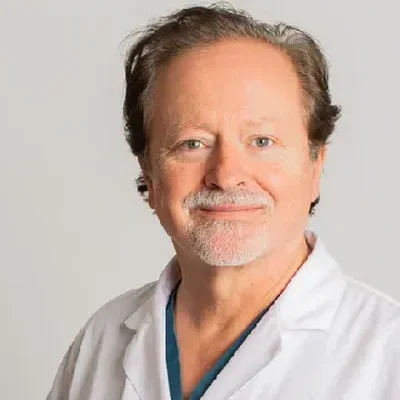
Most IVF patients never see the embryology lab. Samuel Wood is on both sides of that glass: he is board-certified in obstetrics and gynecology and in reproductive endocrinology and infertility, and he separately holds a high complexity laboratory director credential (HCLD/CC) from the American Board of Bioanalysts in two areas, per his clinic biography — the kind of license that lets a physician sign for bench work on human eggs. He is president and director of fertility services at Gen 5 Fertility Center, the San Diego practice our directory record lists as established in 2018, and his clinical biography puts him at more than 30 years in practice.
The training path is unusually wide rather than linear. Wood holds an MD, a doctorate in biochemistry and molecular biophysics, a master’s in psychology and an MBA, followed by obstetrics and gynecology residency at the University of North Carolina at Chapel Hill and a reproductive endocrinology and infertility fellowship at UC San Diego in La Jolla. In practice at Gen 5, that combination shows up in the part of the cycle other physicians delegate: the clinic’s ovarian rejuvenation protocol is written around how Wood himself injects ovarian tissue through the vaginal wall under ultrasound guidance, and the patient materials describe the injection technique as specific to him.
His published work is concentrated in that same niche. The clinic’s research page lists 15 papers from 2016 through 2023, nearly all of them jointly by Wood and Edward Sills, on intra-ovarian platelet-rich plasma and enriched platelet factors. His biography also carries directory and rating-site listings — U.S. News & World Report “Top Doctor,” SuperDoctors, Avvo 9.8 (“Superb”), Vitals 4 of 4, San Diego Magazine “50 People to Watch,” San Diego Metropolitan “Men who Impact San Diego” — and claims he is the only US fertility specialist listed in three Marquis Who’s Who volumes. Those are directory entries and vendor ratings rather than clinical accreditation, and the uniqueness claim is the clinic’s; the same applies to the “world-renowned” and “leading fertility specialist” phrasing in his bio. He is a past member of the Board of Directors of the San Diego County Medical Society.
Clinical Expertise
- Diminished ovarian reserve and poor egg quality: individualized stimulation for patients told their AMH is low, their FSH is high or their embryo yield is thin, including the clinic’s protocol of an ovarian platelet injection before a stimulation cycle
- Ovarian rejuvenation protocols: performs generation 1 through 4 intra-ovarian procedures — autologous PRP, enriched platelet factors including EnPLAF, ULTRA and ULTIMATE. The clinic’s own pages call the approach “a relatively new procedure” and put response in “a variable percentage of women”; our sources document no outcome data for the program
- IVF and ICSI cycle management: stimulation through transfer, with the clinic stating it typically transfers a single embryo and freezes the remaining genetically normal embryos
- Reproductive genetics and PGT-A: embryo screening for chromosome number, with biopsy samples sent to an outside reproductive genetics laboratory
- Third-party reproduction: donor egg cycles arranged through YourEggs and A Perfect Match, and gestational carrier cycles through Great Beginnings Surrogacy Services
- Family building for LGBTQ+ patients: donor-sperm IUI and IVF, co-IVF, split insemination and pre-transition gamete or embryo freezing
Why Choose Dr. Samuel Wood
He is qualified for the bench as well as the exam room. He holds the clinical subspecialty certification and, separately, the laboratory-director credential. For a patient with a thin egg yield that means one accountable person across the protocol and the bench work where retrieved eggs are assessed, injected and frozen.
His whole practice is aimed at the cases other clinics decline. Gen 5’s patient-facing pages address women who have been told they are “too old,” that their AMH is “too low,” that all of “your embryos are abnormal.” Wood’s research output follows the same patients, which means the protocol choices for low-reserve cycles come from a physician who has been writing about them for years, not from a brochure.
He publishes, but on his own program. The 15 papers listed for the clinic run through the same two or three names, with Wood as co-author. That is genuine continuity of investigation rather than a broad academic record, and it is worth reading as such: the evidence base for the rejuvenation protocols he performs is substantially the clinic’s own reporting, which our sources do not independently corroborate with outcome figures.
Practical fit. He takes international patients, and the clinic’s reviews repeatedly name the same coordinators through the cycle. His listed availability is a weekday morning clinic — Monday to Friday, 7:30 AM to 4:00 PM — so a stimulated cycle means scheduling scans inside working hours.
Professional Affiliations
Fellow of the American College of Obstetricians and Gynecologists (FACOG). Board-certified in obstetrics and gynecology and in reproductive endocrinology and infertility, according to his clinic biography, which adds that he achieved both “in the quickest possible time” — the biography’s own phrasing, with no dates attached and no certifying-board timeline cited to back it. A certified high complexity laboratory director (HCLD/CC) of the American Board of Bioanalysts. Past member of the Board of Directors of the San Diego County Medical Society. Our sources do not document ASRM or SART membership for him, and the clinic’s site lists no professional-society affiliations beyond these.
Suitable For
Patients over 35 with low reserve. The clinic’s core intake: age 35-plus, low AMH, high FSH, few antral follicles, or embryos that keep failing genetic testing. Wood’s protocol options here include an ovarian platelet injection before stimulation — offered as the clinic’s own approach, with no documented outcome data.
Repeat IVF failures. Gen 5’s stated niche is patients who have “undergone multiple unsuccessful IVF cycles,” where the review covers stimulation, lab handling and screening together rather than changing only the medication.
Preservation before timing runs out. Egg, embryo and sperm freezing, including a financing plan that covers an egg-freezing cycle plus five years of storage.
Donor egg, surrogate and LGBTQ+ families. Third-party cycles arranged through named partner agencies, and co-IVF or split insemination for couples where one partner provides eggs and the other carries or gestates.