'%20d='m0%200%2016%2011h61%2061%2061%2061%2060L47%2037h61%2061%2060%2061L16%2063h61%2061%2061%2061%2060L47%2089h61%2061%2060%2061L16%20115h61%2061%2061%2061%2060L47%20141h61%2061%2060%2061L16%20166h61%2061%2061%2061%2060L47%20192h61%2061%2060%2061L16%20218h61%2061%2061%2061%2060z'/%3e%3c/svg%3e)
About
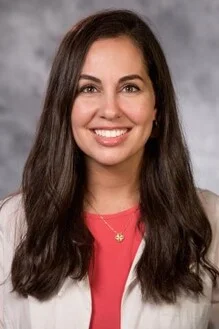
Dr. Sarah M. Moustafa did her medical degree at Duke (MD, 2014), left the state for obstetrics and gynecology residency at Yale-New Haven Hospital (2014-2018), then came back to North Carolina for a reproductive endocrinology and infertility fellowship at UNC-Chapel Hill, completed in 2021. She now practices at Duke Fertility Center in Morrisville, in the Research Triangle between Durham and Raleigh.
Two details shape what a first visit with her looks like. Duke Health lists her clinical appointments in English and in Arabic, which is unusual at a North Carolina clinic and matters for patients who would otherwise bring a family member to translate a protocol discussion. And Duke’s physician listing identifies her as LGBTQ+ identified or an ally, matching the center’s own program structure: donor insemination for female couples, reciprocal IVF, and freezing before gender-affirming treatment for transgender patients are all services the clinic advertises.
Her Duke Health rating is 4.92 out of 5 from 49 patient ratings, with five written comments — a physician-level score on Duke’s own survey instrument, separate from the clinic’s aggregate third-party reviews. Her recorded scope is female infertility, in vitro fertilization, and the endocrine side of reproduction, the part of the job that decides your stimulation protocol before anyone touches a monitor.
Clinical Expertise
- In Vitro Fertilization: protocol selection and full-cycle management, from ovarian stimulation and monitoring through retrieval, fertilization — with ICSI where sperm parameters require it — and embryo transfer
- Female infertility evaluation: tubal, uterine and ovarian-cause workup using the center’s own testing menu, including AMH, FSH, LH and estradiol panels, hysterosalpingogram and saline infusion sonogram
- Reproductive endocrinology: ovulatory and hormonal causes of infertility, the diagnosis layer that determines whether a patient starts at monitoring, ovulation induction, IUI or straight to IVF
- LGBTQ+ family building: fertility care planned around donor gametes and known donors, with the center’s psychological and legal-support resources in the same program
Why Choose Dr. Sarah M. Moustafa
Arabic-language care. Patients who read and speak Arabic can take the treatment plan in Arabic rather than reconstructing it at home. In a cycle decided by medication timing and consent forms, that removes a whole class of error.
A training path built inside top-tier academic programs. Duke for medicine, Yale-New Haven for residency, UNC-Chapel Hill for the subspecialty fellowship. Her whole clinical formation happened in teaching hospitals, which is the environment where a physician learns to read ambiguous results rather than follow a template.
Credentialing you can check against Duke’s own listing. ABOG certification in obstetrics and gynecology and FACOG fellowship are both recorded on her Duke profile. Her subspecialty qualification is the UNC REI fellowship; Duke’s profile does not list REI subspecialty board certification separately, so ask if that distinction matters to your case.
Among the strongest physician ratings at the center. 4.92 across 49 Duke Health ratings places her with the highest published clinician scores at the fertility center, where listed colleagues range from about 4.7 to 4.9.
Professional Affiliations
Fellow of the American College of Obstetricians and Gynecologists. Board certified in obstetrics and gynecology by the American Board of Obstetrics and Gynecology. Training: MD at Duke University (2014), obstetrics and gynecology residency at Yale-New Haven Hospital (2014-2018), reproductive endocrinology and infertility fellowship at the University of North Carolina at Chapel Hill (2021). She practices at Duke Fertility Center, and her indexed publications appear in the PubMed literature.
Suitable For
- Patients beginning an IVF cycle: she manages the full sequence, and the center prices IVF self-pay at $12,450-$18,000 with medications quoted separately at $5,000-$6,000
- Hormonal and ovulatory causes of infertility: reproductive endocrinology is a named part of her practice, not an afterthought
- Arabic-speaking patients and families traveling to North Carolina for care: clinical appointments available in Arabic
- LGBTQ+ patients building a family: an explicitly identified ally practicing in a program that lists donor insemination, reciprocal IVF and preservation before gender-affirming care
- Patients who want a physician who answers questions slowly: her rating profile is built on time spent explaining, which is the part of an IVF consult you actually use later