'%20d='m0%200%2016%2011h61%2061%2061%2061%2060L47%2037h61%2061%2060%2061L16%2063h61%2061%2061%2061%2060L47%2089h61%2061%2060%2061L16%20115h61%2061%2061%2061%2060L47%20141h61%2061%2060%2061L16%20166h61%2061%2061%2061%2060L47%20192h61%2061%2060%2061L16%20218h61%2061%2061%2061%2060z'/%3e%3c/svg%3e)
About
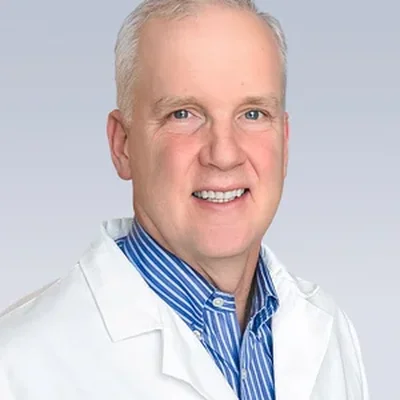
Most fertility specialists stop at the ovaries. Scott Edwards publishes on sperm motility — how and why a sample’s movement fails — and he also holds an AAGL membership, the society for minimally invasive gynecologic surgery, which tells you where his hands go when medication is not the answer. Both interests fit the same job: he is the Director of Reproductive Endocrinology at Pennsylvania Hospital, one of Penn Medicine’s flagship institutions, and a Professor of Clinical Obstetrics and Gynecology at the Perelman School of Medicine, where he teaches residents and students.
His published work runs through the practical middle of a fertility practice: sperm function, the management of pregnancy loss, and exercise during pregnancy. That last topic is the kind of question asked in every second-trimester visit, and it is unusual to find a reproductive endocrinologist who has formally studied it rather than improvising an answer. Clinically he covers IVF and ICSI, ovulation induction, egg freezing and sperm banking, and the surgical corrections that make a transfer worth attempting — hysteroscopic resection of polyps, fibroids and Asherman’s adhesions, laparoscopic work on endometriosis and blocked or fluid-filled tubes.
Edwards took his MD at Yale School of Medicine, trained in obstetrics and gynecology at the University of California San Diego Medical Center, and completed his REI fellowship at the Hospital of the University of Pennsylvania. He certified in obstetrics and gynecology in 1997 and has practiced at Penn since, close to thirty years. Philadelphia Magazine has listed him as a Top Doctor every year from 2018 through 2025. He splits clinical time between Penn Fertility Care’s Washington Square office at 800 Walnut Street and the Market Street center.
Clinical Expertise
- IVF cycle management — stimulation, monitoring, retrieval and transfer, in a division that logged 2,061 ART cycles in 2023
- ICSI and male factor infertility — evaluation of the male partner, including sperm parameters, with research published on motility
- Hysteroscopic and laparoscopic reproductive surgery — cavity restoration before transfer: polyps, submucosal fibroids, intrauterine adhesions, endometriosis, hydrosalpinx
- Recurrent pregnancy loss — management research is one of his publication threads, and the topic anchors much of his referral population
- Reproductive endocrine disorders — PCOS, amenorrhea, thyroid and pituitary contributions to anovulation
- Fertility preservation — egg freezing and sperm banking, including before oncology treatment
- Intrauterine insemination and ovulation induction — the lower-cost steps that precede IVF when the tubes are open
Why Choose Dr. Edwards
He evaluates the couple, not the patient. Male factor research plus IVF/ICSI practice means a partner’s abnormal semen analysis is read by the same physician running the cycle, not outsourced.
Surgeon and prescriber in one. When a cavity problem is the reason a transfer failed, the physician who spotted it can fix it, and the same person then plans the next cycle.
Hospital-level directorship. Running reproductive endocrinology at Pennsylvania Hospital places him in the administrative chain that sets surgical scheduling and safety standards across Penn Medicine’s fertility sites.
Eight consecutive years of local recognition — on Philadelphia Magazine’s Top Doctor list from 2018 through 2025.
Washington Square location, a Center City address with a shorter commute for many Philadelphia patients than University City.
Professional Affiliations
American Society for Reproductive Medicine; American College of Obstetricians and Gynecologists; American Association of Gynecologic Laparoscopists; Philadelphia Reproductive Endocrinology Society. Board-certified in Obstetrics and Gynecology since 1997, fellowship-trained in reproductive endocrinology and infertility at the Hospital of the University of Pennsylvania, and practicing within a SART member clinic whose cycles are reported to the CDC.
Suitable For
Couples who want one physician to work up both of them, especially when the semen analysis is borderline.
Patients told their uterus needs a procedure first — polyp, fibroid, adhesion, or a fluid-filled tube that has to be addressed before an embryo goes back.
Recurrent pregnancy loss, where management strategy matters as much as diagnosis.
PCOS, hypothalamic amenorrhea or pituitary disease causing anovulation.
Anyone freezing eggs or sperm before chemotherapy, surgery or simply time.
Center City and West Philadelphia patients who would rather be monitored at 800 Walnut Street.