'%20d='m0%200%2016%2011h61%2061%2061%2061%2060L47%2037h61%2061%2060%2061L16%2063h61%2061%2061%2061%2060L47%2089h61%2061%2060%2061L16%20115h61%2061%2061%2061%2060L47%20141h61%2061%2060%2061L16%20166h61%2061%2061%2061%2060L47%20192h61%2061%2060%2061L16%20218h61%2061%2061%2061%2060z'/%3e%3c/svg%3e)
About
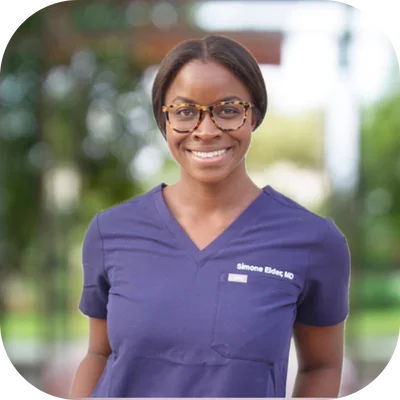
Simone Elder’s record before fellowship is a list of named distinctions rather than a general statement of merit: a Gates Millennium Scholarship at Rice University, where she wrote an honors thesis in biochemistry and cell biology; the Gustav Seligmann Prize for Excellence in Obstetrics and Gynecology at Weill Cornell Medical College; National Medical Foundation fellowships; and, as a senior medical student, selection by the Association of American Medical Colleges as a Franklin C. McLean NMF Scholar for scholarship, leadership and community service.
Her entrance into medicine also took her abroad before it took her into a clinic. She pursued international women’s health fieldwork in India, China and South Africa, experiencing programs where reproductive care is delivered under resource constraints rather than the insurance-and-lab infrastructure she now practices inside. She frames that as professional rather than biographical: her stated passion is helping patients navigate reproductive medicine “with compassion, expertise, and a global perspective.”
Clinical training then ran through two institutions with very different characters. She completed her obstetrics and gynecology residency at NewYork-Presbyterian Hospital with Weill Cornell, where she received a teaching award, and her reproductive endocrinology and infertility fellowship at the University of Colorado, where her research contributions were recognized and supported through the NIH Loan Repayment Program — a federal award tied to a research commitment rather than to clinical volume, and a detail that separates her training record from a purely clinical fellowship. She now practices in Colorado.
Clinical Expertise
- IVF: stimulation, monitoring, retrieval and transfer within a practice that performs day-5 culture, blastocyst biopsy for PGT, and single embryo transfer as its stated default
- Fertility preservation and egg freezing: oocyte cryopreservation and preservation planning for patients facing gonadotoxic treatment, supported by the lab advances — vitrification and automated cryostorage — that this practice adopted early
- Reproductive endocrinology with a research base: fellowship work at the University of Colorado recognized by an NIH-supported award, which is the kind of training that goes into reading a protocol’s evidence rather than only its instructions
- Family building for non-traditional paths: donor egg, donor sperm and gestational carrier programs are run at this practice, and its physicians state care regardless of marital status or sexual orientation; the practice is a member of the Colorado LGBTQ Chamber of Commerce
- Patient education: a residency teaching award and an academic medical background, useful in the informed-consent conversations that ART cycles pile up
Why Choose Dr. Simone Elder
Extramural recognition, named. Gates Millennium Scholar, Franklin C. McLean NMF Scholar, the Gustav Seligmann Prize and NIH Loan Repayment Program support are external awards with their own selection processes, not internal employee recognition.
She taught residents at a Cornell-affiliated hospital. NewYork-Presbyterian/Weill Cornell with a teaching award means she has explained this material to physicians in training, which is the same skill a patient needs at a consent visit.
Fieldwork in three countries. Practice in India, China and South Africa is an unusual background in a Denver-area fertility clinic, and it is the part of her profile that speaks to cross-cultural and international patients directly.
Fellowship in the same state where she practices. Her University of Colorado REI training sits inside the regional academic program that supplies much of Colorado’s reproductive medicine staffing, which usually means her protocols and referral habits match local practice.
Professional Affiliations
American Society for Reproductive Medicine; Society for Reproductive Endocrinology and Infertility; American College of Obstetricians and Gynecologists (Fellow). Her practice reports cycles to SART under the center’s single clinic registration.
This page is deliberately thin where her source material is thin: the material reviewed documents her training institutions, awards and research support but no named program role, subspecialty certificate number or publication list. Ask the office for those directly if they matter to your decision.
Suitable For
- Patients who choose physicians on academic signal: scholarship, teaching awards and NIH-supported research recognition, all named
- Egg freezing and fertility preservation: preservation is a documented focus area within a practice whose lab adopted vitrification-era technology early
- International patients and out-of-state patients: fieldwork across three continents, in a practice drawing patients from dozens of states
- LGBTQ+ family building at this center: donor gamete and gestational carrier programs run here, with practice-level commitment to care regardless of orientation
- Patients who want their plan explained rather than announced: a physician recognized for teaching