'%20d='m0%200%2016%2011h61%2061%2061%2061%2060L47%2037h61%2061%2060%2061L16%2063h61%2061%2061%2061%2060L47%2089h61%2061%2060%2061L16%20115h61%2061%2061%2061%2060L47%20141h61%2061%2060%2061L16%20166h61%2061%2061%2061%2060L47%20192h61%2061%2060%2061L16%20218h61%2061%2061%2061%2060z'/%3e%3c/svg%3e)
About
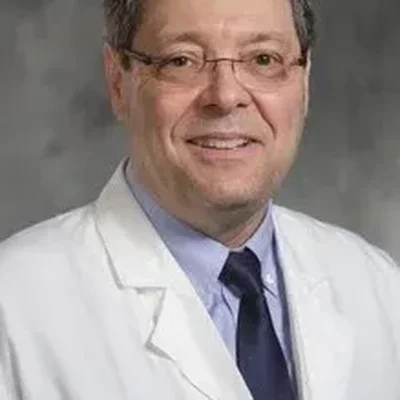
Duke’s Division of Reproductive Endocrinology and Infertility is run by Dr. Steven L. Young, who holds the F. Bayard Carter Distinguished Professorship — described in Duke’s own materials as among the highest academic honors in the obstetrics and gynecology department. Practically, the division chief is the physician who sets standards for the specialists you will actually be scheduled with at Duke Fertility Center, and who decides how the service handles the cases nobody wants.
His own route into that seat is a scientist’s. MD/PhD from the University of Miami (1991), obstetrics and gynecology residency at Yale/New Haven Hospital (1995), reproductive endocrinology and infertility fellowship at the University of North Carolina at Chapel Hill (1997). He has practiced the subspecialty since 1997, close to 28 years, and has published 161 scholarly articles.
Those publications are not scattered. They concentrate on endometrial receptivity — whether the uterine lining is actually in a state to accept an embryo — and on endometriosis. Those two subjects are where IVF stops being a mechanical problem, and they explain why patients referred to him tend to arrive after other clinics have run out of explanations. Duke Health lists him at 4.77 out of 5 in patient ratings, accepting new patients.
Clinical Expertise
- In Vitro Fertilization: complex-cycle management for patients whose history includes failed stimulation or failed transfer, at a SART-reporting academic center
- Endometriosis-associated infertility: how the disease damages ovarian reserve, pelvic anatomy and implantation, and what to treat before attempting a pregnancy
- Endometrial receptivity: evaluation of the uterine lining as the limiting factor in implantation, the subject of his published research program
- Recurrent pregnancy loss: structured assessment across genetic, anatomic, endocrine and immune contributions rather than a single test
- Complex female infertility: the referral tier — second and third opinions after other programs have stopped offering options
Why Choose Dr. Steven L. Young
Twenty-eight years in one subspecialty. He has been a reproductive endocrinologist since 1997, which is long enough to have watched most infertility protocols cycle through and be abandoned, and to have made the mistakes that changed departmental policy.
A named professorship and a division chair. The distinction here is not decoration: the F. Bayard Carter professorship is attached to the leadership role, so the clinician setting the division’s standards is also the clinician taking patients.
He researches the specific thing that goes wrong after a good embryo fails. Endometrial receptivity is his published focus. Patients with repeated implantation failure are usually told their embryos were fine, which leaves the lining as the variable — the question he has spent his research career on.
161 publications. Duke’s materials list 37 articles for one colleague at the same center, which gives some sense of the spread. His own output concentrates on endometriosis and receptivity rather than general interest.
Professional Affiliations
Chief of the Division of Reproductive Endocrinology and Infertility at Duke University, where he also holds the F. Bayard Carter Distinguished Professorship — described in Duke’s materials as among the obstetrics and gynecology department’s highest academic honors. He practices at Duke Fertility Center, a Society for Assisted Reproductive Technology member clinic reporting cycle data to SART and the CDC. Training: University of Miami MD/PhD (1991), Yale/New Haven Hospital residency (1995), UNC-Chapel Hill REI fellowship (1997). Duke’s published profile records his appointments, publications and fellowship training rather than an individual certification line.
Suitable For
- Patients with endometriosis who have been told to “try IVF and see”: the disease is a named research program here, not an incidental finding
- Two or more failed transfers with good-looking embryos: receptivity evaluation is his specialty, and the center keeps banked embryos in monitored off-site storage, tracked by RFID, for whatever step comes next
- Recurrent pregnancy loss: structured workup, with the center’s own testing menu priced in advance
- Anyone who has already been discharged from treatment elsewhere: the division chief takes new patients, and the academic infrastructure behind him — genetics, urology, reproductive surgery — is inside one health system