'%20d='m0%200%2016%2011h61%2061%2061%2061%2060L47%2037h61%2061%2060%2061L16%2063h61%2061%2061%2061%2060L47%2089h61%2061%2060%2061L16%20115h61%2061%2061%2061%2060L47%20141h61%2061%2060%2061L16%20166h61%2061%2061%2061%2060L47%20192h61%2061%2060%2061L16%20218h61%2061%2061%2061%2060z'/%3e%3c/svg%3e)
About
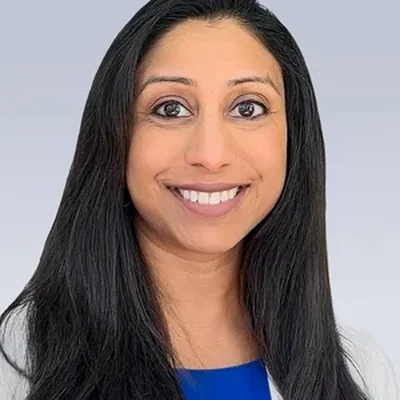
The success-rate table on this page exists because of rules, and Suneeta Senapati helps write them. She sits on the executive committee and the research committee of the Society for Assisted Reproductive Technology, the organization that defines what counts as a cycle, a transfer and a live birth in national reporting, and she serves on the American Society for Reproductive Medicine’s Practice Committee, which issues the guidance clinics cite when they recommend — or refuse — a treatment. Very few practicing fertility physicians have both seats at once.
Her other identity is surgical. Senapati is an REI-trained operative hysteroscopist and laparoscopist: the fibroid that deforms a cavity, the polyp that blocks an implantation window, the Asherman’s adhesions after a D&C, the endometrioma and the damaged tube. She pairs that with a master’s in clinical epidemiology from Penn (2012), and her research is population-scale rather than bench-scale — infertility epidemiology, early pregnancy loss, endometriosis, and who does and does not get to fertility care. She contributed to a standardized first-trimester ultrasound lexicon, the effort to make “what the early scan shows” mean the same thing in every clinic’s chart.
She also builds service design. With Anuja Dokras she created Penn’s Fast Track to Fertility program, a compressed-pathway model published in NEJM Catalyst, aimed at cutting the dead time between referral, workup and treatment start. Trained at Ohio State (MD, 2000), Michigan residency (2005) and Penn fellowship (2007), certified in 2011, she is an associate professor at the Hospital of the University of Pennsylvania and works with the division’s Turner syndrome and PCOS programs, where reproductive risk has to be managed for decades rather than one cycle.
Clinical Expertise
- Reproductive surgery — hysteroscopic myomectomy, polypectomy and adhesiolysis; laparoscopic endometriosis excision, adhesiolysis and salpingectomy for hydrosalpinx before transfer
- Endometriosis-associated infertility — when to operate, when to stimulate, and when surgery would only delay a cycle
- Recurrent pregnancy loss and early pregnancy — evaluation, plus the ultrasound terminology work that makes scans comparable between visits and clinics
- IVF and IUI cycle management — including donor egg, donor embryo and gestational carrier pathways, all on the division’s registered service list
- Fertility preservation — egg, embryo and ovarian tissue freezing for patients facing gonadotoxic therapy
- Uterine anomalies — congenital cavity differences assessed before an embryo is placed
- Pathway redesign — the Fast Track to Fertility model, built to shorten the interval from first call to first stimulation
Why Choose Dr. Senapati
She helps set the rules her competitors follow. SART executive committee and ASRM practice committee membership means the guidance documents other clinics read are documents she reviewed.
Scalpel and protocol. Many REI physicians prescribe surgery written by someone else; she does the hysteroscopy or laparoscopy herself and then runs the cycle that follows.
She works on waiting time as a clinical problem. Fast Track to Fertility exists because delay reduces ovarian reserve, and she has published the model rather than just claimed it.
Epidemiology training. An MSCE informs how she handles the population questions patients ask individually: how often this happens, to whom, and what the numbers actually mean for you.
Longitudinal programs. Turner syndrome and PCOS patients need one physician across years, which is the kind of care her program affiliations are built for.
Professional Affiliations
Society for Assisted Reproductive Technology, executive and research committees; American Society for Reproductive Medicine, Practice Committee; American College of Obstetricians and Gynecologists; Society for Reproductive Endocrinology and Infertility. Board-certified in Obstetrics and Gynecology since 2011, fellowship trained in reproductive endocrinology and infertility at Penn in 2007, with a master’s in clinical epidemiology.
Suitable For
Endometriosis patients deciding whether excision improves their odds before IVF, and how much time it costs.
Anyone told a fibroid, polyp or adhesion is in the way, particularly after a failed transfer.
Patients with recurrent loss who need early pregnancy surveillance by someone who helped standardize how those scans are described.
Women facing sterilizing treatment, where tissue, egg or embryo freezing must be arranged in days.
Turner syndrome and PCOS patients needing reproductive care that continues past a single cycle.
Patients comparing clinics on governance and reporting rigor rather than on marketing language.