'%20d='m0%200%2016%2011h61%2061%2061%2061%2060L47%2037h61%2061%2060%2061L16%2063h61%2061%2061%2061%2060L47%2089h61%2061%2060%2061L16%20115h61%2061%2061%2061%2060L47%20141h61%2061%2060%2061L16%20166h61%2061%2061%2061%2060L47%20192h61%2061%2060%2061L16%20218h61%2061%2061%2061%2060z'/%3e%3c/svg%3e)
About
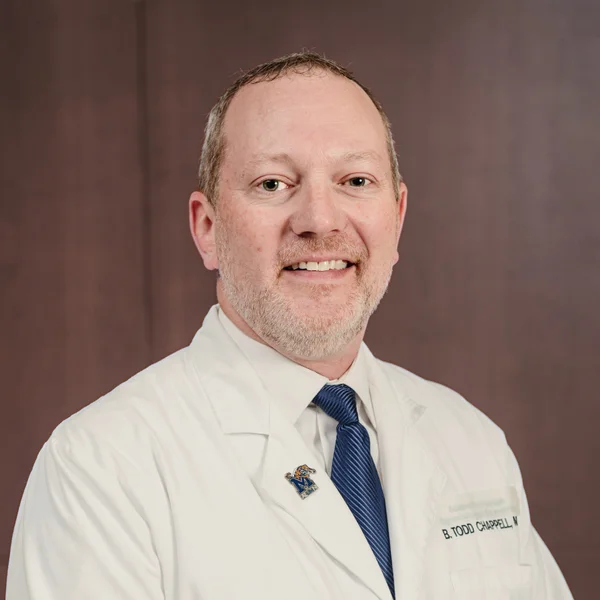
Fertility Associates of Memphis describes its surgery program as run by “Dr. Todd Chappell, board certified in general OB/GYN,” and that distinction is the point: Chappell is not a reproductive endocrinologist. He is the surgeon the reproductive endocrinologists send patients to when an anatomy problem has to be fixed before, or instead of, an embryo transfer. He holds the ABOG Minimally Invasive Gynecologic Surgery focused-practice certification and brings more than 17 years of operative experience to a practice whose egg retrieval, embryo culture and transfer all happen in the same building.
His two jobs at FAM are initial infertility evaluations and complex surgery. The first puts him in front of new patients before anyone has decided whether they need IVF; the second covers hysteroscopy, laparoscopy and robotic surgery across myomectomy, endometriosis, cesarean scar defects, abdominal cerclage, repair of congenital uterine anomalies and general gynecology including hysterectomy. Those are the findings that show up on a workup — a septum, a fibroid indenting the cavity, an isthmocele holding fluid where an embryo would land — and each has to be dealt with by someone who operates rather than someone who prescribes.
He is a Fellow of the American College of Obstetricians and Gynecologists and is board certified in general OB/GYN by the American Board of Obstetrics and Gynecology. Born and raised in northwest Tennessee, he took a biology degree at the University of Memphis in 1999, his medical degree at the University of Tennessee College of Medicine in 2005, and completed residency at the University of Tennessee Health Science Center in 2009 as administrative chief resident.
Clinical Expertise
- Hysteroscopic surgery: cavity work on polyps, submucosal fibroids, scar tissue and septa — the procedures that clean up a uterine cavity before transfer, and the surgical treatment FAM lists for structural causes of recurrent miscarriage
- Laparoscopy and robotic surgery: endometriosis excision, adhesiolysis, tubal disease, ovarian and uterine pathology approached through small incisions rather than open surgery
- Myomectomy: fibroid removal with the uterus left in place, for patients whose cavity or access is distorted by fibroids
- Cesarean scar defect repair: correction of the pouch that forms at a prior low-transverse incision, a named interest of his and a finding that can matter for symptoms and for later pregnancies
- Abdominal cerclage: placement at the cervix from above for cervical insufficiency in patients whose history makes a vaginal approach inadequate
- Uterine anomaly repair: reconstructive work on congenital malformations of the reproductive tract
- General gynecology, including hysterectomy: he is the practice’s definitive surgical option when childbearing is complete or when disease requires removal
- Initial infertility evaluation: the anatomical half of a new patient’s workup, done inside a fertility practice rather than in a separate gynecology office
Why Choose Dr. Todd Chappell
A MIGS-certified surgeon inside a fertility clinic. The surgeon sits in the same practice as the lab and the cycle team, and he also sees new patients at the evaluation stage, so the anatomical half of a workup does not require an outside referral.
Focused-practice certification, not a claim of interest. ABOG’s MIGS focused-practice credential is a defined certification pathway beyond general OB/GYN certification; he also holds FACOG. His bio page names the certification and more than 17 years of experience; the clinic’s team-listing summary still carries an older “more than 15 years” line without it.
His listed procedures match the findings that block transfers. Septum, submucosal fibroid, endometrioma, isthmocele, incompetent cervix — these are the anatomical reasons an IVF cycle fails, and each is on his operative list rather than referred out of practice.
Educated and trained entirely in Tennessee. Born and raised in northwest Tennessee, he took a biology degree at the University of Memphis in 1999, his medical degree at the University of Tennessee College of Medicine in 2005, and residency at the University of Tennessee Health Science Center in 2009 as administrative chief resident — the same institution where Sierra Bishop later trained.
He works alongside four REIs. Surgical timing — whether to operate before stimulation, before transfer, or not at all — is decided in the same building as the embryology lab, with the clinic’s ART director and genetics director on the same staff.
Professional Affiliations
Fellow of the American College of Obstetricians and Gynecologists; board certified in general Obstetrics and Gynecology by the American Board of Obstetrics and Gynecology, with ABOG certification in Minimally Invasive Gynecologic Surgery Focused Practice. Member of the American Medical Association, the Tennessee Medical Association, the Memphis Medical Society and the Memphis OB/GYN Society. He practices at a SART-member clinic reporting under the registration Kutteh Ke Fertility Associates of Memphis, PLLC.
Suitable For
- Patients with fibroids before IVF: myomectomy to restore cavity shape when fibroids distort the endometrial cavity or block access
- Endometriosis patients: excision by a surgeon whose named interest is the disease, coordinated with a fertility plan rather than as pain management alone
- Anyone told they have a uterine septum, polyps or intrauterine scar tissue: hysteroscopic correction as part of a fertility workup, including recurrent-loss workups
- Patients with a prior cesarean and a scar defect: isthmocele repair, a specific interest of his
- Cervical insufficiency in a second or third trimester loss pattern: abdominal cerclage, a procedure most general OB/GYN practices do not offer
- Patients needing a decision, not a referral: initial infertility evaluation and the surgery it leads to, from the same physician
- Completing families with surgical gynecologic disease: hysterectomy and general gynecology without leaving the practice