The absolute risk of a serious complication from one IVF cycle is roughly 0.1–2%, and most of it is OHSS — which modern protocols now largely prevent. IVF is among medicine’s most scrutinized procedures — 40+ years of data, 12+ million births worldwide — but “low risk” is not “zero risk.”
“Ask your doctor for absolute numbers, not percentages of change. A ‘30% increase’ that moves a 1.0% risk to 1.5% is a different decision than patients imagine when they hear the relative figure alone.” — Reproductive medicine specialist, ProIVF Medical Advisory Board, on IVF risk counseling, 2025
What Is OHSS and How Likely Is It?
Ovarian hyperstimulation syndrome (OHSS) is IVF’s most significant drug complication: over-responding ovaries leak fluid into the abdomen, and modern protocols have pushed severe cases down to 0.1-0.5%.
Key risk factors: PCOS (5-10× higher; AMH >4.5 ng/mL), age under 35, low BMI (<20 kg/m²), AFC >24, previous OHSS, high trigger-day response (E2 >4,000 pg/mL, >20 follicles >12 mm). Severe OHSS: 0.1-0.3% with antagonist + agonist trigger, 2-5% for PCOS on a long protocol with hCG trigger, 3-8% with high AFC + hCG trigger.
Prevention, ranked: a GnRH agonist trigger instead of hCG cuts OHSS about 85% (Cochrane 2014: 17 RCTs, n = 1,847; OR 0.15, 0.05-0.47 — a 5% risk falls to nil-2%) but lowers live birth in fresh transfers (OR 0.47, 0.31-0.70), which is why it is paired with freeze-all; antagonist protocol −50-60% vs long; cabergoline 0.5 mg/day × 8 days 60-70%; 10% calcium gluconate 50-65%; coasting or cancellation 100%, weak evidence.
Since roughly 2015, antagonist protocols cut severe OHSS from 2-5% to 0.1-0.5% — ASRM OHSS guideline, 2016 — and agonist trigger plus freeze-all brings high-risk patients to 0.1-0.3%. We still see PCOS patients handed long protocols: an antagonist-capable clinic with individualized triggers is the single most important OHSS decision — IVF hospital directory.
Emergency signs: severe abdominal pain, inability to urinate, weight gain >1 kg/day, breathlessness, leg swelling (thrombosis); onset 4-7 days after trigger.
How Risky Are Egg Retrieval and Embryo Transfer?
Retrieval’s serious complication rate — hospitalization, transfusion or surgery — is 0.2-0.5% (2-5 per 1,000): lower than diagnostic laparoscopy (~1-2%), far below tubal surgery (5-10%).
Egg retrieval complications: bleeding — vaginal 1-3% minor, 0.2-0.5% needing intervention; intra-abdominal 0.05-0.2% (coagulopathy, adherent ovaries; pressure → transfusion → laparoscopy); pelvic infection/abscess 0.1-0.5% (endometrioma puncture, PID, hydrosalpinx; antibiotics → drainage); ovarian torsion 0.05-0.1% (OHSS, enlarged ovaries; laparoscopic detorsion); bowel, ureter or anesthesia injury <0.01%.
Embryo transfer: difficult transfer (cervical manipulation) 5-15%, implantation −~10%; endometrial trauma/bleeding 3-8%; cervical stenosis 0.5-2% (transmyometrial/hysteroscopic route); ectopic 1-3% vs 2-3% naturally; heterotopic 0.1-0.3%.
Procedural risk mitigation: ultrasound guidance; antibiotic prophylaxis for endometriomas/hydrosalpinx; single embryo transfer; avoid puncturing endometriomas.
What Side Effects Do IVF Medications Cause?
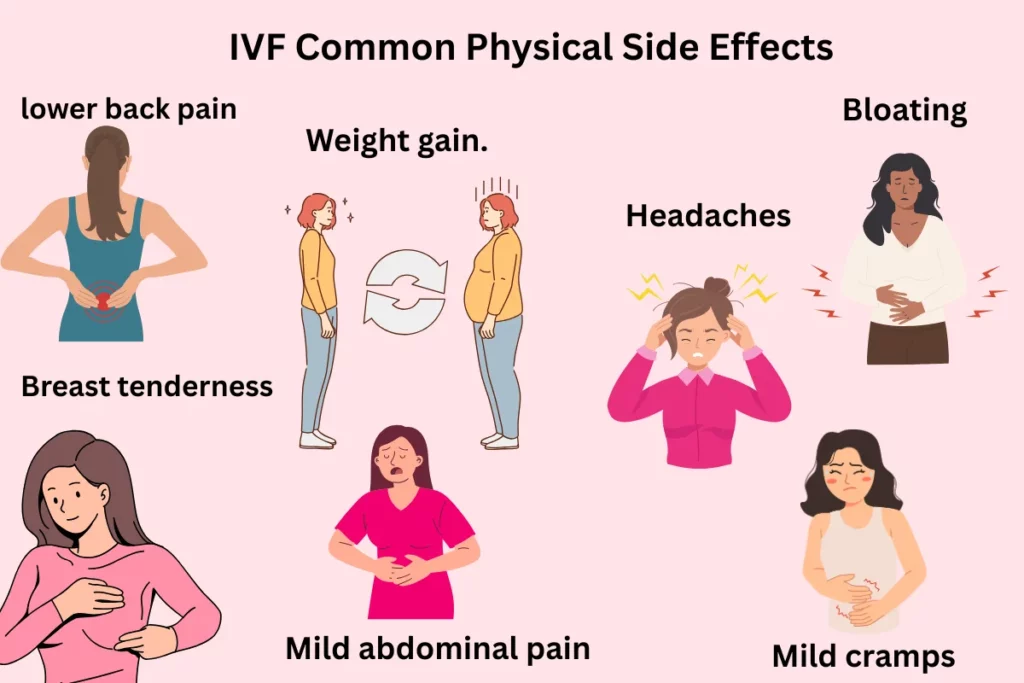
Gonadotropins (Gonal-F, Puregon, Menopur): injection-site redness/swelling 30-50% (rotate sites, ice), breast tenderness 20-30%, bloating 40-60% (severe — evaluate for OHSS), headache 10-25% (acetaminophen; no NSAIDs), fatigue 30-50%.
Antagonists, triggers and luteal support: GnRH antagonists: local skin reactions 10-15%, nausea 5-10%, systemic allergy <0.1%. hCG trigger: bloating, mood changes 30-50%, higher OHSS risk; agonist trigger: hot flashes 15-30%, lower OHSS risk; dual trigger for poor responders. Progesterone: vaginal gels irritate 10-20%; IM oil: site pain or sterile abscess 15-30%; oral: drowsiness 30-60%, not recommended.
Medication safety notes: NSAIDs may impair follicle development; moderate alcohol is neutral, heavy drinking lowers success; St. John’s Wort blunts GnRH agonists — disclose every supplement. Progesterone-shot pain: our progesterone shot guide.
Can Twins and Higher-Order Multiples Make IVF Dangerous?
Multiples are IVF’s most preventable serious complication: single embryo transfer (SET) has cut their share from over 30% (early 2000s) to 10-15%.
Perinatal outcomes (singleton / twin / triplet): preterm <37 weeks 8-10/55-65/>95%; <32 weeks 1.5-2/10-15/30-50%; birth weight <2,500 g 8-10/50-60/>95%; NICU 8-12/25-50/70-80%; cerebral palsy 1:500/1:80/1:20; preeclampsia 5-8/12-20/25-40%; gestational diabetes 6-12/8-15/15-30%; maternal mortality* 1:10,000/1:3,000/1:800.
*All pregnancy-related; IVF does not independently increase maternal mortality.
IVF vs natural (singletons): preterm 8.3 vs 6.0% (1.4×), low birth weight 8.0 vs 5.5%, preeclampsia 6-8 vs 3-5% (1.5-2×), placenta previa 1.5 vs 0.5% (3×), perinatal mortality 0.4 vs 0.3% (1.3×).
Context and prevention: much of the gap reflects infertility itself — in a Nordic within-sibling analysis of 4.5 million singletons (PLoS Med 2021; 78,095 fresh-ET, 17,990 frozen-ET, 33,056 sibling groups) the very-preterm difference lost significance (fresh ET OR 1.18, 1.00-1.41; frozen ET 0.92, 0.67-1.27). SET reduces multiples to 1-2% while preserving cumulative live birth; Scandinavia, Australia and Japan run elective SET as standard, with twin rates below 5% and no drop in live births; ASRM recommends SET under 38 with a good-quality blastocyst.
Does IVF Increase the Risk of Birth Defects?
IVF’s absolute excess risk of major congenital anomaly is roughly 1-2 percentage points (background 2-3%, IVF 3-5%); over 95% of IVF babies are born without anomalies — the most studied question in IVF.
Major congenital anomalies (IVF vs natural; RR; excess): natural 2-3%; all IVF 3-6% (RR 1.3-1.4, +1-2 points); fresh ET 3.5-6% (1.3-1.5); frozen ET 2.5-4% (1.1-1.2, +0.5-1); ICSI 4-7% (1.2-1.5).
Confounders behind much of this risk:
- Parental infertility itself: advanced paternal age raises de novo mutations; endometriosis may affect implantation.
- Sibling comparisons shrink the gap but do not close it: in a Utah sibling cohort (Fertil Steril 2026) major anomalies were 3.7% after IVF versus 1.4% in naturally conceived siblings (adjusted RR 1.9, 1.0-3.8) — a 2.3-point absolute difference the authors attribute to infertility and treatment factors together.
- Frozen transfers show lower anomaly rates than fresh; ICSI’s extra risk partly reflects severe male-factor genetics.
Imprinting disorders: 74,637 ART-conceived children linked to Danish and Finnish registries (Hum Reprod 2020) showed no overall rise (adjusted OR 1.35, 0.80-2.29); Beckwith-Wiedemann was the exception (adjusted OR 2.84, 1.34-6.01, absolute risk 10.7 per 100,000), while Prader-Willi, Silver-Russell and Angelman were not increased.
Does IVF Cause Cancer?
Most large cohorts find no meaningful increase, but the evidence is not uniformly null, and the ovarian signal concentrates in women who never achieved parity.
Breast cancer: Dutch OMEGA (25,108 women, median 21.1 years, JAMA 2016): SIR 1.01 (0.93-1.09) vs population, HR 1.01 (0.86-1.19) vs subfertile non-ART women, HR 0.55 (0.39-0.77) after ≥7 cycles. Israeli Maccabi (Hum Reprod 2022): HR 1.10 (0.94-1.28). Swedish registry (61,579 treated vs 579,760 controls, median 9.7 years, Hum Reprod 2021): HR 1.14 (1.12-1.16), highest at age 40+ (1.37, 1.29-1.45) — general-population, not subfertile, controls. A 2024 meta-analysis of 28 studies: no overall signal, lower risk in nulliparous women (RR 0.81, 0.68-0.96).
Ovarian cancer: Dutch OMEGA (30,625 women, median 24 years, J Natl Cancer Inst 2021): SIR 1.43 (1.18-1.71) overall but HR 1.02 (0.70-1.50) after age and parity adjustment; borderline tumours SIR 2.20 (1.66-2.86). In 3.3 million parous Nordic women, cancer was higher after ART births (HR 1.70, 1.42-2.03, Br J Cancer 2023). The 2024 meta-analysis pooled RR 1.33 (1.05-1.69); both cohort authors attribute the signal to nulliparity, not stimulation.
Clinical takeaways:
- Breast: no increase against subfertile controls; the one positive registry used general-population controls.
- Ovarian: a small relative rise that largely disappears after parity adjustment.
- Endometrial: no significant increase over 24 years of Dutch OMEGA follow-up — SIR 1.19 (0.97-1.44), adjusted HR 1.11 (0.74-1.67); obesity and endometriosis drive risk (Hum Reprod 2025).
- Cervical: no increase in the 2024 meta-analysis (RR 0.67, 0.46-0.97).
Is the Emotional Toll of IVF Underestimated?
IVF distress is among the least-discussed risks: clinically significant anxiety affects 25-40% — a quality-of-life impact compared to cancer — yet most enter treatment unprepared.
Incidence (IVF patients vs general population): anxiety 25-40% vs 10-15% (highest in the 2-week wait); depression 10-20% vs 5-8%, rising with failed cycles; psychological dropout 15-30% (exceeds medical dropout); relationship strain 15-25% (70% report stress, 15% severe); sexual dysfunction 20-35% vs 10-15%; social isolation 20-30%; post-treatment regret 5-15%.
Evidence-based coping: Domar’s randomised trial of 166 women in a first IVF cycle (Fertil Steril 2015) improved emotional quality of life (FertiQoL +5.95, 2.89-9.00) and cut dropout (5.5% vs 15.2%) but did not raise pregnancy (OR 1.02, 0.53-1.98). A 2023 meta-analysis of 58 RCTs (Hum Reprod Update 2023) put the fall in distress at Hedges g 0.82 overall — only g 0.23 outside the Middle East — with pregnancy RR 1.25 (1.07-1.47) on low-to-moderate evidence.
Can IVF Costs Force Patients to Quit?
Financial risk is the most common reason treatment stops: in the self-pay-heavy US, 20-30% of patients abandon treatment before completing planned cycles.
Financial risk by country (cost/cycle; coverage; abandonment): US $15,000-$25,000; 15 states mandate IVF coverage; 25-30%. UK £5,000-£8,000; NHS 1-3 cycles (regional); 5-10%. China ¥30,000-¥50,000; partial Beijing/Zhejiang coverage; 20-30%. Japan ¥300,000-¥500,000; insurance covers >50% since 2022; <10%. Denmark DKK 25,000-40,000 and Israel ₪15,000-25,000: public/full coverage; <5% and <2%.
Hidden costs: medications +¥8,000-¥20,000 (China)/$3,000-$8,000 (US); PGT-A +¥20,000-¥40,000/$3,000-$6,000; ICSI ¥5,000-¥8,000/$1,200-$2,500; frozen transfer after failed fresh ¥5,000-¥8,000/$3,000-$5,000; 8-15 clinic visits of 1-4 hours; travel +¥3,000-¥20,000.
Financial risk management: multi-cycle packages; shared-risk/refund programs (1.5-2× cost, 50-100% refunded if no live birth); verify insurance; medical tourism — Thailand, Malaysia, Spain, Greece and the Czech Republic are 40-60% cheaper; deduct medical costs where allowed.
The Risk-Benefit Framework: IVF vs the Alternatives
Every medical decision is a tradeoff: not “is IVF risky?” but “risky compared to what?”
Age 35, bilateral tubal blockage: natural conception impossible; tubal surgery: 5-10% serious-complication risk (ectopic, open surgery) for 12-25% live birth per cycle over 3-6 months; IVF: ~0.5% procedural/severe-OHSS risk, 40-45% live birth, 1.5 months; adoption: 12-48 months. Verdict: IVF is safer than surgery and the benefit is unattainable naturally.
Age 32, unexplained infertility for 18 months: natural: 15-20% live birth per 6 months, ¥0, 0% risk; 3 IUI cycles: 20-25% per 6 months, <0.1% risk, ¥6,000-¥12,000; one IVF cycle: 45-50% per 6 months, 0.3-0.5% risk, ¥30,000-¥60,000. Verdict: IUI is the best risk-benefit-cost first line; IVF now buys only a modest 6-month gain.
Age 42, AMH 0.5 ng/mL: own-egg IVF: the same 0.3-0.5% procedural risk as at 32 but only 5-10% live birth per cycle; natural: <1% per month; donor-egg IVF: 45-55%. Verdict: identical risk, far less benefit — donor eggs flip the ratio.
Patient Cases
All cases are anonymized composites based on common clinical presentations.
Case 1: Severe OHSS After a Long Protocol — Liu, 28, PCOS, Chengdu
Liu, 28, developed severe OHSS after IVF — a long agonist protocol with hCG trigger, started despite AMH 6.8 ng/mL; by day 12 estradiol reached 5,200 pg/mL with 34 follicles >10 mm, and retrieval yielded 28 eggs.
Four days later she gained 4 kg, couldn’t breathe, needing 6 days of hospitalization, fluids, albumin and paracentesis (2.8 L drained).
“I was terrified,” she recalls. “No one told me my PCOS made the risk this much higher. I assumed the protocol the doctor chose was safe.”
What should have been different: antagonist protocol + agonist trigger + freeze-all would have cut her severe-OHSS risk from ~5% to 0.1-0.3%; a frozen transfer 3 months later produced a healthy singleton. “I only wish I’d known to ask about OHSS risk beforehand.”
Case 2: Severe Anxiety During the Two-Week Wait — Lin, 36, Shanghai
Lin, 36, had tried for 4 years — 3 failed IUI cycles and 1 failed IVF. Her second cycle was medically successful (10 eggs, 7 fertilized, 2 blastocysts), but the 2-week wait brought panic attacks, insomnia and an inability to work.
“I started compulsively testing from day 7. I’d be sure I was pregnant, then sure I wasn’t — sometimes within the same hour.” The test was positive, yet she needed psychiatric support through the first trimester — and delivered a healthy baby at term. “I needed psychological preparation as much as medical preparation. I would never do IVF again — not because it failed, but because I cannot survive that ordeal again.”
Key lesson: psychological preparation belongs in every IVF plan, especially after previous failures — structured support halved dropout in trials (5.5% vs 15.2%) and reduced distress (pooled g 0.82).
Case 3: A Birth Defect Found After IVF — Zhao, 32, and Her Husband, 34, Hangzhou
Zhao’s pregnancy, via ICSI for male factor infertility, was smooth until the 20-week anatomy scan revealed a ventricular septal defect (VSD).
“We were devastated, and our first thought was: did IVF cause this?” Their daughter was born at term; cardiac repair at 6 months succeeded. The cardiac surgeon noted VSD is the commonest heart defect and occurs naturally too — IVF adds a small absolute excess, not a new risk category. “We would do IVF again, but we’d request a detailed fetal echocardiogram earlier.”
Key lesson: IVF pregnancies warrant a detailed anatomy scan and fetal echocardiogram at 20-22 weeks — the ~1-2% absolute excess anomaly risk is a reason for surveillance, not for avoiding IVF.
FAQ
Q: What is the most common complication of IVF?
Mild OHSS — bloating, discomfort and nausea in 20-33% of patients — resolves within 7-14 days. The commonest serious complication is moderate-severe OHSS, 0.1-8% depending on risk factors and protocol.
Q: Does IVF increase the risk of birth defects?
Yes, but small: background anomaly risk is 2-3% naturally vs 3-5% after IVF — roughly 1-2 points. Frozen transfer carries lower risk than fresh, and over 95% of IVF children are born without anomalies.
Q: Does IVF cause cancer?
Breast cancer: no increase in cohorts that compare subfertile with subfertile women, though one registry against the general population found HR 1.14. Ovarian cancer: SIR 1.43 in Dutch OMEGA fell to HR 1.02 after age and parity adjustment — nulliparity, not stimulation, is the leading explanation.
Q: How can OHSS be prevented?
An antagonist protocol with a GnRH agonist trigger instead of hCG cuts severe OHSS by 80-90%; for high-risk patients (PCOS, high AFC, high AMH) elective freeze-all removes fresh-cycle risk, and cabergoline or calcium infusions add reduction.
Q: Is IVF safer now than 10 years ago?
Significantly: antagonist protocols (from about 2015) cut severe OHSS from 2-5% to 0.1-0.5%, SET policies dropped multiple pregnancies from over 30% to 10-15%, and better culture media and vitrification improved frozen-transfer outcomes.
Q: What is the risk of a failed IVF cycle?
Cycle failure — no live birth — is the most common single-cycle outcome: 50-70% depending on age, a treatment outcome rather than a complication. Complete cancellation with no embryos to transfer occurs in about 5-15%.
Q: Are the risks different for frozen vs fresh transfer?
Yes — frozen transfer: lower OHSS risk (zero in the transfer cycle), fewer multiples with SET, lower anomaly risk and slightly higher live birth per transfer; fresh transfer: shorter time, lower cost per attempt, no thaw-loss risk (vitrification survival >95%).
Q: What should I ask my doctor about IVF risks?
Eight questions: (1) my OHSS risk given AMH, AFC and history?
(2) antagonist protocol? (3) an agonist trigger if I am high-risk? (4) do I need PGT-A, and what are its limits? (5) how many embryos — 1 or 2? (6) the clinic’s multiple-pregnancy rate? (7) what support exists for severe anxiety or depression? (8) total cost including medications, and what happens financially if the cycle is cancelled?
How to Think Rationally About IVF Risk
Five habits keep the numbers honest.
- Absolute vs relative risk. “30% higher” sounds alarming; “1.5% instead of 1.0%” says it honestly — always ask for absolute numbers.
- Know your baseline. Age, BMI, AMH, AFC, PCOS status and history set your risk profile.
- Consider the comparator. With tubal blockage or advanced age the alternatives are often no pregnancy or more invasive surgery — risk means something only in context.
- Prepare for the emotional dimension. Plan for failure, the two-week wait and cumulative burden now, not after a crisis.
- Choose your clinic carefully. Ask about OHSS rates, multiple-pregnancy rates and complication reporting — a clinic that does not track them may not manage them; compare safety metrics in our fertility clinic directory.
To weigh whether treatment abroad changes the math for your budget, contact our team.
Last updated: July 17, 2026. Informational only, not medical advice; IVF risks vary with individual history, clinic protocols and location — consult a licensed reproductive endocrinologist.
About this article: Written by the ProIVF Medical Editorial Team — the team cross-checked the 21 sources below against ASRM guidance, ESHRE’s OHSS guideline, Cochrane reviews, SART/CDC ART surveillance, HFEA registry data, the Dutch OMEGA cohort and the Nordic CoNARTaS register; signed off in our 2026 annual audit by the senior medical editor (20 years of reproductive-medicine practice). Reviewed by the ProIVF Medical Advisory Board.
Sources
- American Society for Reproductive Medicine (ASRM) — Practice Committee Guidelines
- ESHRE — OHSS Prevention Guideline
- Youssef MA, Van der Veen F, Al-Inany HG, et al. Cochrane Database Syst Rev 2014;(10):CD008046. PubMed
- CDC — ART Success Rates
- SART — National Summary Report 2022
- HFEA — UK IVF registry data
- NICE — Fertility guideline CG183
- Reeder MR, et al. Fertil Steril 2026;125:326-337. PubMed
- Westvik-Johari K, et al. PLoS Med 2021;18:e1003683. PubMed
- Sutcliffe AG, et al. Am J Obstet Gynecol 2023;228:82.e1-82.e17. PubMed
- Purkayastha M, et al. BMJ Open 2024;14:e091910. PubMed
- Henningsen AA, et al. Hum Reprod 2020;35:1178-1184. PubMed
- van den Belt-Dusebout AW, et al. JAMA 2016;316:300-312. PubMed
- Vassard D, et al. Hum Reprod 2021;36:3152-3160. PubMed
- Machtinger R, et al. Hum Reprod 2022;37:577-585. PubMed
- Spaan M, et al. J Natl Cancer Inst 2021;113:699-709. PubMed
- Spaan M, et al. Hum Reprod 2025;40:739-749. PubMed
- Sandvei MS, et al. Br J Cancer 2023;128:825-832. PubMed
- Chen C, et al. Crit Rev Oncol Hematol 2024;197:104320. PubMed
- Domar AD, et al. Fertil Steril 2015;104:440-51.e7. PubMed
- Dube L, et al. Hum Reprod Update 2023;29:71-94. PubMed