Egg & Sperm Donation Program
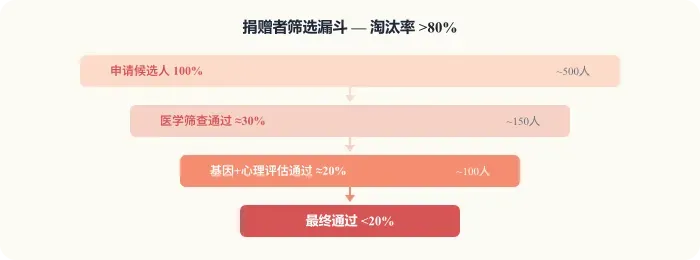
Donor egg IVF from $25,000 in the US and $8,000 in Malaysia. Donors under 35 deliver a 62% single-transfer pregnancy rate, rising above 80% cumulatively after two transfers. Donors are rigorously screened with a rejection rate over 80% (AMH > 3.0 ng/mL, AFC > 12). Licensed clinics in the US and Malaysia, strong legal protection, and full Chinese-language support throughout.
Get Your Personalized Plan
Free 1-on-1 evaluation by senior advisors
3,000+
Families Served
98%
Customer Satisfaction
2
Countries Covered
24h
Advisor Response Time
Why Choose This Service
Rigorous donor screening with a rejection rate above 80% (AMH > 3.0, AFC > 12)
62% single-transfer pregnancy rate with donors under 35, above 80% cumulative after two transfers
Complete genetic report covering 200+ inherited-condition carrier screens
Legal counsel safeguards both parties; California offers the strongest framework
Itemized costs locked in advance, with no hidden fees
Over 95% embryo thaw survival, thanks to mature vitrification
3,000+ families served; consultants respond in under 4 hours on average
Anonymous and known donation are both supported
What's Included
From pre-treatment evaluation to post-treatment follow-up, fully covered
Is This Service Right for You?
These groups will benefit the most from this service
Women with diminished ovarian reserve or no usable eggs (AMH < 0.5, diagnosed POF)
Men with severe oligospermia or azoospermia who need donor sperm
Families with a hereditary-disease risk who need donor gametes
Single individuals and same-sex couples building a family
Patients after 2 or more failed transfers where egg quality is the likely factor
Patients facing a 3-5 year donor-egg waiting list at home who want to start sooner
Process Steps
Standard procedure, subject to actual hospital plan
Free consultation and assessment
A senior consultant contacts you within 24 hours of your form submission for a 30-minute one-on-one review of your health, fertility history, and goals.
Personalized treatment plan
A detailed plan covering cost breakdown, recommended clinics and doctors, and an estimated timeline arrives within 3 business days, with no pressure to commit.
Donor matching and screening
Donors are shortlisted from the candidate pool against your preferences, with full profiles such as photos, education, genetic report, and family history; anonymous or known donation both supported.
Legal contract
A licensed reproductive attorney drafts the agreement defining both parties' rights; California law clearly secures parentage after birth.
Medical cycle
Donor stimulation and retrieval, ICSI fertilization and culture, PGT-A screening, and embryo transfer, while the recipient prepares her endometrium in parallel.
Pregnancy test and follow-up
A blood test 14 days after transfer confirms pregnancy; the consultant arranges your return home and provides a medication plan plus 3 months of remote follow-up.
Every situation is different
Our advisors tailor the most suitable plan based on your age, health and family-building goals
When You Are Facing These Challenges
Do any of these sound familiar?
- Repeated IVF failure — several transfers with no implantation, physically and emotionally drained, unsure what comes next
- Premature ovarian failure (POF) — AMH close to zero, and the doctor says donor eggs are the only realistic option
- Severe male-factor infertility — an oligospermia or azoospermia diagnosis that leaves a couple in long, anxious uncertainty
This is not the end of your path to parenthood. Donor egg IVF (third-party assisted reproduction) has helped millions of families worldwide build the family they wanted. According to the ASRM Third-Party Reproduction program, live-birth rates with rigorously screened young donor eggs are markedly higher than own-egg IVF in the same age group, and the recipient’s age stops being the limiting factor.
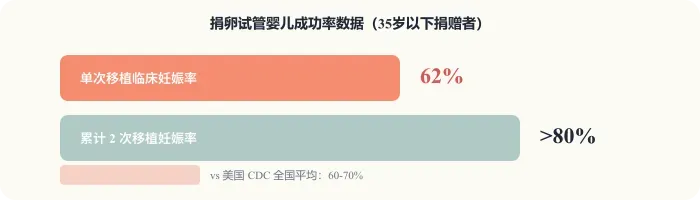
ProIVF clinical data: In 2024, families who completed donor-egg IVF through this platform reached a 62% single-transfer clinical pregnancy rate, with cumulative pregnancy above 80% after two transfers. Per the US CDC ART success-rate reports, donor eggs from donors under 35 reach cumulative live-birth rates of 60-70%.
US vs. Malaysia: Which Egg Donation Destination Fits You?
The two destinations differ most in legal protection, cost, and eligibility, so budget and family status usually decide. Below is a side-by-side comparison of the two programs we cover.
| Comparison | 🇺🇸 California, USA | 🇲🇾 Malaysia |
|---|---|---|
| Legality | Fully legal, the world’s most comprehensive legal framework | Legal, but with more restrictions |
| Total cost range | $25,000 - $45,000 | $8,000 - $15,000 |
| Waiting time | 2-6 weeks (egg banks match immediately) | 4-8 weeks |
| Anonymous / known donation | Both models supported | Generally anonymous |
| Donor profile | Detailed (photos, education, family history, genetic report) | Basic health profile |
| Eligibility | All applicants, including singles and same-sex couples | Generally married heterosexual couples only |
| Legal protection | Well-defined parental-rights law | Basic legal framework |
| Language support | Full Chinese interpretation | Partial Chinese support |
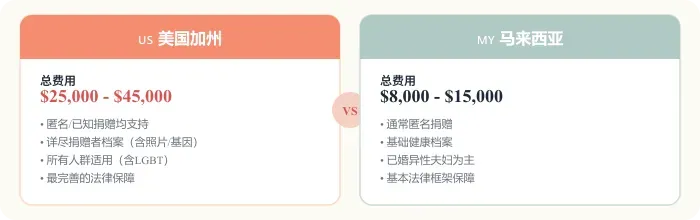
How to choose? If budget allows and you want the strongest legal protection and success rates, see our US fertility clinics. If budget is limited and you meet the married-couple requirement, our Malaysia fertility clinics offer strong value.
What Does Donor Egg IVF Cost?
A California donor-egg cycle totals $25,000-$45,000, and a Malaysia cycle about $8,000-$15,000, and every item is disclosed before you sign. We commit to full cost transparency with no hidden fees.
🇺🇸 California cost breakdown
| Item | Estimated amount |
|---|---|
| Donor compensation | $5,000 - $10,000 |
| Agency / matching fee | $3,000 - $6,000 |
| Egg retrieval + fertilization and culture | $8,000 - $12,000 |
| PGT-A genetic screening | $3,000 - $5,000 |
| Embryo transfer | $3,000 - $5,000 |
| Medication | $2,000 - $4,000 |
| Legal fees | $2,500 - $4,000 |
| Psychological counseling | $500 - $1,000 |
| Total | $25,000 - $45,000 |
🇲🇾 Malaysia cost breakdown
| Item | Estimated amount |
|---|---|
| Donor compensation | $1,000 - $3,000 |
| Egg retrieval + fertilization and culture | $4,000 - $6,000 |
| PGT-A genetic screening | $1,500 - $2,500 |
| Embryo transfer | $1,500 - $3,000 |
| Medication | $500 - $1,500 |
| Total | $8,000 - $15,000 |
💡 Money-saving tip: Frozen donor eggs from an egg bank cut part of the agency fee and shorten the cycle. Your consultant gives a precise, personalized quote during the free first consultation.
Cost is driven mainly by donor compensation, the clinic’s own pricing, whether PGT-A screening is added, and legal fees. Malaysia runs at roughly one-third of US cost, but legal protection and donor-profile depth differ. Before deciding, talk to a specialist about your situation to get an accurate estimate.
How Strict Is Donor Screening?
Every donor passes 8 categories and more than 40 checks, and fewer than 20% are ultimately accepted. Screening is what allows a 62% single-transfer pregnancy rate to hold across the program.
Medical screening
- Full physical exam and hormone panel (FSH, LH, E2, AMH)
- Transvaginal ultrasound for ovarian reserve, requiring an AFC above 12
- AMH above 3.0 ng/mL to ensure enough eggs per retrieval
- Karyotype analysis to rule out chromosomal abnormalities
- Expanded genetic carrier screening for over 200 conditions, detailed on our PGT genetic screening service
- Full infectious-disease panel (HIV, hepatitis B and C, syphilis, CMV, and more)
Non-medical assessment
- Psychological evaluation and professional counseling
- Verification of educational and intellectual background
- Detailed recording and matching of physical characteristics
- Three-generation family medical-history review
- Lifestyle and behavioral assessment
From Consultation to Pregnancy: The Full Process
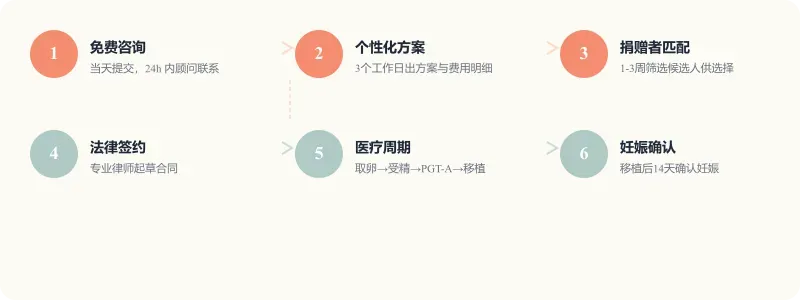
The standard journey runs 6-10 weeks across six steps, from the first call to a confirmed pregnancy. Each stage below has a defined owner and timeline.
- Free consultation (same day) → a consultant contacts you within 24 hours for a 30-minute one-on-one assessment
- Personalized plan (3 business days) → a detailed plan with costs and recommended clinics and doctors, such as our IVF full package
- Donor matching (1-3 weeks) → candidates are shortlisted to your requirements and full profiles are provided
- Legal contract → a licensed reproductive attorney drafts the agreement and defines both parties’ rights
- Medical cycle (4-6 weeks) → donor stimulation and retrieval, ICSI fertilization, blastocyst culture over 5-6 days, PGT-A screening, and embryo transfer, with the recipient preparing her endometrium in parallel
- Pregnancy confirmation → a blood test 14 days after transfer, followed by ongoing tracking to stable pregnancy
What Are the Real Success Rates for Donor Eggs?
The biggest advantage of donor eggs is that success barely depends on recipient age: with donors under 35 the single-transfer clinical pregnancy rate is about 62%. The tables below separate outcomes by recipient age and report platform-wide results.
Live-birth rate by recipient age
| Recipient age | Own-egg IVF live birth | Donor-egg IVF live birth | Source |
|---|---|---|---|
| Under 35 | 40-50% | 60-70% | SART 2022 |
| 35-37 | 30-40% | 58-65% | CDC ART 2023 |
| 38-40 | 20-25% | 55-62% | CDC ART 2023 |
| 41-42 | 10-15% | 50-58% | SART 2022 |
| 42-44 | 5-8% | 45-55% | ASRM 2023 practice guideline |
Per the ASRM Third-Party Reproduction program and the CDC ART Success Rates report (2023), donor-egg live-birth rates are set mainly by donor age (typically under 30) and screening standards rather than recipient age, with no statistically significant difference among recipients under 42.
Platform-wide results
| Metric | Data |
|---|---|
| Families served to date | 3,000+ |
| Donor screening rejection rate | Over 80% |
| Average donor AMH | Above 3.0 ng/mL |
| Average donor AFC | Above 12 |
| Average eggs retrieved | 15-20 |
| Single-transfer pregnancy rate (donors under 35) | 62% |
| Cumulative pregnancy rate (2 transfers) | Above 80% |
| Embryo thaw survival rate | Above 95% |
| Average consultant response time | Under 4 hours |
Sources: clinical data above draw on the US CDC ART Success Rates, the ASRM Third-Party Reproduction program, and the SART annual report (2022). Individual results vary with uterine environment and embryo quality.
Donor Sperm Program
Alongside donor eggs, ProIVF offers donor sperm (third-party sperm donation) for families where male-factor infertility is the barrier, with IUI cycles from about $1,500.
Who it helps
- Severe oligospermia or azoospermia, where TESA or PESA still yields no usable sperm
- Male carriers of single-gene disorders such as thalassemia or SMA, to avoid passing them on
- Single women and same-sex couples conceiving through IUI or IVF with donor sperm
- Repeated IVF fertilization failure suspected to be sperm-related
Process and cost
| Item | IUI (insemination) | IVF |
|---|---|---|
| Cycle length | 2-4 weeks | 4-6 weeks |
| Sperm sample cost | $500-1,500 | $500-1,500 |
| Medical cost | $800-2,000 | $10,000-18,000 |
| Total cycle cost | $1,500-3,000 | $12,000-20,000 |
| Per-cycle success rate | 10-20% | 50-65% (donor sperm + PGT-A) |
Sperm donor screening
Sperm donors meet the same standard as egg donors: a full physical exam, karyotype analysis, carrier screening for over 200 conditions, infectious-disease testing, and psychological evaluation. Profiles are browsable online and cover height, blood type, education, occupation, family history, and childhood photos. For the combined donor-sperm and IVF workflow, see our IVF full package.
Real Patient Stories
All cases below are anonymized and published with the patients’ consent.
Case 1: Age 41 with POF, one California donor-egg transfer
Li, 41, Shanghai — After three failed own-egg IVF attempts at home due to premature ovarian failure (AMH below 0.1), Li chose a ProIVF California donor-egg plan in 2024; matching to transfer took about 5 months.
| Detail | Information |
|---|---|
| Destination | California, USA |
| Donor age | 26, passed all medical and non-medical screening |
| Total cost | About $38,000 |
| Eggs retrieved | 16 mature eggs, 12 fertilized, 6 blastocysts |
| PGT-A result | 3 chromosomally normal embryos |
| Outcome | First frozen-transfer succeeded; healthy baby delivered |
“I hesitated for a long time about donor eggs, afraid a child not genetically mine would feel like a stranger. But looking at my baby now, all I want to say is thank you to that brave young woman, and thank you to myself for not giving up. Blood is not the only bond; love is.”
Case 2: Age 34 with azoospermia, donor-sperm IVF in Malaysia
Zhang and his wife, 34 and 32, Guangzhou — After 3 years of infertility, the husband was diagnosed with non-obstructive azoospermia (NOA) and TESA retrieved no sperm. The couple chose a ProIVF Malaysia donor-sperm plus IVF plan.
| Detail | Information |
|---|---|
| Destination | Malaysia |
| Donor | Chinese-heritage donor, master’s degree, passed all genetic screening |
| Total cost | About $14,500 |
| Eggs retrieved (wife) | 12 mature eggs, 9 fertilized, 5 blastocysts |
| PGT-A result | 4 chromosomally normal embryos |
| Outcome | First transfer succeeded; a healthy girl delivered at 38 weeks, weighing 3,150 g |
“When we learned we would use donor sperm, I worried how our child would feel growing up. The doctor and counselor guided us through it step by step. Holding her now, I know that being a good father is what matters.”
Case 3: Age 36 with low reserve, fast egg-bank matching
Wang, 36, Shenzhen — With an AMH of 0.8 ng/mL and endometriosis cysts removed from both ovaries, her own-egg quality was rated poor, so she chose frozen donor eggs from a US egg bank to take the shortest path.
| Detail | Information |
|---|---|
| Plan | US egg bank (frozen donor eggs) |
| Matching time | 1 week (instant egg-bank match) |
| Total cost | About $29,500, saving part of the agency fee |
| Eggs used | 6 donor eggs, 5 fertilized, 3 blastocysts |
| PGT-A result | 2 euploid embryos |
| Cycle length | 3 weeks, no need to coordinate a donor schedule |
“I am extremely busy and could not spend months abroad. The egg-bank plan suited me perfectly; everything was settled in about 2 weeks, and I stayed under 2 weeks total for the transfer itself.”
Legal Protection
Parentage and donor rights are settled by contract and law before any cycle begins. The two destinations differ in strength of framework.
- California, USA: the world’s most comprehensive third-party-reproduction legal system, with donor rights and obligations clearly defined and parentage registered directly at birth
- Malaysia: operates within a legal framework, generally limited to married heterosexual couples, with basic contract protection
- All donations are governed by legal contracts reviewed by licensed reproductive attorneys to protect every party
Recipient Questions
Will my child look like me?
Half the child’s genes come from the father and half from the donor, so a real family resemblance is planned, not left to chance. Matching prioritizes blood-type compatibility first, then your preferences for appearance, build, height, and education, and donor childhood photos and family-trait records are available to set accurate expectations.
What preparation does the recipient need?
Preparation takes about 2-4 weeks and is guided throughout by your consultant. Your doctor arranges a hysteroscopy and an HSG to confirm a healthy uterine cavity and lining, then medication begins on day 5 of your cycle to optimize conditions for implantation.
Can donor eggs be frozen?
Yes. Vitrification is the most mature egg-freezing technology, with thaw-survival rates above 95%. Choosing frozen donor eggs from an egg bank both shortens the wait and lowers the total cost.
What to Consider Before Choosing Donor Eggs
Donor-egg IVF has the highest success of any third-party path, but it carries fixed limits you should weigh before deciding.
- No guarantee of a live birth: donor eggs greatly outperform own eggs, yet each transfer still carries uncertainty, and PGT-A lowers but cannot eliminate chromosomal-anomaly risk
- Legal complexity: rules differ widely by country, and some jurisdictions need extra steps to confirm parentage, so assess legal risk before starting
- Psychological adjustment: families using donor gametes may wrestle with the idea of genetic connection, so counseling from the decision stage onward is recommended
- No guaranteed embryo count: even a screened donor can yield a limited number of euploid embryos after fertilization, blastocyst formation, and PGT-A, so extra transfers or cycles may raise total cost
- Cost risk: one cycle does not buy one success, and repeated transfers or additional cycles can exceed the estimate
- A child’s future right to know: some countries allow open donation, where a child can access donor information at adulthood, so factor this into the model you choose
Before deciding, consult a specialist for a one-on-one assessment and weigh the limits above.
Your Concerns, Addressed
“Is my privacy safe?” Personal data is stored with bank-level encryption, donor profiles are visible only after signing, and a strict confidentiality agreement covers the whole process.
“How big is the legal risk?” A licensed reproductive attorney is assigned in every country we serve, all donor arrangements run through formal contracts, and California law clearly protects parentage after birth.
“Will there be hidden fees?” You receive an itemized fee list before signing and every charge is transparent. We promise zero add-ons beyond the contract.
“What about the psychological pressure?” A professional counselor supports you from the decision phase through postpartum, helping your family move steadily through each stage.
“What if it does not work?” If the first transfer fails, your consultant reviews the cause and adjusts the plan. Because donor eggs usually yield several euploid embryos, most patients have frozen embryos for a second transfer, many clinics discount it, and cumulative pregnancy after 2 transfers exceeds 80%.
About This Article
This page was written by the ProIVF Medical Editorial Team and reviewed by the ProIVF Medical Advisory Board, drawing on peer-reviewed research and authoritative clinical guidelines:
- American Society for Reproductive Medicine (ASRM), Third-Party Reproduction Practice Committee Guidance (Fertility and Sterility, 2023)
- US Centers for Disease Control and Prevention (CDC), ART Success Rates annual report (2023)
- Society for Assisted Reproductive Technology (SART), annual report (2022)
- European Society of Human Reproduction and Embryology (ESHRE), PGT Consortium 19th Annual Report (2023)
- “Outcomes of donor egg IVF: a systematic review and meta-analysis.” Human Reproduction Update, 2023
- “Oocyte donation across age groups: SART CORS database analysis.” Fertility and Sterility, 2022
- “Psychological outcomes of families conceived through oocyte donation: a 20-year follow-up.” Human Reproduction, 2023
All clinical figures are sourced, and all cases are anonymized with patient consent. This content is reviewed for accuracy, balance, and evidence-based practice.
Data updated: July 13, 2026. This article is for general information only and is not medical advice; consult a licensed fertility specialist about your specific case. Success figures are multi-center reference ranges and vary with donor quality, uterine environment, and embryo quality. Cost figures are multi-center reference ranges and vary with your protocol, country, and chosen clinic. ProIVF recommends confirming current pricing directly with your target clinic before deciding.
Before vs After: Data Comparison
The following comparison shows key metrics before and after using this service, sourced from peer-reviewed clinical studies
Single-transfer clinical pregnancy rate (recipient under 35)
Source:SART 2022 / CDC ART 2023
Cumulative pregnancy rate (2 transfers)
Source:ASRM 2023
How much age affects success
Source:With own eggs, success drops over 40% after 40; donor eggs are largely unaffected by recipient age
Chance of a euploid embryo (per cycle)
Source:ESHRE PGT Consortium 2023
Average eggs retrieved
Source:Donor average versus own eggs at age 39 and above
FAQ
Common questions about Egg & Sperm Donation Program
How are egg donors screened, and how strict is the process?
How much does donor egg IVF cost?
Is egg donation legal, and should we choose the US or Malaysia?
What is the success rate with donor eggs?
Is donation anonymous, or can we meet the donor?
How long does the whole process take?
How does the donor sperm process work, and what does it cost?
What happens after I submit a consultation request?
What if the first transfer does not succeed?
Still have questions?
Talk to a specialist for personalized answersYou May Also Need
Other services related to Egg & Sperm Donation Program
Egg & Embryo Freezing
Elective egg and embryo freezing with vitrification technology that buys women time. Ideal for delaying parenthood for age, career or medical reasons — mature, proven technique with post-thaw survival rates above 95%.
View DetailsEmbryo Genetic Screening (PGT-A & PGT-M)
Preimplantation genetic testing (PGT-A / PGT-M) that screens all 23 chromosome pairs and 200+ single-gene disorders before transfer. It lowers miscarriage from 30% to under 5%, blocks inherited disease, and is the key technology behind higher IVF success.
View DetailsComplete IVF Package with PGT-A Screening
A one-team IVF journey from first consultation to a positive pregnancy test — medical care, housing, transfers, and interpreters included. Built on third-generation PGT-A screening (chromosome accuracy ≥99.8% on NGS), 65-75% single-transfer success under age 35, and a miscarriage rate cut from 25% to below 5% (ASRM 2023). Covers top fertility clinics in the USA, Malaysia, and Thailand.
View DetailsGestational Surrogacy Program
Safe, legal and transparent gestational surrogacy in the four most established destinations: California (USA), Georgia, Mexico and Colombia. California offers the world's most complete legal framework — commercial surrogacy is fully legal, a Pre-Birth Order secures the intended parents' rights, and the baby is a US citizen at birth. Georgia and Mexico deliver the same journey at roughly half the US cost.
View DetailsRecommended hospitals
Top-rated reproductive centers offering this service
Banafsheh (Bana) Kashani, MD - Fertility and IVF Specialist
Aliso Viejo, California
Carolinas Fertility Institute - Charlotte #2
Charlotte, North Carolina
Ever-Link Fertility Centre (GenPrime Everlink)
Shah Alam, Selangor
Aspire Fertility - Alamo Heights
San Antonio
IVcare Fertility
Petaling Jaya, Selangor
New Direction Fertility Centers - Scottsdale
Scottsdale, Arizona
Ready to learn about your personalized plan?
Get a free evaluation from our advisors and a tailored fertility plan