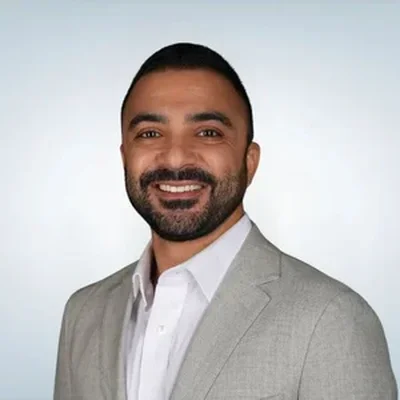

About
Eastern Virginia Medical School is home to the Jones Institute, where the first baby in the United States was conceived through IVF. Dr. Hadi Ramadan spent his residency years doing research inside that program, collected the institution’s top resident research prize, and was inducted into Alpha Omega Alpha — an honor society that admits a small fraction of each medical class. Most physicians carry one such line; his 2020 and 2021 award list runs to seven, spanning research, general gynecology, gynecologic oncology and minimally invasive surgery.
His training began elsewhere and in a different specialty area entirely. He took his MD at the American University of Beirut, then spent two years at the University of Chicago working on the pathophysiology of preeclampsia. That obstetric-cardiology period accounts for a cluster of early papers in Hypertension, Pregnancy Hypertension and Hypertension in Pregnancy, including work on cardiac strain in chronically hypertensive women and on cardiogenic shock in pregnancy. He closed the loop with an REI fellowship at Massachusetts General Hospital and Harvard Medical School.
As a specialist he turned to the questions at the other end of the IVF cycle: whether freezing compromises outcomes (his 2022 Scientific Reports paper found cryopreservation does not affect the clinical pregnancy rate of blastocysts derived from vitrified oocytes), how trophectoderm grade predicts early beta-hCG rise, whether endometrial and sub-endometrial blood flow can flag uterine receptivity, and how ICSI results with testicular sperm differ between obstructive and non-obstructive azoospermia across the SART CORS registry. He practices at Boston IVF’s Downtown Boston and Westborough centers and consults in Arabic. ProIVF also lists him under its Waltham page because of his network membership; his own published in-person consult site is Downtown Boston.
Clinical Expertise
- PCOS and stimulation: He names PCOS as a research focus, which in practice means protocol selection and ovarian hyperstimulation risk managed from the evidence rather than by default dose.
- Fertility preservation: Oocyte cryopreservation and the outcomes after it, plus earlier survey work on what students and young women actually understand about elective egg freezing.
- Embryo transfer technique: Transfer mechanics, culture conditions and receptivity markers are declared research interests — the narrow margin between a chromosomally normal embryo and a pregnancy.
- IVF and ICSI: Full cycle management, including registry analysis of testicular-sperm ICSI outcomes by azoospermia type and by maternal and paternal age.
- Medical background in pregnancy hypertension: Years of preeclampsia and cardiac research translate into careful risk framing for patients with hypertension or other medical conditions who are pursuing pregnancy.
Why Choose Dr. Ramadan
Research done at the origin site of American IVF. The Jones Institute is where the technique was first proved in the United States, and his awards there were for that work. It shows up in a publication record that keeps returning to lab-and-procedure details rather than general outcome reporting.
Breadth that a single certificate does not show. Best Gynecology Resident, Best Gynecologic Oncology Resident, and recognition of excellence in minimally invasive gynecology in the same two-year span describe a surgeon’s training alongside the reproductive endocrinology fellowship — relevant for patients whose infertility has a fibroid, endometriosis or adnexal component.
He has published on the questions patients ask last. Does freezing the eggs reduce the chance that the resulting embryo implants? Does the grade of the embryo’s outer cell layer matter for the hormone rise in early pregnancy? Does scraping during retrieval change how many eggs are recovered? Each of these is a paper, not a brochure line.
Care in Arabic, at two sites. Arabic-language consultation, in-person at Downtown Boston and Westborough, with telehealth open to patients anywhere in Massachusetts.
Professional Affiliations
Double board-certified by the American Board of Obstetrics and Gynecology in Obstetrics and Gynecology and in Reproductive Endocrinology and Infertility. He reports at ASRM, AAGL, PCRS, SRI and ISSHP meetings, with papers in Fertility and Sterility, Journal of Assisted Reproduction and Genetics, Scientific Reports, Reproductive Sciences, Archives of Gynecology and Obstetrics, Fertility Research and Practice, Hypertension, Pregnancy Hypertension and Hypertension in Pregnancy.
Suitable For
- PCOS patients comparing stimulation protocols, particularly those worried about overstimulation and cycle cancellation.
- Patients freezing eggs or embryos before cancer treatment — or before delaying childbearing — who want outcome data rather than reassurance.
- Arabic-speaking families, where history, medication and prior treatment details come through without a translator in the room.
- Patients with a failed transfer or two, who want the technique, culture environment and receptivity assessment discussed as variables rather than accepted as fixed.
- Downtown Boston and Metro West residents, since he sees patients at both the city center and Westborough, and telehealth covers the state.