IVF success rates after 35 decline in a predictable, measurable way — 35–40% live birth per cycle at 35–37 versus 5–10% over 42 — but six strategies (acting early, protocol matching, PGT-A, supplementation and more) lift cumulative three-cycle success to 60–70% for women in their mid-30s. This guide covers what actually changes with age, what the numbers mean for you, and which interventions are evidence-based.
“The older a woman is, the longer it generally takes to conceive.” — American Society for Reproductive Medicine, ASRM, Aging and Women’s Reproductive Health patient FAQ
Why Does Fertility Decline After 35?
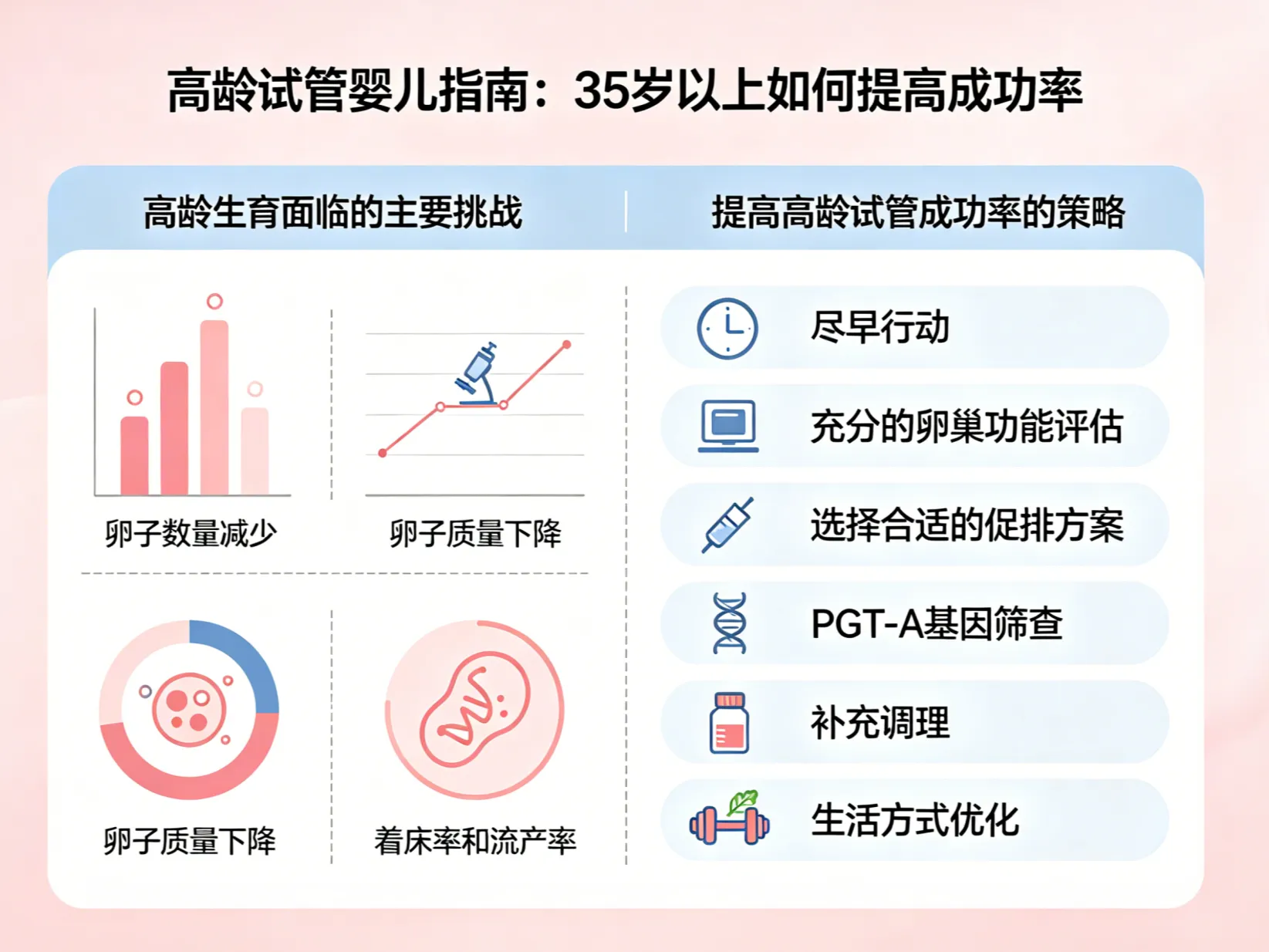
Three biological changes drive every statistic in this article: fewer eggs, more chromosomally abnormal eggs, and lower implantation with higher miscarriage.
1. Egg Quantity Falls Steeply
A female is born with roughly 1–2 million eggs, but only about 25,000 remain by age 35 and around 5,000 by 40. Lower ovarian reserve means fewer eggs retrieved per IVF cycle stimulation.
2. Egg Quality Declines Through Chromosomal Errors
The share of eggs with normal chromosomes drops sharply with age, and that single fact explains most of the success-rate curve:
| Age | Normal Chromosomes | Abnormal Chromosomes |
|---|---|---|
| 30 | ~70% | ~30% |
| 35 | ~55% | ~45% |
| 38 | ~40% | ~60% |
| 40 | ~30% | ~70% |
| 42+ | <20% | >80% |
3. Implantation Drops and Miscarriage Rises
Implantation rates fall as embryo chromosomal normality falls, while miscarriage climbs from about 20% at 35 to roughly 40% at 40. Pregnancy complications such as gestational diabetes and hypertension also become more common, which is why obstetric monitoring intensifies after 35.
What Are the Real IVF Success Rates by Age?
Your age group sets the baseline: live birth per single IVF cycle runs from 35–40% at 35–37 down to 5–10% over 42.
| Age Group | Live Birth per Cycle | Cumulative (3 Cycles) |
|---|---|---|
| 35–37 | 35–40% | 60–70% |
| 38–40 | 20–30% | 45–55% |
| 41–42 | 10–18% | 25–35% |
| 42+ | 5–10% | 15–20% |
Note: transferring PGT-A screened, chromosomally normal embryos yields significantly higher results than these own-egg averages.
For the public datasets behind this pattern of age-stratified reporting, the CDC’s ART success rates programme and the SART national summary publish outcomes by age band for every US clinic.
How Can You Improve IVF Success Over 35?
Six strategies carry the most weight, in order of impact — start with time, then testing, protocol, screening, supplementation and lifestyle.
1. Start Sooner
Time is the most valuable asset in this entire guide: every year of delay costs roughly 5–10% of success. If you have decided on IVF, begin the work-up now rather than after more “natural attempts.”
2. Complete a Full Ovarian Assessment First
Before your first stimulation, document reserve and reversible factors:
- AMH — ovarian reserve marker; read our low-AMH IVF guide if it comes back low
- Baseline FSH and estradiol (E2) — measured on cycle days 2–3
- Antral follicle count (AFC) — ultrasound count of recruitable follicles
- Thyroid function and vitamin D — both influence implantation
3. Match the Stimulation Protocol to Your Reserve
Protocol choice matters more over 35, because ovaries respond unevenly:
| Protocol | Characteristics | Best For |
|---|---|---|
| Antagonist | Shorter, lower medication dose | Diminished reserve |
| Mild stimulation | Low-dose medication | Very low reserve |
| Natural cycle | No medication | Extremely low reserve |
| DuoStim | Two retrievals in one cycle | Time-pressed, low reserve |
4. Consider PGT-A Screening — Strongly Recommended
For women over 35, preimplantation genetic testing for aneuploidy is close to essential because abnormality rates are high.
- Selects chromosomally normal (euploid) embryos before transfer
- Euploid embryo transfer success reaches 55–70%, far less age-dependent
- Substantially reduces miscarriage per transfer
- Avoids the time, cost and grief of transferring embryos that cannot implant
See our PGT genetic screening guide for what PGT-A can and cannot do.
5. Supplement 3–6 Months Before Starting
Evidence supports a pretreatment window of three to six months:
| Supplement | Daily Dose | Proposed Effect |
|---|---|---|
| Coenzyme Q10 | 200–600 mg | Supports egg mitochondrial function |
| DHEA | 25–75 mg | May improve ovarian response |
| Folic acid | 400–800 mcg | Prevents neural tube defects |
| Vitamin D | 2,000–4,000 IU | Supports endometrial receptivity |
| Omega-3 | 1,000–2,000 mg | Anti-inflammatory, blood flow |
Important: take all supplements only under your reproductive doctor’s direction — doses above assume a clinician has confirmed they suit your case.
6. Optimise Lifestyle Foundations
- Exercise: 3–4 moderate sessions weekly — yoga, swimming, brisk walking
- Diet: Mediterranean pattern — vegetables, fish, olive oil
- Sleep: 7–8 hours of quality sleep
- Stress: meditation, breathing work, counselling where needed
Should You Bank Embryos or Consider Donor Eggs?
Two structural strategies answer low egg yield and poor egg quality respectively.
Embryo Banking for Low Reserve
For older patients with few follicles, a common plan is:
- Complete 2–3 stimulation and retrieval cycles first
- Test the pooled embryos together with PGT-A
- Transfer the single best euploid embryo when the lining is ready
When Donor Eggs Become the Better Path
If repeated cycles produce no euploid embryos, donor eggs bypass the age problem entirely because the eggs come from a younger donor.
- US donor-egg programmes achieve 50–60% success per transfer, linked to donor age
- Thailand and Malaysia also offer donor programmes at lower cost
- China has scarce donor eggs and long waiting lists, which pushes many patients overseas
How Do You Prepare Mentally?
Set expectations before starting: IVF over 35 often takes multiple cycles, not every transfer succeeds, and a Plan B — donor eggs or adoption — protects you from a dead-end mindset.
Build the support system early: honest communication with your partner, a fertility peer community, and professional counselling whenever the emotional load stops being manageable.
FAQ
Q: Can I do IVF at 45 with my own eggs?
Technically yes, but own-egg success is below 5% per cycle at that age, so most specialists recommend donor eggs instead. Pregnancy complications also rise sharply after 45, requiring close obstetric monitoring throughout.
Q: How many IVF cycles will I need over 35?
It varies by age band: 35–37 averages 1–2 cycles, 38–40 typically needs 2–3, and over 40 often requires 3 or more. PGT-A reduces the number of wasted transfers by screening embryos first.
Q: Are babies conceived after 35 healthy?
Yes — babies born after 35 from PGT-A screened euploid embryos show health outcomes comparable to naturally conceived babies. Because screening removes chromosomally abnormal embryos before transfer, birth-defect risk from aneuploidy is actually lowered.
Q: What is the miscarriage risk at 40?
Miscarriage climbs to roughly 40% at age 40, versus about 20% at 35, driven mainly by embryo chromosomal abnormality. Transferring a PGT-A euploid embryo is the most effective way to cut that number.
Q: How many eggs remain at 35 and 40?
Approximately 25,000 remain at 35 and about 5,000 at 40, down from 1–2 million at birth. Fewer recruitable follicles means fewer eggs retrieved per stimulation cycle.
Q: Does PGT-A guarantee a euploid transfer will work?
No, but it moves the odds decisively: euploid embryo transfer success is 55–70% depending on age, compared with 5–40% for unscreened embryos across the age bands above.
The Bottom Line on IVF After 35
Age is the dominant variable in IVF, but it is not a verdict — cumulative success of 60–70% within three cycles is realistic at 35–37, and PGT-A plus the right protocol keep outcomes meaningful into the early 40s. The three decisions that matter most are starting now, choosing a clinic experienced with advanced maternal age, and agreeing in advance when to switch strategy.
Compare experienced clinics in our hospital directory or contact our advisory team for a personalised assessment.
About this article: researched and written by the ProIVF Medical Editorial Team following Google E-E-A-T health content guidelines and reviewed by the ProIVF Medical Advisory Board. Success-rate figures are population-level references, not predictions of individual outcome — confirm your personal prognosis with a reproductive endocrinologist. This article is for informational purposes only and is not medical advice. Editorial standards: ProIVF About page. Last updated: 2026-09-20.