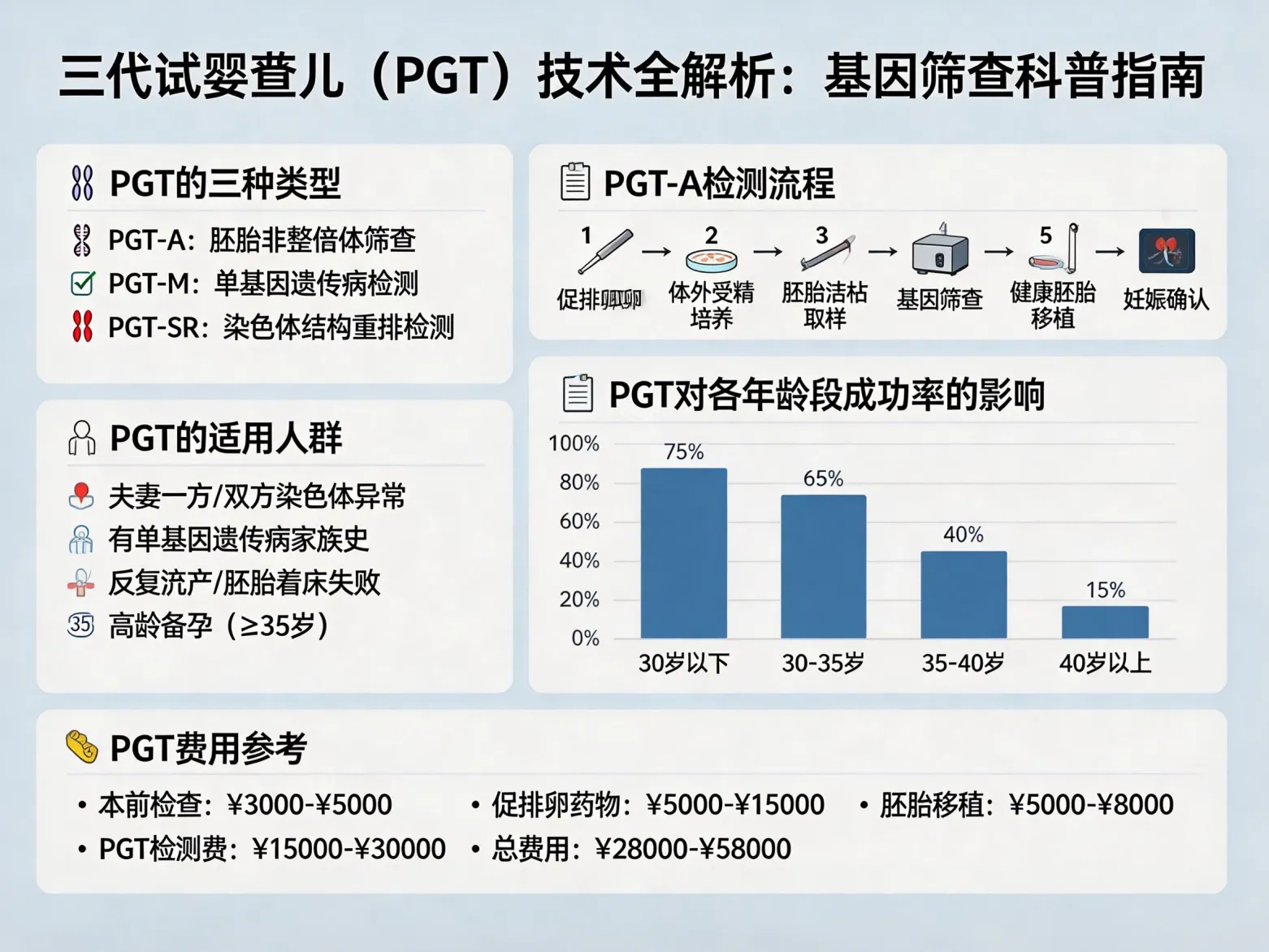
Preimplantation genetic testing (PGT) screens IVF embryos before transfer, and screened (euploid) embryo transfers reach 45-55% success even for women over 40 versus 10-18% for unscreened transfers. This guide compares PGT-A, PGT-M, and PGT-SR, walks through the biopsy workflow and its ~98% accuracy limit, and lists costs by country.
What Do PGT-A, PGT-M, and PGT-SR Each Test For?
PGT is the umbrella term for genetic testing of embryos before transfer — the technology behind what Chinese patients call “third-generation IVF.” The three variants answer different questions for different families.
| Type | Full Name | What It Detects | Who It’s For |
|---|---|---|---|
| PGT-A | Aneuploidy Screening | Abnormal chromosome number | Advanced age, repeated failure, recurrent miscarriage |
| PGT-M | Monogenic Disease Testing | Specific inherited disease genes | Couples carrying a known genetic disorder |
| PGT-SR | Structural Rearrangement Testing | Chromosome structure defects | Balanced translocation carriers |
Screening embryos before transfer raises the success rate of each IVF cycle, cuts miscarriage risk, and prevents transmission of inherited disease.
What Is Chromosomal Aneuploidy?
Humans have 23 pairs — 46 chromosomes — and aneuploidy means any deviation from that number:
- Trisomy: one extra chromosome (Trisomy 21 causes Down syndrome).
- Monosomy: one missing chromosome.
- Most aneuploid embryos cannot develop to term and account for the majority of early pregnancy loss.
How Does the PGT-A Procedure Work?
PGT-A adds a biopsy and a lab wait to a standard IVF cycle but does not change the stimulation itself. The six-step workflow:
- Embryo culture to blastocyst — day 5-6 of development.
- Trophectoderm biopsy — 5-10 outer-layer cells are removed; the inner cell mass that becomes the fetus is untouched.
- Cryopreservation — biopsied embryos are frozen while testing proceeds.
- NGS sequencing in a genetics laboratory.
- Results in 7-14 days.
- Euploid embryo selected for frozen transfer.
How Are PGT-A Results Classified?
| Result | Meaning | Transfer Recommendation |
|---|---|---|
| Euploid (normal) | 46 chromosomes, balanced | Recommended for transfer |
| Aneuploid (abnormal) | Missing or extra chromosome | Not transferred |
| Mosaic | Mix of normal and abnormal cells | Requires specialist evaluation; cautious transfer |
Mosaic interpretation remains debated, which is one reason PGT-A accuracy is about 98% rather than 100%.
What Is PGT-M and Who Needs It?
PGT-M tests embryos for a specific single-gene disease when both partners carry the mutation. Conditions commonly screened include:
- Thalassemia
- Cystic fibrosis
- Spinal muscular atrophy (SMA)
- Hemophilia
- Huntington’s disease
The PGT-M pathway: both partners first confirm carrier status by genetic testing; the lab then builds a custom assay for that family over roughly 2-4 weeks; embryos are biopsied and tested against that assay; and only embryos free of the disease genotype are transferred. Because custom design is required, PGT-M costs more than PGT-A in every country.
Who Should Consider PGT?
PGT is strongly recommended when the chance or consequence of an abnormal embryo is high:
- Female age 35 or older
- Recurrent pregnancy loss — 2 or more miscarriages (see our recurrent pregnancy loss IVF guide)
- Recurrent implantation failure — 3 or more failed transfers
- Either partner carries a chromosomal structural abnormality
- A clear family history of genetic disease
Reasonable but optional cases: wanting fewer transfer attempts per baby, sex selection where legally permitted, and the reassurance of knowing an embryo is chromosomally normal. In the UK, social sex selection is prohibited — the HFEA permits sex selection only to avoid serious sex-linked disease.
Does PGT-A Improve Success Rates at Every Age?
Transferring a tested-euploid embryo raises per-transfer success to 45-55% even after 40, versus 10-18% without screening. The full comparison:
| Age Group | Transfer Without PGT | Euploid Embryo Transfer With PGT |
|---|---|---|
| Under 35 | 40-50% | 60-70% |
| 35-37 | 35-40% | 55-65% |
| 38-40 | 25-30% | 50-60% |
| Over 40 | 10-18% | 45-55% |
Unscreened baselines follow national reporting such as the CDC ART success rates and SART databases.
“The ART Success Rates national database contains pregnancy and birth results from clinics performing assisted reproductive technology (ART) procedures in the United States.” — U.S. Centers for Disease Control and Prevention (CDC), Assisted Reproductive Technology Success Rates report, 2024
The key finding: PGT-A pulls success rates for older women close to those of younger patients, because the embryo transferred is known to be chromosomally normal. It does not, however, create more embryos — see our advanced maternal age IVF guide for how age still shapes the starting egg pool.
How Much Does PGT Cost by Country?
PGT-A testing runs $3,000-$5,000 in the United States and $1,500-$3,000 in Thailand, before IVF cycle costs.
| Country/Region | PGT-A Cost | PGT-M Cost |
|---|---|---|
| United States | $3,000 - $5,000 | $5,000 - $8,000 |
| Thailand | $1,500 - $3,000 | $3,000 - $5,000 |
| Malaysia | $1,500 - $2,500 | $3,000 - $4,500 |
| Japan | $2,000 - $3,500 | $4,000 - $6,000 |
PGT-M is consistently more expensive because each family needs a custom-built assay.
Is PGT Safe for the Embryo?
Yes on current evidence: biopsies are performed by experienced embryologists with minimal damage to the embryo, large studies confirm PGT does not increase birth-defect risk, and post-biopsy embryos survive freezing at rates above 95%.
What Are the Limitations?
- Accuracy is about 98%, not 100% — a normal result does not guarantee a healthy child.
- Mosaic results are genuinely ambiguous and still debated.
- Some embryos return “no result” and may need re-biopsy.
- Testing adds time and cost to the treatment timeline.
- Only embryos reaching blastocyst (day 5-6) can be biopsied, so not every embryo is testable.
FAQ
Q: How is third-generation IVF different from first and second generation?
Generation 1 (standard IVF) lets sperm and egg fertilize together in the dish. Generation 2 (ICSI) injects a single sperm into each egg for male-factor infertility.
Generation 3 (PGT) adds genetic screening on top of either — the three are stacked layers, not replacements.
Q: Does PGT-A destroy usable embryos?
No — PGT-A only identifies which embryos are chromosomally abnormal; it destroys none. In older patients a higher share of embryos are aneuploid, so fewer remain transferable, but that spares you transfers whose unscreened success is only 10-18% after 40.
Q: Can you have PGT in mainland China?
Mainland China permits PGT only with medical indications — such as 2 or more miscarriages or a confirmed hereditary disease — and social sex selection is prohibited. Clinics in the United States, Thailand, Malaysia, and Japan apply fewer restrictions, which is why many Chinese patients test abroad.
Q: How long does PGT testing take?
Results arrive 7-14 days after the day 5-6 biopsy. Because of that wait, PGT cycles virtually always use frozen embryo transfer in a later cycle.
Q: Does a normal PGT result guarantee a healthy baby?
No. PGT-A accuracy is about 98% and it screens chromosome number and targeted genes, not every possible condition.
A euploid transfer still carries the normal background risk of miscarriage and pregnancy complications.
Q: Which is cheaper, PGT-A or PGT-M?
PGT-A: $3,000-$5,000 in the US versus $5,000-$8,000 for PGT-M, whose custom family assay drives the price up. Thailand is roughly half US pricing for both tests.
Is PGT Worth It for You?
PGT is one of the most consequential advances in assisted reproduction: for women over 35 and families carrying genetic disease, it converts uncertain transfers into targeted ones, lifting per-transfer success to 45-70% depending on age while adding roughly 1-2 weeks and $1,500-$8,000 in lab costs. The decision comes down to your age, embryo number, and genetic risk — a clinic with an in-house PGT laboratory can model all three for your case.
Compare accredited programs with on-site genetics labs in our IVF hospital directory, or contact our team for a screening second opinion. For a deeper technical comparison of biopsy and sequencing options, see our embryo testing guide.
About this article: Researched and written by the ProIVF Medical Editorial Team based on ASRM and ESHRE preimplantation genetic testing guidance and national ART outcome data, and reviewed by the ProIVF Medical Advisory Board. Learn about our editorial standards on our About page.
Last updated: 2026-09-20. This article is for informational purposes only and does not constitute medical advice. Testing indications, accuracy, and legality vary by country and individual history — consult a qualified reproductive endocrinologist or genetic counselor about your own situation.