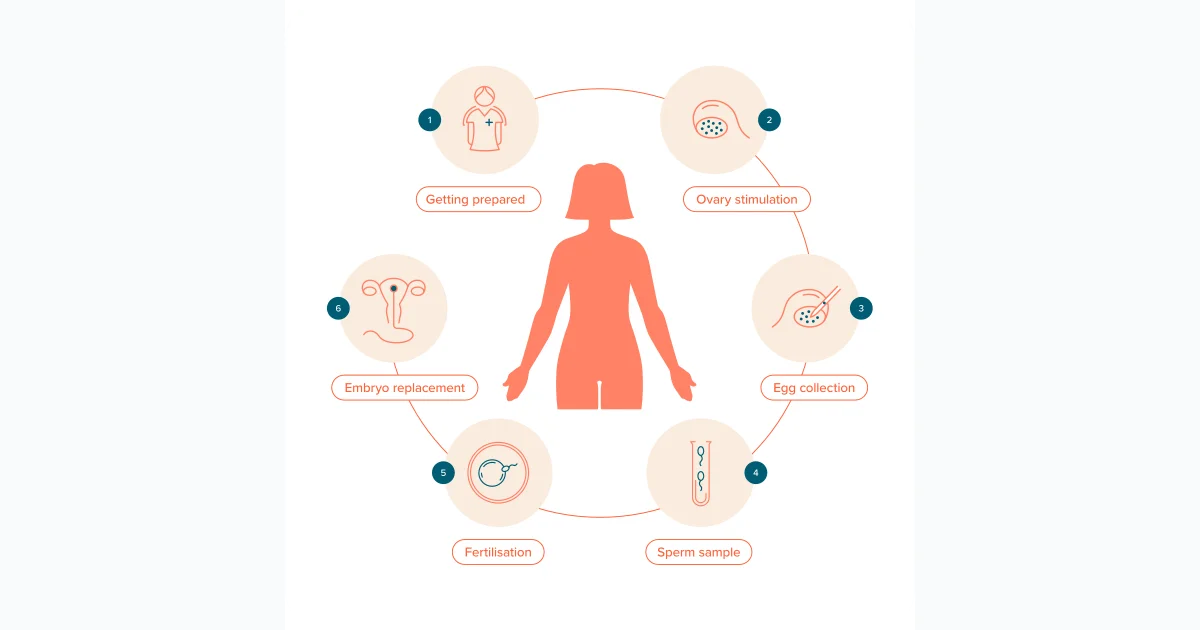
An IVF cycle is one complete round of treatment, running from ovarian stimulation through egg retrieval, fertilization, embryo transfer, and the first pregnancy test. It takes 4-6 weeks and costs $15,000-$25,000 per cycle in the US, and if it does not end in a live birth, the patient can start another cycle using fresh or frozen embryos.
What Counts as One IVF Cycle?
The most widely accepted clinical definition is: one IVF cycle = the complete sequence from ovarian stimulation through the first pregnancy test after embryo transfer.
New to treatment? Start with our beginner’s guide to what IVF is.
A cycle covers these phases:
| Phase | What happens |
|---|---|
| Ovarian stimulation | 8-14 days of hormone injections |
| Trigger shot & egg retrieval | 1 day (procedure under anesthesia) |
| Fertilization & embryo culture | 3-6 days in the lab |
| Embryo transfer | 1 day (about 15 minutes) |
| Luteal support & pregnancy test | 10-14 days of progesterone support |
Key nuance: if embryos are frozen in a “freeze-all” cycle and transferred the following month, registry data still counts it as one initiated cycle. SART tallies a frozen embryo transfer (FET) as a separate transfer cycle, while the CDC groups by egg retrieval batch — the reason fresh and frozen paths differ in timeline, cost, and reported success.
For the detailed mechanics of each phase, read our step-by-step IVF process guide.
How Long Does an IVF Cycle Take?
The active phase of one cycle runs 4 to 6 weeks, depending on your path. A fresh transfer without genetic testing takes about 28-35 days from first injection to pregnancy test: 10-14 days of stimulation, 1 day of retrieval, 3-6 days of culture, then transfer followed by 10-14 days of luteal support.
A frozen transfer with PGT testing stretches the calendar to roughly 8-12 weeks: 2 weeks of stimulation and retrieval, 2-3 weeks of culture and genetic testing, then 2-4 weeks of endometrial preparation before the FET itself. Stimulation style — natural, mini, or conventional — also shifts the timeline, as covered in our IVF stimulation protocol guide.
“The IVF process takes about two to three weeks from start to finish.” — American Society for Reproductive Medicine (ASRM), 2024
For day-by-day scheduling, appointment counts, and phase-by-phase notes, see our IVF timeline guide.
How Much Does One IVF Cycle Cost?
Cost per cycle varies dramatically by country and clinic:
| Country | Average cost (including medication) |
|---|---|
| United States | $15,000 - $25,000 |
| Canada | CAD 8,000 - 15,000 |
| United Kingdom | £5,000 - £8,000 |
| Spain | €5,000 - €8,000 |
| Thailand | $8,000 - $12,000 |
| Mexico | $5,000 - $8,000 |
| India | $3,000 - $6,000 |
What the Cycle Fee Usually Includes
Most clinic packages cover:
- Monitoring visits (ultrasound and bloodwork during stimulation)
- Egg retrieval procedure and anesthesia
- Lab work for fertilization and embryo culture
- The embryo transfer procedure
- One cycle of medication (sometimes capped)
What It Usually Excludes
- Pre-cycle testing and consultation fees
- ICSI (adds $1,500-$3,000)
- PGT-A or PGT-M genetic testing (adds $3,000-$6,000)
- Embryo freezing and storage ($500-$1,000 per year)
- Donor eggs or donor sperm
- Medication beyond the initial allocation
What About Insurance?
Nineteen US states require insurance plans to cover some fertility treatment, but scope varies enormously — Massachusetts mandates IVF itself while most states impose no such requirement, and even mandated plans cap cycle counts or dollar amounts. Our IVF cost guide compares countries in detail, and the US IVF insurance guide plus IVF cost in the USA break down state-by-state coverage.
How Many IVF Cycles Do Most People Need?
One-cycle success is the exception, not the rule. According to SART cumulative data, live birth rates climb with each completed cycle:
| Cycles completed | Cumulative live birth rate (all ages) |
|---|---|
| 1 cycle | 30-40% |
| 2 cycles | 50-60% |
| 3 cycles | 65-75% |
| 4 cycles | 75-85% |
These are broad averages. Younger patients and donor-egg recipients accumulate success faster, while women over 40 progress more slowly. See our success rates by age guide and advanced maternal age IVF guide for age-specific detail.
Important distinction: when clinics publish “success rates,” they usually mean live birth per egg retrieval or per transfer — not per “cycle” as patients define it. One retrieval that yields several frozen embryos can support multiple transfer attempts, all traced back to the same cycle.
What Are the Per-Cycle Success Rates by Age?
The single most important predictor is the woman’s age at egg retrieval. Based on CDC 2022 ART data, live birth rates per retrieval with a patient’s own eggs run:
| Age group | Live birth rate per egg retrieval |
|---|---|
| Under 35 | 45-55% |
| 35-37 | 35-40% |
| 38-40 | 25-30% |
| 41-42 | 10-15% |
| Over 42 | 3-8% |
With donor eggs the numbers rise sharply — donor-egg IVF succeeds in roughly 50-60% of cycles regardless of the recipient’s age. Our IVF success rate guide and data source explainer put these figures in context.
What Do Real Patient Cycle Journeys Look Like?
The following cases are anonymized examples drawn from common clinical scenarios observed by reproductive endocrinologists.
Case 1: Success in one cycle — Sarah, 34
Sarah, 34, from Seattle began IVF after two years of unexplained infertility. Her first cycle produced 14 eggs, 11 fertilized conventionally, and 3 frozen blastocysts; a single fresh day-5 transfer returned a positive hCG of 320 mIU/mL at day 14.
Total cost for one cycle including medication: $19,000. “I had read so many stories about needing multiple rounds that I prepared myself for at least two,” she says. “When the nurse called with my beta results, I asked her to repeat it three times.”
Case 2: Protocol change, then success in cycle two — Elena, 39
Elena, 39, from Denver had her first cycle canceled on stimulation day 8 for poor response — only 3 follicles reached measurable size. Switched from an antagonist protocol to a mild-stimulation protocol, her second cycle yielded 9 eggs, 6 fertilizations, and 2 euploid blastocysts on PGT-A, and her first FET ended in a live birth.
Combined cost for both cycles: $34,000. “Canceling the first cycle was devastating, but changing the protocol made all the difference,” she recalls. “Your first failed cycle teaches your doctor how your body actually responds.”
Case 3: One retrieval, three transfers — Amina, 37
Amina, 37, from London produced 12 eggs in a single retrieval; 8 fertilized and 4 blastocysts were frozen. Her fresh transfer failed to implant, and her first FET was negative, but the second FET — after a modified endometrial preparation protocol — succeeded.
“One retrieval funded four transfer attempts,” she notes. “If I had given up after the first failed transfer, I would have missed what worked.” Total cost for the retrieval cycle plus three transfers: approximately £14,000.
What Types of IVF Cycles Are There?
Cycles differ by stimulation drug dose and method, which changes egg yield, cost, and candidate fit:
| Cycle type | Medication | Eggs retrieved | Best suited for |
|---|---|---|---|
| Conventional stimulation | High-dose injections | 8-15 | Normal AMH, good ovarian reserve |
| Mini-stimulation | Low-dose injections + oral drugs | 2-6 | Low AMH, diminished reserve, age 40+ |
| Natural cycle | Essentially no medication | 1-2 | Very poor responders or medication-sensitive patients |
| Luteal-phase stimulation | Stimulation continues after retrieval | 2-6 | Supplemental strategy to recruit extra eggs |
Conventional stimulation is the standard, highest-volume protocol, while mini-stimulation prioritizes egg quality over quantity for low-reserve patients. Each protocol differs in drugs, monitoring frequency, and total cost — compare them in our stimulation protocol guide.
What Factors Decide Whether a Cycle Succeeds?
Six variables determine most cycle outcomes:
| Factor | How it affects the cycle |
|---|---|
| Female age | The single biggest factor — sets egg quality and chromosomal normality |
| Ovarian reserve (AMH/AFC) | Drives egg count, and transitively the number of transferable embryos |
| Semen quality | Affects fertilization rate and embryo development potential |
| Endometrial status | Lining thickness and receptivity decide whether implantation can occur |
| Embryo chromosomes | Chromosomally normal embryos implant at markedly higher rates |
| Lifestyle | Smoking, high BMI, and stress lower success rates |
After a failed cycle, doctors typically adjust the protocol around these factors. Read our what affects IVF success rates guide, and for low reserve specifically, the low AMH IVF guide.
Why Are IVF Cycles Canceled, and What Happens Then?
About 10-15% of initiated cycles are canceled before retrieval, most often for these reasons:
- Poor ovarian response: fewer than 3 mature follicles develop, making continuation unlikely to succeed
- OHSS risk: more than 20-25 follicles plus very high estrogen — canceling avoids serious complications
- Premature ovulation: eggs release on their own before retrieval
- Uterine abnormalities: insufficient lining thickness, polyps, or cysts
A cancellation is not a failure — it is a chance to re-plan, and most patients do better in cycle two after a protocol change. Refund handling for canceled cycles is covered in our IVF cost guide, and complication prevention in our egg retrieval and OHSS guide.
FAQ
Q: What is the difference between an IVF cycle and a frozen embryo transfer cycle?
In registry reports a “cycle” usually means the egg retrieval cycle, with each FET counted separately. Practically, a fresh cycle involves stimulation and retrieval, while an FET only prepares the uterus — it is shorter (2-4 weeks) and cheaper ($3,000-$5,000 in the US).
Q: How soon can I start a new cycle after a failed one?
Most clinics advise waiting 1-3 menstrual cycles before a new retrieval, letting the body clear hormones and the team review what to change. Back-to-back stimulations are possible but generally discouraged for ovarian recovery.
Q: Is PGT testing part of a standard cycle?
No — PGT is optional and adds $3,000-$6,000 per cycle. It is most recommended for women 35 and older, known genetic risks, and recurrent pregnancy loss or implantation failure; see our PGT genetic screening guide.
Q: Does one IVF cycle equal one baby?
Not necessarily. One IVF cycle equals 1 egg retrieval, not 1 guaranteed baby: a single cycle can produce multiple usable embryos and several transfer attempts — theoretically even more than one child — while another cycle may produce no transferable embryo at all.
Q: How many IVF cycles can I do in a year?
With frozen transfers only (no new retrieval), 4-6 FET cycles fit into a year. With fresh retrievals, most patients complete 2-4 cycles annually, since each retrieval needs stimulation and recovery time.
Q: Does transferring more embryos change the cycle cost?
No — transferring 1 or 2 embryos costs the same, because fees are driven by retrieval and lab work, not the transfer itself. Two embryos do raise the multiple-pregnancy risk, with its own medical and financial consequences.
Q: What if a cycle produces no eggs or no embryos?
This is called a failed or canceled cycle. Roughly 10-15% of initiated cycles are canceled before retrieval for poor response, and of cycles that reach retrieval, about 5-10% yield no usable embryos.
Most clinics refund part of the medication cost, but not lab or procedure fees.
Q: How does egg count affect per-cycle success?
Retrieving 10-15 mature eggs gives the highest probability of at least one euploid blastocyst. Fewer than 4 eggs cuts success significantly, though quality still counts — some patients conceive with just 2 good-quality eggs.
Planning Your Next Step
Understanding what one IVF cycle really costs — in time, money, and emotional energy — is the foundation of a sound decision:
- One cycle is not the endpoint. Most patients need several, so prepare mentally and financially for at least 2-3 attempts.
- Definitions shape price comparisons. When comparing quotes, confirm whether the fee covers a full cycle (stimulation through transfer) or only the procedure.
- Frozen embryos multiply a cycle’s value. One retrieval can fund multiple transfers, stretching every dollar of the retrieval cost.
- Age is the biggest variable. Past 37, per-cycle success falls measurably each year, so time matters.
Your next step is matching clinics to your medical profile and budget — browse verified IVF hospitals or contact our team for personalized guidance, and read our how to choose an IVF clinic guide before deciding.
Related reading:
- IVF preparation checklist — tests to complete before a cycle
- IUI vs IVF comparison guide — whether to try IUI first
- Egg freezing guide — fertility preservation and IVF cycles
- Endometriosis IVF guide — cycle strategy for a specific diagnosis
Last updated: July 9, 2026. This article is for informational purposes only and does not constitute medical advice. IVF cycle definitions, costs, and success rates vary by clinic, country, and individual patient factors. ProIVF recommends consulting a licensed reproductive endocrinologist and verifying all pricing directly with your chosen clinic before making treatment decisions.
This article was written by the ProIVF Medical Editorial Team and reviewed by the ProIVF Medical Advisory Board, based on public data and clinical guidelines from ASRM, the CDC ART program, SART, and the HFEA.