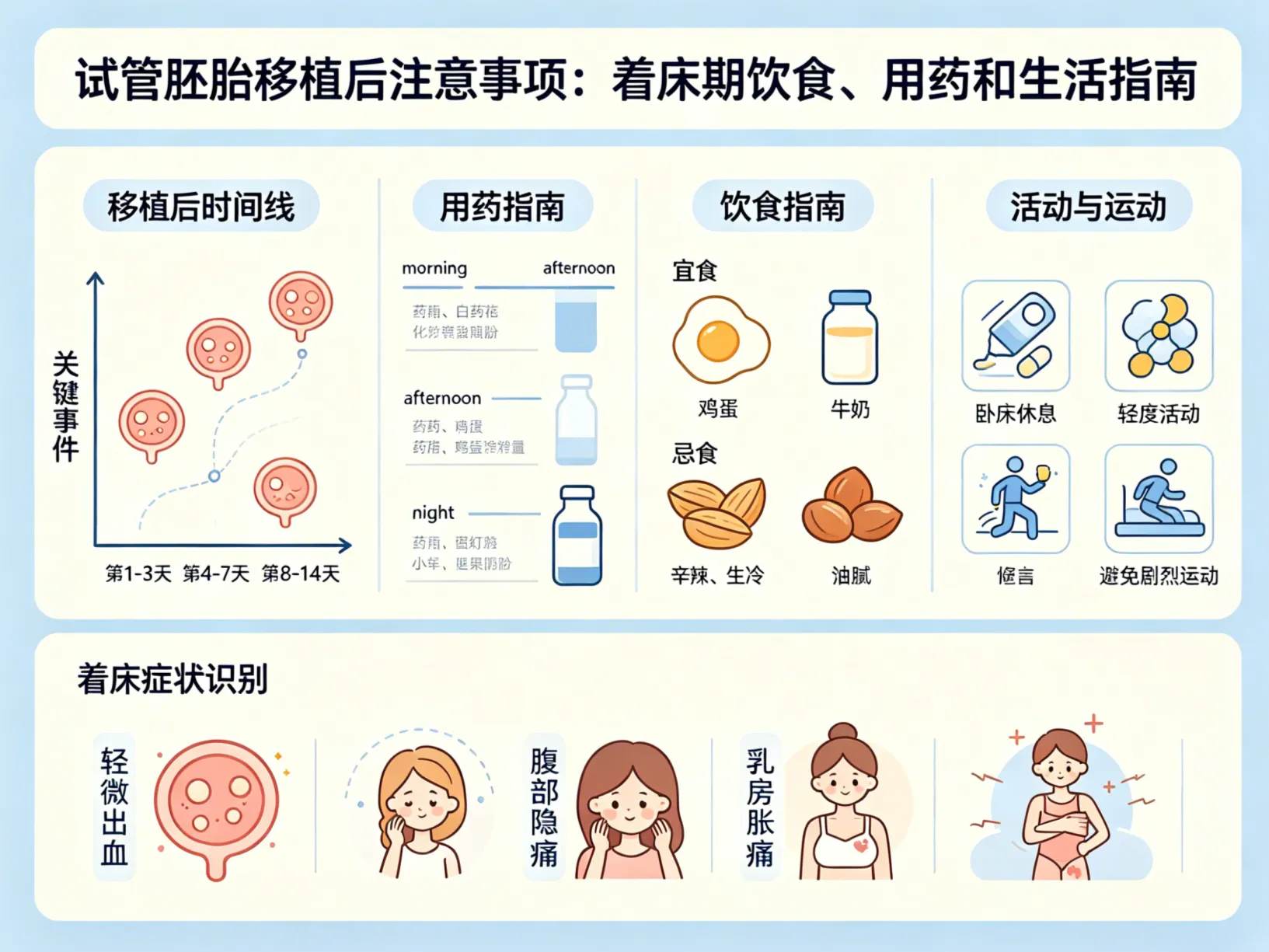
The 14 days after embryo transfer are the implantation window, and only three things on it are evidence-based: taking progesterone exactly on schedule, keeping up normal light activity, and waiting for a blood β-hCG test at day 12-14. Bed rest, extreme dieting and daily home testing are not among them.
“Home pregnancy tests detect hCG in urine. The sensitivity of most commercial tests is 20–25 mIU/mL. Blood tests can detect hCG at levels as low as 5 mIU/mL, making them more sensitive in early pregnancy.” — American Society for Reproductive Medicine, ASRM, Early Pregnancy patient fact sheet
That sensitivity gap explains the single most common mistake in the two-week wait: testing too early and reading a false negative as a failed cycle. Our full pregnancy test timing guide covers the same numbers in more depth.
What Happens in the 14 Days After Embryo Transfer?
Implantation is a process measured in days, not minutes, and most of it is silent. A day 5 blastocyst still has to hatch, attach and invade the endometrium before any hCG reaches a detectable level.
| Day after transfer | Embryo development | What your body feels |
|---|---|---|
| 1-2 | Blastocyst hatching | Usually nothing at all |
| 3-4 | Implantation begins | Some women notice light spotting or bloating |
| 5-7 | Implantation completes | hCG secretion starts |
| 8-10 | Early embryonic development | Early pregnancy symptoms possible |
| 12-14 | — | Blood pregnancy test |
Because hCG only becomes detectable after implantation completes, symptoms and test results in the first 5 days tell you nothing about the outcome. The wider IVF timeline is mapped in the step-by-step IVF process guide.
Do You Need Bed Rest After Embryo Transfer?
No — current evidence does not support bed rest after transfer. Rest 20-30 minutes at the clinic, then go home and resume normal activity the same day.
Prolonged lying down may actually work against you by reducing uterine blood flow, and it measurably increases anxiety during an already stressful wait. Staying calm and occupied matters more for the outcome than staying horizontal.
What is the right amount of rest?
- At the clinic: 20-30 minutes of rest immediately after the procedure, then discharge.
- On transfer day: normal light activity at home — no exercise, no errands that strain you.
- From day 2: return to work and routine as you feel comfortable.
- Throughout: keep emotional wellbeing as a scheduled priority, not an afterthought.
What Medications Do You Take After Transfer?
Progesterone (luteal phase) support is the one part of aftercare you should never improvise on. Stimulation medications and the retrieval procedure disrupt natural luteal function, so supplemented progesterone is what maintains the endometrial lining through implantation.
Which luteal support drugs are used?
| Drug type | Common preparations | How it is taken |
|---|---|---|
| Vaginal progesterone | Progesterone soft capsules, Crinone gel | 2-3 times daily, vaginal |
| Intramuscular progesterone | Progesterone injection | Daily injection |
| Oral progestin | Dydrogesterone (Duphaston) | 2-3 times daily, oral |
| Estrogen | Estradiol valerate (Progynova) | Dose adjusted to endometrial thickness |
Estrogen is added mainly in frozen embryo transfer cycles, where the lining was prepared hormonally rather than by a natural ovulation.
What are the medication rules that matter?
- Same time every day: set alarms; consistency of blood levels is the point.
- Never stop on your own: bleeding during the two-week wait is not a reason to halt progesterone.
- Continue to 8-10 weeks of pregnancy, then taper only under your doctor’s direction.
- Missed dose: take it as soon as you remember and never double up to compensate.
If you are unsure whether a symptom is drug-related or pregnancy-related, call the clinic rather than adjusting the dose — the UK HFEA publishes the same advice for patients in regulated clinics.
What Should You Eat After Embryo Transfer?
Eat for stable blood sugar and regular bowel function: high protein, folate, fiber and healthy fats. No food has been shown to make an embryo implant.
What to put on your plate
| Category | Examples | Why it helps |
|---|---|---|
| High protein | Eggs, fish, lean meat, tofu | Supports embryonic development |
| Folate-rich | Dark leafy greens, citrus fruit | Prevents neural tube defects |
| High fiber | Whole grains, vegetables, fruit | Counters progesterone-driven constipation |
| Healthy fats | Avocado, nuts, olive oil | Anti-inflammatory |
| Warm foods | Soups, broths, congee | Easier digestion; the “warming” principle in Chinese post-cycle care |
What to leave off it
- Raw or undercooked food: sashimi, raw meat, soft-boiled eggs — listeria and toxoplasma risk
- High-mercury fish: shark, swordfish; canned tuna only in moderation
- Alcohol: zero for the whole two-week wait and pregnancy
- Caffeine: maximum 200 mg per day, roughly one cup of coffee
- Unpasteurised dairy: soft cheeses and raw-milk products
- Very spicy food: only a problem if it triggers diarrhoea or reflux
How do you prevent constipation?
Progesterone slows intestinal motility, which makes constipation the most reliably reported aftercare complaint.
- Drink 2,000 mL or more of water daily.
- Build every meal around a fiber source.
- Walk 20-30 minutes a day.
- Use lactulose only after checking with your clinic.
Straining is uncomfortable but does not displace an embryo; the reason to treat constipation is comfort and hemorrhoid prevention, not implantation risk.
Which Activities Are Safe During the Two-Week Wait?
Normal daily life is safe, and it is better for you than inactivity. The restriction list is short and specific.
Safe to do
- Regular work, cooking and everyday errands
- Gentle walking for 20-30 minutes daily
- Light housework
- Social activities that keep you relaxed
Better avoided
- Heavy lifting above 5 kg
- Vigorous exercise — running, jumping, high-intensity training
- Sexual intercourse for the first 2 weeks after transfer
- Hot tubs, saunas and steam rooms, because raised core temperature may affect implantation
- Long hot baths — showers are fine
Short-haul flying does not affect implantation; rest 1-2 days before travelling, and move your legs regularly on long-haul flights because of thrombosis risk.
Travel questions come up constantly at this stage. Clinic-level outcome data for destinations you might travel to are published annually by the CDC ART success rates programme.
Which Symptoms Actually Signal Implantation?
Possible implantation signals include light pink or brown spotting, mild period-like cramping, breast tenderness, fatigue and a persistently slightly elevated temperature. None of them is diagnostic.
Why symptoms cannot confirm or rule out pregnancy
- No symptoms does not mean no pregnancy — most women feel nothing during implantation.
- Symptoms do not confirm pregnancy — progesterone supplementation produces the same breast tenderness, bloating and fatigue.
- Testing before day 7 is unreliable — urine hCG has not yet reached detectable levels.
When to call your clinic the same day
- Heavy bleeding, more than a normal period
- Severe abdominal pain
- Fever above 38 °C
- Vomiting so severe you cannot keep fluids down
- Pain or burning on urination
These five signs point to complications that need assessment — ovarian hyperstimulation, infection or, rarely, ectopic or heterotopic pregnancy. If you had a fresh retrieval recently, review the emergency thresholds in our egg retrieval and OHSS guide.
When Is a Pregnancy Test Accurate After Transfer?
A blood β-hCG test at day 12-14 after transfer is the only result you should plan around. Home urine tests at day 7 are not accurate enough to act on, and even at day 10 they still produce false negatives.
| Timing | Method | Reliability |
|---|---|---|
| Day 7 after transfer | Home urine test | Not accurate — not recommended |
| Day 10 after transfer | Home urine test | More reliable, false negatives still possible |
| Day 12-14 after transfer | Blood β-hCG | Most accurate — recommended |
How do you read a β-hCG result?
| β-hCG level | Interpretation |
|---|---|
| Below 5 mIU/mL | Not pregnant |
| 5-25 mIU/mL | Borderline — repeat the test |
| 25-100 mIU/mL | Early pregnancy |
| Above 100 mIU/mL | Pregnancy confirmed |
A borderline result is a schedule change, not a verdict: the repeat test 48 hours later, when hCG should be rising, is what carries the information.
How Do You Cope With the Two-Week Wait?
The two-week wait is the most psychologically difficult stretch of an IVF cycle, and symptom-monitoring makes it worse.
- Keep your schedule full — work, hobbies, social plans
- Stop searching implantation symptoms repeatedly
- Talk to your partner or one trusted friend rather than a search engine
- Do things that absorb attention: reading, films, short walks
- Do not test early — a false negative costs you two weeks of grief for no information
Age is the dominant predictor of whether the wait ends in a live birth, and clinic-specific figures for your age band are set out in our IVF success rate by age guide. ACOG’s patient FAQ on infertility treatment summarises the same treatment options from an obstetric perspective.
FAQ
Q: Can I fly after embryo transfer?
Yes for short-haul flights — cabin pressure and sitting do not affect implantation. Rest 1-2 days before travelling, and on long-haul routes move your legs and hydrate regularly to reduce thrombosis risk.
Q: Does bleeding after transfer mean the cycle failed?
No. Light pink or brown spotting around days 3-4 can be normal implantation bleeding, and vaginal progesterone products irritate the cervix on their own.
Only bleeding heavier than a period, or bleeding with severe pain, needs same-day assessment — and only the blood test at day 12-14 settles the outcome.
Q: Can I shower after embryo transfer?
Yes, with water kept around 37-38 °C. Avoid bathtubs, hot tubs and saunas, because a sustained rise in core body temperature is the factor of concern, not the shower itself.
Q: How soon after transfer can I trust a test?
A blood β-hCG at day 12-14 is the standard, because blood assays detect hCG from about 5 mIU/mL while most home tests need 20-25 mIU/mL. A home test at day 7 tells you almost nothing.
Q: What if I miss a progesterone dose?
Take it as soon as you remember and do not double the next dose. One late dose is far less risky than stopping a regimen that is normally continued to 8-10 weeks of pregnancy.
Q: Can I go back to work after transfer?
Yes — desk work and normal routines are encouraged from the day after transfer. The restrictions are lifting above 5 kg, high-intensity exercise and heat exposure, not ordinary activity.
The Bottom Line After Embryo Transfer
Three things determine how well you handle the two-week wait: progesterone taken on time at the same hours every day, normal light activity instead of bed rest, and one blood test at day 12-14 instead of daily urine tests. Everything else on the avoid list — alcohol, raw food, unpasteurised dairy, hot tubs, heavy lifting — is standard early-pregnancy precaution rather than an implantation intervention.
Choose a clinic whose aftercare protocol and outcome reporting you can actually verify in our IVF hospital directory, or contact our advisory team to review your medication schedule and monitoring plan before you start.
About this article: researched and written by the ProIVF Medical Editorial Team following Google E-E-A-T health content guidelines and reviewed by the ProIVF Medical Advisory Board. Symptom guidance is population-level information, not a diagnosis — contact your fertility clinic for any bleeding, pain or fever after transfer. This article is for informational purposes only and is not medical advice. Editorial standards: ProIVF About page. Last updated: 2026-09-20.