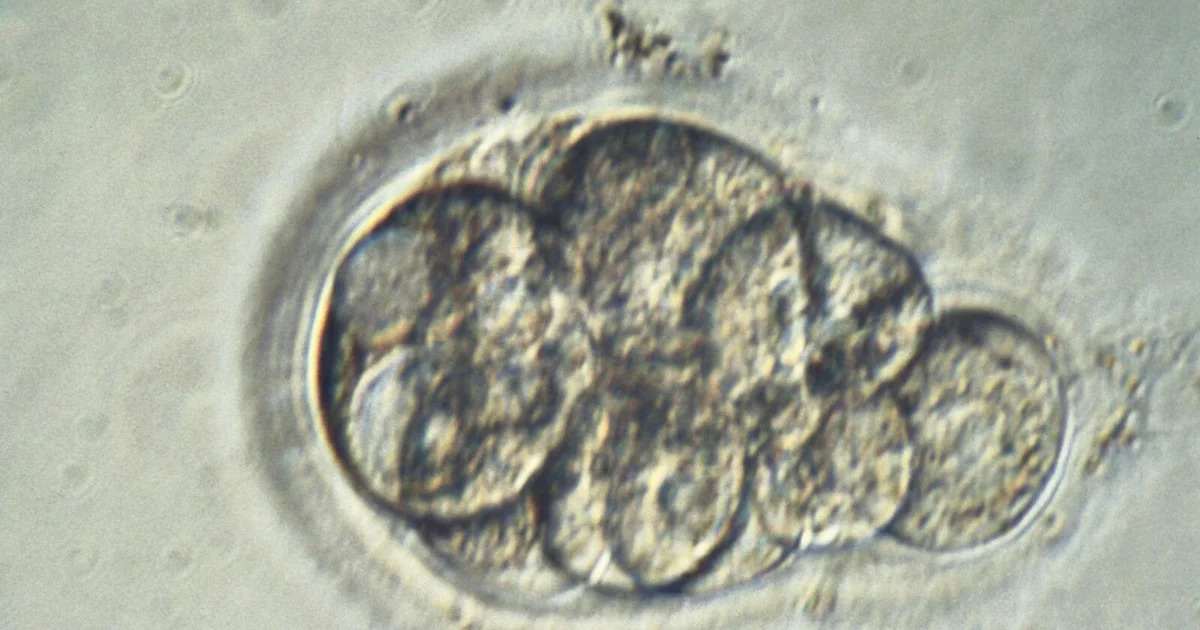
IVF attrition is the gap between the number of eggs a clinic retrieves and the number of babies that come home: in the 2023 SART national report, live births per intended egg retrieval were 53.2% for patients under 35 and 9.4% for those 40 or older. This guide walks through each gate where embryos are lost, with the published rates behind every number.
The figures below come from peer-reviewed studies indexed in PubMed (Gordon 2022, Franasiak 2014, Lobo 2025, and others), the SART 2023 national summary, and CDC ART success-rate reporting, compiled by the ProIVF Medical Editorial Team and reviewed by the ProIVF Medical Advisory Board. Clinic-level results vary, and no number here is a personal prognosis.
Most of these cohorts are retrospective and often single-center, so each range describes a population rather than your likely outcome. Where a figure is a model assumption rather than a measured result, the text says so.
The five gates from retrieved egg to live birth
Attrition is cumulative, and each gate multiplies rather than adds. A cycle that looks strong at retrieval can still end with nothing to transfer.
| Gate | What is measured | Published range | Source |
|---|---|---|---|
| 1. Fertilization | Mature oocyte becoming a 2PN zygote (two pronuclei visible) | ICSI raises the chance per mature oocyte by 1.49× versus conventional insemination (RR 1.49, 95% CI 1.35-1.65) | Aboulghar meta-analysis, Fertil Steril 2013 |
| 2. Blastocyst conversion | 2PN zygote developing to a transferable blastocyst | 52%-83%, rising as maternal age falls | Gordon 2022, J Assist Reprod Genet |
| 3. Euploidy | Blastocyst with a normal chromosome count | Chance of having no euploid embryo: 2%-6% at ages 26-37, 33% at 42, 53% at 44 | Franasiak 2014, Fertil Steril |
| 4. Implantation and live birth | Euploid blastocyst transferred becoming a live birth | About 60% live birth per euploid blastocyst in the counseling model | Goldman 2017, Hum Reprod |
| 5. Whole-cycle outcome | Live birth per intended egg retrieval | 53.2% (<35), 39.9% (35-37), 26.2% (38-40), 9.4% (≥40) | SART 2023 national data, CDC ART |
Gate 1: how many retrieved eggs actually fertilize?
Fertilization is the first filter, and it is the one most sensitive to how the lab inseminates the eggs. A meta-analysis of couples with unexplained infertility found that the pooled relative risk of a mature oocyte fertilizing was 1.49 (95% CI 1.35-1.65) with ICSI (intracytoplasmic sperm injection) versus conventional insemination, and that complete fertilization failure was 8.22 times more likely with conventional insemination (RR 8.22, 95% CI 4.44-15.23).
That does not make ICSI mandatory for every cycle. The same review noted that the evidence for better pregnancy and live-birth outcomes was still limited, which is why many clinics reserve ICSI for male-factor diagnoses, previous fertilization failure, or planned PGT-A.
What this gate means for you: ask for your own numbers rather than a clinic average. The relevant figure is fertilized eggs per mature egg retrieved, not per egg retrieved, because immature eggs were never in the race.
Gate 2: how many fertilized eggs reach blastocyst?
Between 52% and 83% of fertilized eggs reach blastocyst in a 746-cycle PGT-A cohort, and the spread is driven mostly by maternal age. Cleavage-stage development in that Brigham and Women’s Hospital series was 96% to 100% regardless of age, while euploid blastocyst conversion ranged from 0% to 28%.
“For patients above the age of 40 years with less than four 2pn zygotes, the risk of having no transferable embryos was 99.7%.”
- Gordon et al., Journal of Assisted Reproduction and Genetics, 2022
For anyone over 40 considering PGT-A, this is the number to plan around: if a cycle yields fewer than four fertilized eggs, testing every embryo can leave nothing to transfer. The authors’ own recommendation was to discuss transferring untested day-3 or day-5 embryos in that situation.
Gate 3: why does euploidy fall with age?
Chromosome errors accumulate in eggs as women age, and they are the main reason morphologically good embryos fail. The largest single dataset, 15,169 consecutive trophectoderm biopsies analyzed with comprehensive chromosomal screening, found that aneuploidy rose predictably after age 26, that 64% of aneuploid embryos carried a single extra or missing chromosome, and that the chance of having no euploid embryo in a cohort was lowest (2%-6%) between ages 26 and 37.
Two counterintuitive details matter. First, very young patients are not immune: aneuploidy exceeded 40% in women aged 23 or younger in that dataset. Second, the risk curve flattens rather than explodes after 43 — which is why clinics counsel on egg donation at that point instead of promising that one more cycle will change the odds.
Gate 4: what happens after a euploid blastocyst is transferred?
About 60% of transferred euploid blastocysts become live births in the model used for elective egg freezing, so roughly 4 in 10 still do not. That 60% is a modeling input rather than a measured outcome for your clinic: implantation also depends on the uterus, the transfer technique, and embryo quality beyond chromosome count.
The practical takeaway: attrition does not stop at euploidy. A patient with two euploid embryos has two independent attempts, not two babies.
What a realistic funnel looks like
Below is arithmetic on the published ranges, not a prediction for any individual. It shows why a cycle with 12 eggs can produce one baby — or none.
| Stage | A 32-year-old with 12 eggs | A 41-year-old with 15 eggs | Basis |
|---|---|---|---|
| Retrieved eggs | 12 | 15 | Starting point |
| Fertilized (2PN) | 6-9 | 7-10 | Illustrative: roughly half to three-quarters of retrieved eggs fertilize |
| Blastocysts | 3-7 | 3-8 | 52%-83% conversion (Gordon 2022) |
| Euploid blastocysts | 1-3 | 0-1 | Illustrative, inside the age-wide 0%-28% euploid conversion range (Gordon 2022) |
| Chance of no euploid embryo | 2%-6% | 33% at 42, 53% at 44 (nearest reported ages) | Franasiak 2014 |
| Expected live birth | 1 at ~60% per euploid transfer | 0-1 | Goldman 2017 model assumption |
Does retrieving more eggs always help?
More eggs help, but only up to a point, and the plateau arrives earlier than most patients expect. A 2025 pooled analysis of 1,746 patients (mean 12.4 eggs retrieved) found a cumulative live-birth rate of 51.4%, rising above 60% with more than 15 eggs and above 70% with more than 20, with a plateau starting at 21-25 eggs.
The same analysis found that the fresh-transfer live-birth rate fell beyond 14 eggs even as cumulative live birth kept rising. In that range the extra eggs were mostly being banked rather than transferred, so the two curves diverge. Age mattered more than egg number: cumulative live birth was 57.1% under 35, 51.6% at 35-37, and 35.8% at 38 or older.
How many transfers does it take?
Cumulative live birth reached 51.1% after a third blastocyst transfer, 68.3% after a sixth, and 78.0% after a tenth in a cohort of 11,463 women and 31,478 transfers. That steady climb is the most reassuring way to read attrition data, because it measures what a whole treatment course can deliver rather than what one cycle delivers.
The age split after the fourth blastocyst transfer is stark: 68.9% under 35, 57.6% at 35-37, 42.9% at 38-40, 16.3% at 41-42, and 13.5% over 42. That is the same age gradient seen in the per-retrieval SART figures, expressed as a running total.
Three patients, three attrition curves
The three accounts below are composites built from typical clinic pathways, with identifying details changed. Nothing here is a medical record or a guarantee that a similar cycle will follow the same path.
Case 1 — 32, Hangzhou, one cycle in Bangkok: She retrieved 14 eggs, 9 matured, 6 fertilized, and 3 reached blastocyst. PGT-A found one euploid embryo. The single frozen transfer implanted, and she delivered at 39 weeks. Total spend was about 180,000 RMB including travel. Her summary: “I stopped counting eggs after day three and started counting chances — I had one, and it worked.”
Case 2 — 41, Shanghai, two cycles in Shanghai: The first cycle gave 15 eggs, 4 blastocysts, and zero euploid embryos. Her clinic recommended a second retrieval rather than transferring untested embryos. The second cycle gave 9 eggs and one euploid blastocyst, which was transferred and did not implant. Cost for the two cycles was about 160,000 RMB. “The hardest part was not the injections,” she said. “It was learning that four blastocysts could all be chromosomally abnormal.”
Case 3 — 37, Shenzhen, one cycle in the United States: She retrieved 20 eggs, 12 fertilized, 5 reached blastocyst, 2 were euploid. The first transfer produced a live birth; the second embryo remains frozen. Cost was about 28,000 USD including medication and travel, inside the typical range for a US cycle. “Having a spare embryo changed how the first transfer felt,” she said. “It was still scary, but it was no longer all or nothing.”
How to use attrition data in your own planning
Ask for your clinic’s own conversion rates, not the national averages. The three numbers that matter are fertilized eggs per mature egg, blastocysts per fertilized egg, and euploid blastocysts per blastocyst biopsied.
Together those three rates describe your own trajectory more usefully than a headline success rate, because they isolate the gate you can actually act on.
Plan in cycles, not in eggs. Because cumulative live birth rises with each transfer, the useful question is “how many transfers can my embryos support”, which is answerable once you know your blastocyst and euploidy numbers. Read the embryo grading guide before your report arrives, and compare your age-specific baseline in the success rates by age data.
Budget for the possibility of more than one cycle. A US cycle typically runs 15,000-30,000 USD and a cycle in mainland China 30,000-80,000 RMB, so the cost of attrition is usually paid in cycles rather than in single procedures. See how much IVF costs for the breakdown.
FAQ
Q: What is a normal IVF attrition rate?
There is no single normal value, because attrition is measured at different gates: blastocyst conversion runs 52%-83% of fertilized eggs, and live birth per intended retrieval runs from 53.2% under 35 to 9.4% at 40 or older in SART 2023 data.
Q: Is it normal to get zero euploid embryos?
Yes, and the probability is predictable: 2%-6% of cycles in patients aged 26-37 end with no euploid embryo, rising to 33% at age 42 and 53% at age 44 in a 15,169-biopsy dataset.
Q: Do more eggs mean a better chance?
Up to a point: cumulative live birth exceeded 60% with more than 15 eggs and 70% with more than 20, then plateaued at 21-25 eggs in a pooled analysis of 1,746 patients.
Q: Should I test my embryos if I only have a few?
Discuss it before the cycle: for patients over 40 with fewer than four fertilized eggs, the modeled risk of having no transferable embryo after PGT-A was 99.7%, so transferring untested embryos may be the better plan.
Q: Does a failed transfer mean my embryos are bad?
Not necessarily: cumulative live birth reached 68.3% after six blastocyst transfers and 78.0% after ten in a cohort of 11,463 women, so a single failure is common even with good embryos.
Q: How much does attrition cost?
It is paid per cycle rather than per embryo: a US cycle costs about 15,000-30,000 USD and a mainland China cycle 30,000-80,000 RMB, and patients who need two retrievals typically pay twice.
How to plan your IVF journey
Start by asking your clinic for its own fertilization, blastocyst, and euploidy rates at your age, then map those numbers onto a two-cycle budget rather than a single-cycle hope. If you are comparing destinations, our hospital directory lists clinics by country with published success-rate context, and our team can help you read a clinic’s attrition data before you commit.
This article is for general education and does not replace advice from your own reproductive endocrinologist. Treatment decisions depend on your diagnosis, ovarian reserve, prior cycles, and clinic protocols.
Research figures above link to their PubMed record or the cited regulatory page; numbers used as clinical convention and the figures inside the patient cases are illustrative and are not individually sourced.
Written by the ProIVF Medical Editorial Team and reviewed by the ProIVF Medical Advisory Board. Learn more about our editorial process.
Last updated: November 4, 2026





