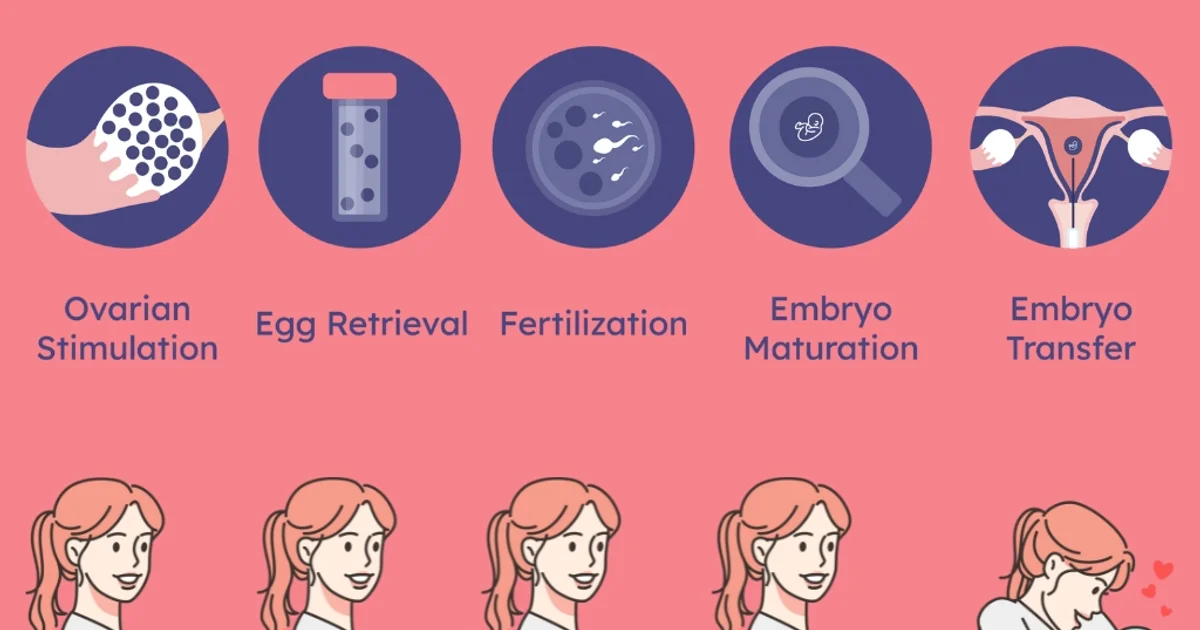
After retrieval the embryology lab decides your next 5–7 days. In a randomised series of 1,380 cycles, 60% of mature eggs fertilized — Dumoulin 1999 — and of the blastocysts judged usable, 67.7% on day 5 and 43.1% on day 7 came back chromosomally normal — Tiegs 2019.
Every figure below is linked to the study it came from, and each of the 8 key decision nodes carries thresholds and trade-offs. Compiled by the ProIVF Medical Editorial Team, reviewed by the Medical Advisory Board.
An embryologist’s view: “The attrition funnel is not failure — it is the most important screen biology runs for you. Most embryos that stop on day 3 carry severe chromosomal errors.” — Senior embryologist, ProIVF Medical Advisory Board, 2025
IVF Embryo Development: Key Statistics at a Glance
| Metric | Value | Source |
|---|---|---|
| Fertilization of mature eggs | 60%, 1,380 randomised cycles | Dumoulin 1999 |
| Live birth under 35, day-3 cells ≤4 → 8 | 31.2% → 48.1% | Wu 2020 |
| Euploid among usable blastocysts, day 5 / 6 / 7 | 67.7% / 52.1% / 43.1% | Tiegs 2019 |
| Live birth, inner cell mass A / B / C | 54.6% / 41.3% / 28.5% | Ai 2021 |
| Live birth per frozen single transfer | 40.8%, median age 32 | Guo 2020 |
| Day 5 over day 6, live birth | RR 1.39, 106,316 transfers | Hou 2026 |
Data sources: the linked PubMed studies. Registry aggregates sit behind the CDC ART success rates and SART outcome reporting portals, which report per-cycle outcomes.
How Embryos Develop Day by Day in IVF
Day 0 — Fertilization
Eggs meet sperm by conventional insemination or by ICSI, one injected sperm per egg. ICSI featured in 84% of US-resident cycles and 93% of non-US-resident cycles at the same clinics in 2014–2022 — Albright 2026.
About 16–18 hours later embryologists look for two pronuclei (2PN), one from each parent; 1PN may be parthenogenetic, and 3PN or more is usually unusable. Total fertilization failure still occurs in about 9% of cycles with no known oocyte gene mutation — Kepkep 2026.
Day 1 — Pronuclear Stage
Around 24 hours after fertilization the zygote prepares its first division; labs that stage day 1 chart pronuclear size and nucleolar alignment.
Day 2 — First Divisions, 2–4 Cells
By day 2 the embryo has 2–4 blastomeres, checked for number, evenness, and fragmentation — shed cytoplasm during division. Light fragmentation is normal; most labs flag only heavy fragmentation, and the cut-off differs by clinic.
Day 3 — Cleavage Stage, 6–10 Cells
Day 3 is the first major checkpoint: 6–10 cells, scored 1–4 on evenness and fragmentation.
- Grade 1: even cells, no fragmentation
- Grade 2: even cells, light fragmentation
- Grade 3: uneven cells, moderate fragmentation
- Grade 4: heavy fragmentation or clearly uneven cells
Cell number carries more than the grade label: across 3,543 frozen single transfers, live birth in women under 35 rose from 31.2% at ≤4 cells to 48.1% at 8 and 48.2% above, while at 35+ it made no measurable difference — Wu 2020.
Day 4 — Morula Stage, 16–32 Cells
The embryo begins compaction, packing tightly and preparing the blastocyst’s fluid-filled cavity.
Day 5 — Blastocyst Stage, ~50–150 Cells
A blastocyst has three structures, and most programs culture to day 5 for transfer or biopsy.
- Inner cell mass (ICM): becomes the fetus
- Trophectoderm (TE): becomes the placenta
- Blastocoel: the internal fluid cavity
Days 6–7 — Expansion and Hatching, 150–200+ Cells
Slower embryos are assessed on day 6 or 7, and the extra days are not free: usable blastocysts were euploid 67.7% (day 5), 52.1% (day 6), 43.1% (day 7) — Tiegs 2019.
Slow is not the same as unviable: among 2,130 euploid frozen single transfers, sustained implantation was 68.9% on day 5, 66.8% on day 6, and 52.6% on day 7 — Tiegs 2019.
Embryo Grading Explained: The Gardner System
The Three Components of Blastocyst Grades
The standard scheme scores expansion (1–6), inner cell mass (A–C, future fetus), and trophectoderm (A–C, future placenta) — the Gardner blastocyst score — Gardner 2001.
Expansion: 1 (small cavity) → 3 (full) → 4 (expanded) → 6 (hatched). ICM/TE: A (many packed cells) → B (looser) → C (few).
Grades and Live Birth Rates
| Grade | Live birth by ICM | Live birth by TE |
|---|---|---|
| A | 54.6% | 52.7% |
| B | 41.3% | 45.6% |
| C | 28.5% | 32.6% |
Expansion moved live birth from 37.1% at stage 3 to 44.2% at stage 4, and the inner cell mass separated outcomes widest: “ICM grade is the strongest predictor of live birth” — Ai 2021. A “4AA” is three measurements, not one percentage.
Data source: Ai J, et al., Front Endocrinol, 2021;12:621221 — 10,482 frozen-thawed single transfers · PMID 33716973
The Key Limitation of Morphological Grading
Grading cannot read chromosomes: about a third of day-5 blastocysts judged usable were not euploid on biopsy — Tiegs 2019 — and the literature disagrees on which grade line matters.
“Neither inner cell mass morphology nor embryo grade predicted clinical pregnancy or live birth.” — Thompson SM, et al., J Assist Reprod Genet, 2013 · PMID 24114628
That is the minority view: in 1,084 fresh single transfers, ICM grade A to C cut live-birth odds by 55%, and trophectoderm added nothing — Subira 2016. Grading is a selection tool, not a diagnostic tool.
An embryologist’s view: “Grades are a triage list, not a verdict. Plenty of ‘ugly’ embryos make healthy babies and ‘beautiful’ ones fail.” — Senior embryologist, ProIVF Medical Advisory Board, 2025
Key Laboratory Technologies Explained
Day 3 vs Day 5 Embryo Transfer
Day 3 skips extended culture but gives up two days of natural selection and cannot be biopsied safely; day 5 lets the culture screen, makes single transfer realistic, and permits biopsy for PGT-A.
In the oldest randomised comparison, implantation reached 50.5% per blastocyst against 30.1% per cleavage embryo, with 2.2 embryos transferred on day 5 versus 3.7 on day 3 — Gardner 1998.
PGT-A and Embryo Genetic Testing
Preimplantation genetic testing for aneuploidy (PGT-A) biopsies the trophectoderm on day 5–6 to screen chromosomes; couples at risk of a single-gene disorder can add PGT-M.
- Euploidy falls as eggs age and as culture drags on — Tiegs 2019
- The day-7 shortfall tracks morphology and oocyte age rather than slow development itself — Cimadomo 2022
- A biopsy removes cells, and mosaic calls in particular are contested, which is why Decision 7 exists
- Cost: ~¥20,000–¥40,000 in China; $3,000–$5,000 in the US
Mosaic embryos: labs grade mosaicism by the share of abnormal cells in the biopsy, and cut-offs differ — under about 40% is usually transferable after counselling, higher prompts genetic evaluation first. PGT-M: custom probes take 4–8 weeks; ~¥15,000–¥30,000 plus ¥3,000–¥5,000 per embryo.
Assisted Hatching
Assisted hatching opens the zona pellucida with a laser or acid.
Across 39 randomised trials of 7,249 women it nudged clinical pregnancy slightly while leaving live birth uncertain, odds ratio 1.09, and multiple pregnancy may rise, odds ratio 1.38 — Lacey 2021. Cost: ~¥2,000–¥5,000 in China.
The 8 Key Medical Decisions in Embryo Development
Cost figures are typical Chinese and US clinic ranges, not a single published standard.
Decision 1: Should You Culture to Day 5 or Transfer on Day 3?
| Day 3 Embryo Status | Recommended Path | What the evidence supports | Cost Impact |
|---|---|---|---|
| 3+ good, most at 8 cells | Culture to blastocyst | Extended culture screens; day-5 euploid transfers implant best | ~¥2,000–¥5,000 extra |
| 1–2 good | Day 3 transfer | No safe day-3 biopsy; blastulation failure leaves nothing | Saves a ¥20,000+ transfer |
| Only 1–2, poor quality | Prioritize day 3 transfer | Slow is not dead: euploid day-7 reached 52.6% | Transfer every usable embryo |
What to ask: my realistic odds of reaching day 5, and the backup if blastulation fails.
Decision 2: Should You Do PGT-A Screening?
| Blastocysts | Expected Euploid | Recommendation | Efficiency |
|---|---|---|---|
| 1 | 0–1 | Usually skip (biopsy attrition) | Low |
| 2–3 | 1–2 | Discuss with your doctor | Moderate |
| 4+ | 2+ | Strongly recommended | High |
Age changes what a count means: chromosomal normality drops with egg age. What to ask: how many futile transfers could PGT-A save me?
Decision 3: Should You Have Assisted Hatching?
Self-check — every box you tick raises the expected benefit:
- Age 38+ (zona thickens)
- Two or more good-quality embryos failed to implant
- Abnormal zona thickness or shape flagged
- Frozen embryo transfer (freezing hardens the zona)
Zero boxes: decline. One or two: reasonable, though the average effect is small (OR 1.09) — Lacey 2021. Three or four: most labs would offer it.
An embryologist’s view: “Assisted hatching is one of the most over-recommended techniques in IVF. A young patient’s zona is fine; AH on her is money wasted.” — Senior embryologist, ProIVF Medical Advisory Board, 2025
Decision 4: Fresh Transfer or Freeze-All?
| Condition | Fresh Transfer | Freeze-All |
|---|---|---|
| Endometrial thickness | >7 mm | <7 mm |
| Estradiol (E2) | <3,000 pg/mL | ≥3,000 pg/mL |
| OHSS risk | Low | High |
| PGT cycle | Not applicable | Required |
| Extra cost | None | Freezing ~¥3,000–¥8,000 |
What to ask: given my E2 and lining, does fresh transfer now or freeze-all later give a higher chance?
Decision 5: One Embryo or Two?
- Under 35 with a good blastocyst → one; single transfer is the only reliable way to avoid twins and prematurity
- Over 38 with average embryos → double may be considered, with physician assessment
- Euploid on PGT-A → one is enough; a second adds multiples risk, not odds
Decision 6: Day 5 vs Day 6 Blastocyst — Which Comes First?
- Prioritize day-5 blastocysts: pooled live birth favoured day 5 — Hou 2026
- Euploidy favours the faster track (see Days 6–7) — Tiegs 2019
- The exception: a poor day-5 and a strong day-6 performed comparably, so grade can outweigh the calendar — Hou 2026
Decision 7: Should a Mosaic Embryo Be Transferred?
- Low-level mosaic (<40%): transferable after genetic counselling; many healthy live births are on record
- High-level mosaic (≥40%): genetic evaluation before deciding
- Amniocentesis, not NIPT, follows either path
Decision 8: Should Average-Grade Embryos Be Discarded?
No — grade C is not grade zero. In 10,482 frozen single transfers, blastocysts with a C inner cell mass still delivered 28.5% live birth, and a C trophectoderm 32.6% — Ai 2021.
Where PGT results exist, chromosome status outranks morphology.
Why Do Embryos Stop Developing?
Arrest is common and mostly chromosomal, which is why morphology alone cannot decide a transfer.
The 5 Main Causes
1. Chromosomal abnormalities — the leading reason embryos stop during the cleavage stage.
2. Egg quality factors — incomplete ooplasmic maturation, mitochondrial dysfunction, spindle abnormalities.
3. Sperm DNA fragmentation — labs commonly flag a fragmentation index above about 30% when development stalls after day 3.
4. Culture conditions — oxygen, temperature and media shift blastocyst yield, though 5% versus 20% oxygen changed blastocyst numbers without changing pregnancy rates — Dumoulin 1999.
5. Environment stress — oxidative stress, light, pH fluctuations.
When Arrest Happens — and What to Do
| Arrest Point | Primary Cause | Response Strategy |
|---|---|---|
| After fertilization (Day 0–1) | Fertilization failure | Consider ICSI or donor eggs/sperm |
| Cleavage stage (Day 2–3) | Chromosomal abnormalities | Improve stimulation, consider PGT |
| Compaction (Day 3–4) | Genome activation failure | Test sperm DFI, optimize culture |
| Blastulation (Day 4–5) | Energy metabolism defects | Change media, reassess lab |
Culture Systems and Lab Technology
Time-Lapse Incubation
Cameras photograph each embryo every 5–10 minutes so the lab can review division patterns without moving the dish. The evidence has not followed the marketing: across 14 randomised trials time-lapse improved implantation marginally, risk ratio 1.10, but not live birth, ongoing pregnancy, or miscarriage — Jiang 2023.
The earlier Cochrane review of 8 trials and 2,303 women found no live birth difference (OR 0.73) and warned results “should be interpreted with extreme caution” — Armstrong 2018. Time-lapse remains “an investigational procedure”, so the ¥3,000–¥8,000 surcharge is optional.
Sequential vs Single-Step Culture Media
No significant pregnancy-rate difference; single-step media, needing fewer handling steps, are now mainstream.
Low-Oxygen Culture
Across 1,380 randomised cycles low oxygen lifted blastocyst yield from about 20% to 26%, while pregnancy (26.6% vs 25.4%) and implantation (13.4% vs 14.0%) were unchanged — Dumoulin 1999.
What Affects Embryo Quality?
Maternal age is the top factor, working on both ends of the funnel: how many embryos reach blastocyst, and how many are chromosomally normal — see IVF success rate by age.
Stimulation protocol: drug type, dose, and trigger choice all affect oocyte quality — IVF stimulation protocols guide.
Sperm quality: high DNA fragmentation is linked to arrest after day 3, and some labs use PICSI or MACS selection.
Lifestyle: optimize 2–3 months ahead — Coenzyme Q10 (200–600 mg/day), Mediterranean diet, BMI 19–24, no smoking or alcohol — IVF preparation checklist.
Four Patients’ Embryo Development Stories
Case 1 — Age 34, One 4AA and Done
Maria, 34, Los Angeles, tubal-factor infertility: 12 eggs retrieved, 10 fertilized, 7 day-5 blastocysts, 4 euploid after PGT-A, best grade 4AA. With 7 blastocysts, biopsy attrition was low-risk, so screen-then-select made sense; cost ~$14,000, 60% covered.
Case 2 — Age 40, Two Blastocysts, One Surprise
Ms. Li, 40, Beijing (AMH 1.2 ng/mL), treated in Thailand: of 8 eggs, 5 fertilized and 2 reached day-6 blastocyst, graded 3BC and 4CB. She skipped PGT-A, and that 4CB is now her healthy one-year-old; cost about $11,000.
Case 3 — Age 37, Perfect-Looking Embryos, 7 of 9 Abnormal
Aisha, 37, Dubai, PCOS: 15 eggs retrieved, 9 blastocysts, all 4BB or better — but PGT-A returned only 2 euploid, which is why she chose testing. Cost about $18,000, including $3,500 for screening.
Case 4 — Age 43, Total Arrest, Then a Second Chance
Ms. Zhang, 43, Shanghai (AMH 0.4 ng/mL), saw cycle 1 arrest: 3 eggs, 2 fertilized, both stopped on day 3. Mild stimulation with growth-hormone priming, three months of CoQ10, and a sperm DFI test paid off in cycle 2: 4 eggs, 3 fertilized, 1 day-6 blastocyst (4BC) transferred, at ~¥30,000 per cycle.
All cases are anonymized examples based on common clinical scenarios.
FAQ
Q: From 10 eggs, how many usually reach day 5?
Ask the clinic for its own blastulation rate per injected egg, because published lab figures vary widely. Downstream steps are better measured: fertilization averaged 60% of mature eggs — Dumoulin 1999.
Q: Can embryos still develop between day 5 and day 6?
Yes, and after a known-euploid transfer the gap is small: sustained implantation was 66.8% on day 6 against 68.9% on day 5 — Tiegs 2019 — although pooled live birth still favoured day 5 — Hou 2026.
Q: Does ICSI improve embryo development?
ICSI addresses fertilization, not what happens afterwards: total fertilization failure sits near 9% even without a known oocyte gene mutation — Kepkep 2026 — and ICSI does not change the chromosome status of the embryos that survive.
Q: How long can embryos be observed in the lab?
Typically to day 7: 14.6% of blastocysts in one series finished expanding only after 144 hours, and stopping culture at day 6 would have cost 4.4% of live births — Cimadomo 2022. Post-thaw survival is lab-specific, so ask for that clinic’s figure.
Q: What tests should we do after repeated poor embryo development?
Workup order: sperm DFI → stimulation protocol → lab conditions → parental karyotype → PGT-A if enough blastocysts. Much of the loss is ordinary attrition, so treatable findings come first — a DFI above 30% is most worth excluding.
Q: Is time-lapse culture worth the extra money?
Not on current evidence. 14 randomised trials found no live birth benefit, only a marginal implantation gain — Jiang 2023 — so an experienced embryologist with a conventional incubator remains the benchmark.
How to Plan Your IVF Embryo Journey
Three Steps
Step 1 — Before treatment: confirm age, AMH, FSH; check PGT-A candidacy (38+, miscarriage history, genetic carrier); pick a clinic with transparent lab data.
Step 2 — During the cycle: day 3 culture vs transfer (Decision 1), day 5 PGT, assisted hatching and fresh vs frozen (Decisions 2–4), then embryo number and order (Decisions 5–6).
Step 3 — After the cycle: record fertilization, blastocyst, and grade rates; if development is repeatedly poor, run the diagnostic workup.
Core Questions for Choosing a Clinic
- Culture routinely to day 5–6; time-lapse optional, not mandatory
- Publish their own blastulation, biopsy, and post-thaw rates by age band
- Assisted hatching by indication only — routine upselling is a red flag
- PGT in-house; single-step or sequential media both fine
- Lab accreditation CAP / JCI — undisclosed is a caution
For the full picture, read what IVF is and the IVF procedure guide, then browse the IVF hospital directory or contact ProIVF.
Content Authorship
Written by the ProIVF Medical Editorial Team and reviewed by the ProIVF Medical Advisory Board. Every clinical figure links to its PubMed record; registry context comes from CDC and SART reporting.
Sources
- Wu J, et al. Hum Reprod 2020;35:2478-2487 · PMID 32944763
- Tiegs AW, et al. Hum Reprod 2019;34:1632-1639 · PMID 31402381
- Cimadomo D, et al. Hum Reprod 2022;37:1134-1147 · PMID 35459944
- Hou W, et al. Acta Obstet Gynecol Scand 2026;105:50-69 · PMID 41268807
- Ai J, et al. Front Endocrinol 2021;12:621221 · PMID 33716973
- Subira J, et al. Hum Fertil 2016;19:254-261 · PMID 27624529
- Thompson SM, et al. J Assist Reprod Genet 2013;30:1577-1581 · PMID 24114628
- Guo N, et al. J Obstet Gynaecol Res 2020;46:2314-2322 · PMID 32924248
- Jiang Y, et al. J Obstet Gynaecol Res 2023;49:2792-2803 · PMID 37778750
- Armstrong S, et al. Cochrane Database Syst Rev 2018;5:CD011320 · PMID 29800485
- Lacey L, et al. Cochrane Database Syst Rev 2021;3:CD001894 · PMID 33730422
- Dumoulin JC, et al. Hum Reprod 1999;14:465-469 · PMID 10099995
- Gardner DK, et al. Hum Reprod 1998;13:3434-3440 · PMID 9886530
- Gardner DK, et al. ART and the Human Blastocyst 2001:118-143 · DOI 10.1007/978-1-4613-0149-3_10
- Kepkep B, et al. Reprod Biol Endocrinol 2026;24 · PMID 42001136
- Albright NL, et al. Am J Obstet Gynecol 2026;235:86-95 · PMID 41722751
- CDC — ART success rates
- SART — Clinic Outcome Reporting System
Last updated: July 14, 2026. Informational only, not medical advice — outcomes vary with history, age, and clinic; consult a fertility specialist.