Thorough preparation is one of the strongest foundations for a successful IVF cycle: clinicians recommend starting physical and emotional preparation 3–6 months before you begin IVF treatment. This checklist covers every item — required medical tests, supplement doses, mindset work, packing lists, and logistics for receiving treatment overseas.
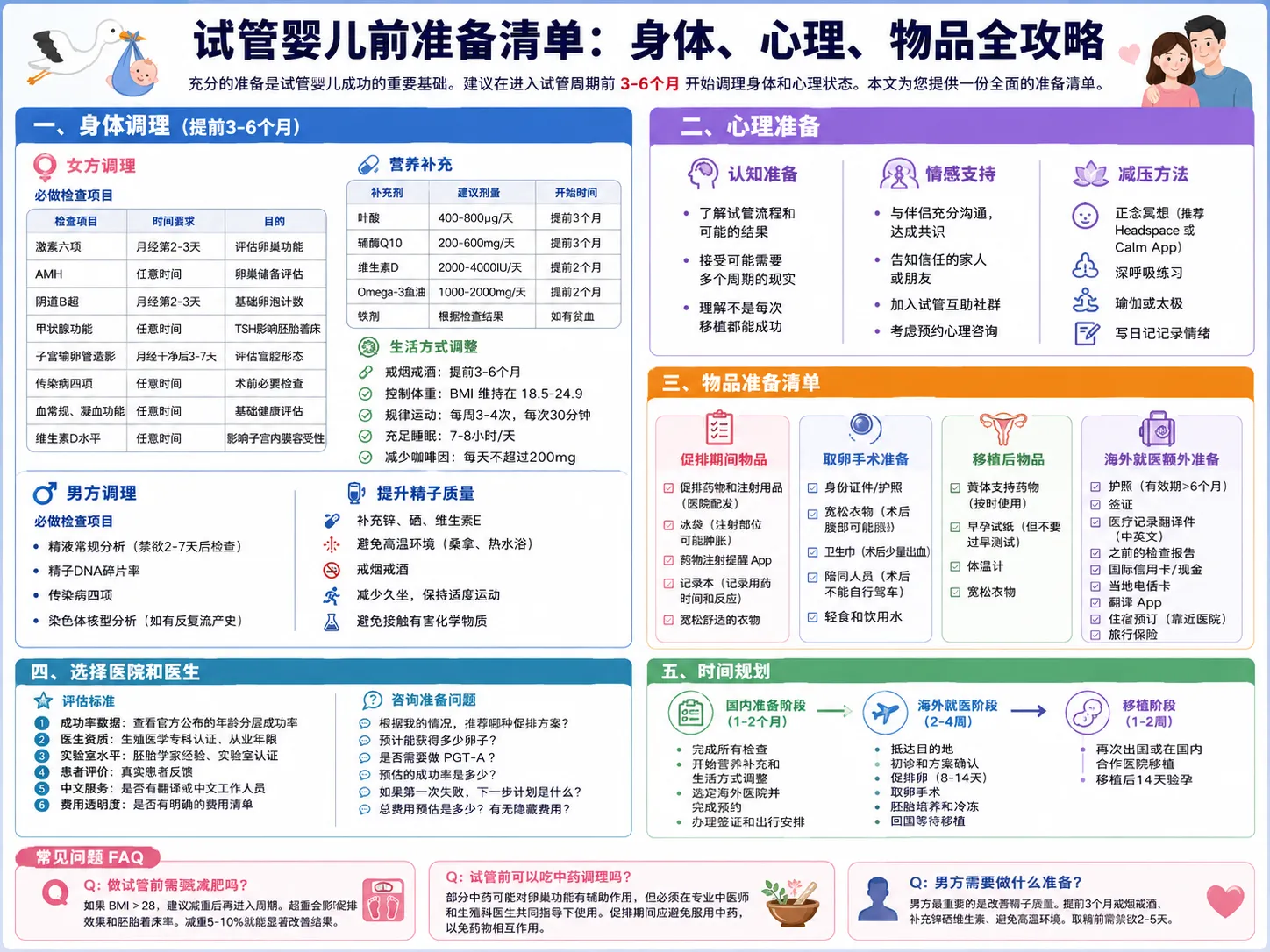
Body Preparation: Health Checks 3–6 Months Before IVF
The pre-cycle window lets you detect and correct health issues before medications start, when changes to body weight, nutrition, and hormone levels can still influence egg and sperm quality.
“Preconception health refers to the health of women and men during their reproductive years, before conception.” — World Health Organization (WHO), 2023
The World Health Organization and the American Society for Reproductive Medicine, ASRM both treat this pre-treatment period as an active care window, not idle waiting time.
Which Medical Tests Does the Female Partner Need?
| Test | Timing | Purpose |
|---|---|---|
| Sex hormone panel (6 markers) | Day 2–3 of the menstrual cycle | Baseline ovarian function |
| AMH (anti-Müllerian hormone) | Any time | Ovarian reserve assessment |
| Transvaginal ultrasound | Day 2–3 of the menstrual cycle | Antral follicle count (AFC) |
| Thyroid function | Any time | TSH affects embryo implantation |
| Hysterosalpingography (HSG) | Days 3–7 after menstruation ends | Uterine cavity assessment |
| Infectious disease panel (4 markers) | Any time | Mandatory pre-treatment screening |
| Complete blood count and coagulation | Any time | Baseline health assessment |
| Vitamin D level | Any time | Affects endometrial receptivity |
Which Supplements Should You Take Before IVF?
| Supplement | Suggested Dose | When to Start |
|---|---|---|
| Folic acid | 400–800 mcg/day | 3 months before |
| Coenzyme Q10 (CoQ10) | 200–600 mg/day | 3 months before |
| Vitamin D | 2,000–4,000 IU/day | 2 months before |
| Omega-3 fish oil | 1,000–2,000 mg/day | 2 months before |
| Iron | Per test results | Only if anemic |
Confirm every supplement with your fertility doctor before starting — doses above are general guidance from the pre-treatment protocol used at most reproductive centers.
What Lifestyle Changes Improve IVF Readiness?
- Quit smoking and alcohol: 3–6 months before your cycle
- Control body weight: keep BMI between 18.5 and 24.9
- Exercise regularly: 3–4 sessions per week, 30 minutes each
- Sleep enough: 7–8 hours per day
- Cut caffeine: no more than 200 mg per day
How Should the Male Partner Prepare?
Sperm quality is half the equation, and the ACOG fertility treatment FAQ recommends evaluating both partners from the first visit.
Required tests:
- Semen analysis (after 2–7 days of abstinence)
- Sperm DNA fragmentation index
- Infectious disease panel (4 markers)
- Chromosome karyotype analysis (if there is a history of recurrent miscarriage)
To improve sperm quality:
- Supplement with zinc, selenium, and vitamin E
- Avoid high-heat environments such as saunas and hot baths
- Quit smoking and alcohol
- Reduce prolonged sitting; keep moderate exercise
- Avoid contact with harmful chemicals
How Can You Prepare Mentally for IVF?
Emotional preparation matters as much as physical preparation, because IVF involves uncertainty, hormones, and waiting periods.
Cognitive Readiness
- Understand the IVF process and its possible outcomes before you start
- Accept that more than one cycle may be needed
- Recognize that not every transfer results in a pregnancy
Emotional Support
- Communicate openly with your partner and reach shared decisions
- Tell trusted family members or friends
- Join an IVF support community
- Consider booking a counseling session in advance
Stress-Relief Methods That Work
- Mindfulness meditation (apps such as Headspace or Calm)
- Deep-breathing exercises
- Yoga or tai chi
- Journaling to track emotions
What Should You Pack for Each Stage of IVF?
During Ovarian Stimulation
- Stimulation medications and injection supplies (provided by the clinic)
- Ice pack (injection sites may swell)
- Medication reminder app
- Notebook to log injection times and reactions
- Loose, comfortable clothing
On Egg Retrieval Day
- ID card / passport
- Loose clothing (abdominal bloating is common afterwards)
- Sanitary pads (light spotting after the procedure)
- An accompanying person — you cannot drive yourself home
- Light food and drinking water
After Embryo Transfer
- Luteal phase support medications (use on schedule)
- Home pregnancy tests (but avoid testing too early)
- Thermometer
- Loose clothing
Extra Items for Treatment Abroad
- Passport valid for more than 6 months
- Visa
- Translated medical records (both languages)
- All previous test reports
- International credit card and cash
- Local SIM card
- Translation app
- Accommodation booked near the clinic
- Travel insurance
How Do You Choose the Right IVF Hospital and Doctor?
Compare clinics on six criteria before committing:
- Success rate data — look for officially published, age-stratified results like those tracked by the CDC ART program
- Doctor credentials — reproductive medicine certification and years of practice
- Laboratory standards — embryologist experience and lab accreditation
- Patient reviews — feedback from real patients
- Language services — interpreters or Chinese-speaking staff
- Cost transparency — a clear, itemized price list
Questions to Ask at Your First Consultation
- Given my situation, which stimulation protocol do you recommend?
- How many eggs am I likely to retrieve?
- Do I need PGT-A screening?
- What is my estimated success rate? (See IVF success rates by age for baseline data.)
- If the first cycle fails, what is the next step?
- What is the total estimated cost, and are there hidden fees?
How Long Does IVF Preparation Take?
Home-Country Preparation Phase — 1–2 Months
- Complete all baseline tests
- Start supplements and lifestyle changes
- Select the overseas hospital and finish booking
- Arrange visa and travel
Treatment Phase Abroad — 2–4 Weeks
- Arrive at the destination
- Initial consultation and protocol confirmation
- Ovarian stimulation (8–14 days)
- Egg retrieval procedure
- Embryo culture and freezing
- Return home to await transfer
Transfer Phase — 1–2 Weeks
- Travel again for transfer, or complete it at a partner clinic at home
- Pregnancy test 14 days after transfer
FAQ
Q: Do I need to lose weight before IVF?
If your BMI is above 28, losing weight before starting treatment is recommended. Excess weight reduces stimulation response and embryo implantation rates, and a loss of just 5–10% of body weight can significantly improve outcomes.
Q: Can I take herbal medicine or Chinese medicine before IVF?
Some herbal remedies may support ovarian function, but only use them under the joint guidance of a qualified herbalist and your fertility doctor. During the 8–14 day stimulation window, stop herbal products to avoid drug interactions.
Q: How should the male partner prepare, and for how long?
The single most important goal is better sperm. Quit smoking and alcohol 3 months ahead, take zinc, selenium, and vitamins, and avoid high-heat environments.
Before sperm collection, observe 2–5 days of abstinence.
Q: When should I start taking folic acid and CoQ10?
Start both 3 months before your planned cycle: folic acid at 400–800 mcg per day and CoQ10 at 200–600 mg per day. Vitamin D (2,000–4,000 IU) and omega-3 fish oil (1,000–2,000 mg) begin 2 months before.
Q: How many days a week should I exercise before IVF?
Aim for 3–4 sessions of about 30 minutes per week, combined with 7–8 hours of sleep each night. Once stimulation begins, switch to gentle activity only, because enlarged ovaries are vulnerable to torsion.
Q: How long do I need to stay in the country where I am treated?
Plan on 2–4 weeks abroad for the stimulation-to-retrieval phase, plus a separate 1–2 week visit for the frozen embryo transfer. Your pregnancy test happens 14 days after transfer.
Start Early, Plan Every Detail
Good preparation measurably improves your odds: begin conditioning at least 3 months ahead and choose an experienced hospital and doctor. To compare accredited clinics and labs, browse our IVF hospital directory, or contact our team for a personalized preparation plan.
This article was researched and written by the ProIVF Medical Editorial Team and reviewed by the ProIVF Medical Advisory Board. It is for informational purposes only and does not constitute medical advice; always confirm your individual plan with a qualified fertility specialist.
Last updated: 2026-09-20