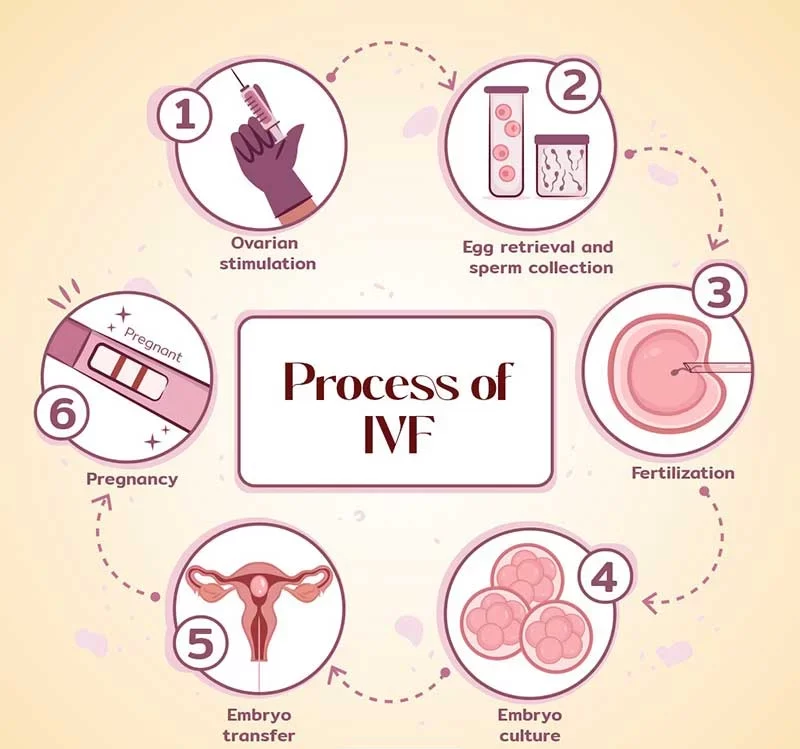
IVF is not a single treatment but a system of precision medical procedures — five core phases (ovarian stimulation, egg retrieval, fertilization, embryo culture, embryo transfer), each with several technical pathways. Choosing the right stimulation protocol can raise egg yield by 30-50%, and transfer timing alone can move live birth rates by roughly 10 percentage points, so the medical logic behind each step matters as much as the steps themselves.
Over 2 million IVF cycles are performed worldwide each year, and about 2.3 of every 100 US newborns were conceived through IVF (source: CDC ART surveillance). A complete cycle — from the first stimulation injection to the pregnancy test — takes 4 to 6 weeks.
This page is the procedure-level hub: it explains the clinical rationale and decision points inside each phase. If you want the basics of what IVF is, start with our What is IVF guide; if you want a patient’s-eye walkthrough of a cycle, read How is IVF done step by step.
What Are the Five Core Medical Phases of IVF?
A complete IVF procedure consists of 5 core phases, each offering multiple technical pathways. The phase-by-phase detail follows; the short version is that phases 1-2 happen at the clinic, phases 3-4 happen in the embryology lab, and phase 5 closes the cycle.
Phase 1: Ovarian Stimulation and Follicle Monitoring
The procedure begins with exogenous gonadotropins (containing FSH and LH) to make multiple follicles develop at once — a natural cycle matures only one egg, while IVF needs several to maximize per-cycle success. Stimulation typically runs 8-14 days depending on the protocol chosen.
Common stimulation protocols compared:
| Protocol | Candidates | Duration | Key features |
|---|---|---|---|
| GnRH antagonist | Most patients, especially PCOS and advanced age | 10-12 days | Shorter cycle, lower OHSS risk |
| Long (down-regulation) | Normal ovarian reserve, endometriosis | 3-4 weeks | Better follicle synchrony, longer cycle |
| Mild stimulation | Low ovarian reserve (AMH < 1) | 8-10 days | Lower medication dose, fewer but potentially better eggs |
| Natural cycle | Extreme poor responders or patients avoiding medication | Per cycle | No stimulation; 1 naturally matured egg |
Monitoring means a transvaginal ultrasound every 1-3 days to measure follicle diameter, plus serum estradiol (E2) blood tests. When lead follicles reach 17-20mm, a trigger shot (hCG or GnRH agonist) finalizes oocyte maturation. For protocol selection in depth, see our IVF stimulation protocols guide.
Phase 2: Egg Retrieval
Egg retrieval (oocyte retrieval) is the only invasive step of the IVF procedure, performed under IV sedation or light anesthesia — patients sleep through it and feel nothing during the aspiration. Most describe waking as “like a nap,” with only mild period-like cramping that resolves within 1-2 days.
The technical sequence:
- A transvaginal ultrasound probe with a needle guide locates each follicle
- A 17G or 18G needle passes through the vaginal fornix into the follicle
- Follicular fluid is aspirated under negative pressure (100-120 mmHg)
- The embryologist immediately identifies and isolates cumulus-oocyte complexes from the fluid
The procedure takes 20-30 minutes, and 8-15 eggs is the ideal yield depending on ovarian reserve and stimulation response. Patients leave after 1-2 hours of observation.
Phase 3: Fertilization
Fertilization begins 2-6 hours after retrieval, and the method is chosen by semen parameters and diagnosis. Conventional IVF and ICSI remain the two workhorses, with PICSI and IMSI as specialized variants:
| Method | Technique | Indications | Fertilization rate |
|---|---|---|---|
| Conventional IVF | Each egg incubated with ~50,000-100,000 sperm | Normal semen parameters | ~70-80% |
| ICSI (intracytoplasmic sperm injection) | A single sperm is injected directly into the ooplasm | Severe oligoasthenozoospermia, prior failed fertilization, frozen sperm | ~70-85% |
| PICSI (physiological ICSI) | Sperm selected by hyaluronan binding | High sperm DNA fragmentation | 62-75% |
| IMSI (high-magnification ICSI) | Sperm morphology screened at 6000x magnification | Repeated ICSI failure | 60-70% |
Fertilization is confirmed 16-18 hours later (Day 1) by checking for two pronuclei (2PN) — the hallmark of normal fertilization.
Phase 4: Embryo Culture
Embryos are cultured for 3-6 days, and modern labs use time-lapse incubation that photographs each embryo every 5-10 minutes for AI-assisted assessment without disturbing the culture environment. The culture milestones and their clinical meaning:
| Day | Stage | Cell count | Clinical significance |
|---|---|---|---|
| Day 1 | Pronuclear | 1 cell | Fertilization confirmed |
| Day 3 | Cleavage | 6-10 cells | Optional transfer point, but lower implantation rate |
| Day 5 | Early blastocyst | 50-150 cells | Highest implantation rate; suitable for PGT biopsy |
| Day 6 | Expanded blastocyst | 150-200 cells | Transferable or freezable; slightly lower rate than Day 5 |
Phase 5: Embryo Transfer and Luteal Support
Embryo transfer is the final step — operationally the simplest yet one of the most technique-dependent. Ultrasound-guided transfer improves implantation by roughly 6-8% compared with “clinical touch” transfer, which is why modern transfers are always done under abdominal ultrasound guidance.
Fresh versus frozen transfer decision:
| Parameter | Fresh transfer | Frozen transfer |
|---|---|---|
| Timeline | 3-5 days after retrieval | 1-2 menstrual cycles later |
| Conditions | Endometrium > 7mm, normal E2, no OHSS risk | PGT screening, OHSS risk, endometrial preparation |
| Clinical live birth rate (SART data) | ~45-50% (by age) | ~50-55% (by age) |
| Advantages | Shorter cycle, saves time | Better uterine receptivity, enables genetic screening |
Luteal support starts immediately after transfer — vaginal progesterone (Crinone, Utrogestan) or intramuscular progesterone — continuing to 10-12 weeks of pregnancy if gestation is confirmed. For post-transfer care details, see our embryo transfer aftercare guide.
Which IVF Procedure Variant Fits Your Case?
IVF is not one-size-fits-all; clinicians choose among several procedure variants based on diagnosis and prognosis. The five main variants are described below.
Conventional IVF — Standard Protocol
The full 5-phase procedure, indicated for tubal factor infertility, ovulatory disorders, and unexplained infertility. Its strengths are maturity and wide applicability; the trade-off is the highest medication load among the variants.
ICSI Procedure
Originally developed for male factor infertility, ICSI is now used in over 70% of US IVF cycles — SART data — and some clinics apply it to every cycle. The ASRM Practice Committee nonetheless recommends reserving it for clear indications only.
Mosaic Embryo Transfer
When only chromosomally mosaic embryos are available, transfer of low-level mosaics after genetic counseling can still result in a live birth. This is a special pathway within the IVF procedure, and about 3-5% of PGT cycles face this decision.
Natural Cycle IVF
No or minimal stimulation medication is used, retrieving 1-2 eggs per natural ovulation. It suits patients with extremely low ovarian reserve, poor medication response, or a wish to avoid drug side effects.
Per-cycle success is lower, but so is per-cycle cost (~$3,000-$5,000 in the US).
Mild Stimulation IVF
A middle path between conventional and natural cycle IVF, using lower gonadotropin doses to target 2-6 eggs. A 2023 Cochrane systematic review (3,265 patients) found no statistically significant difference in live birth rates versus conventional stimulation (OR 0.92, 95% CI 0.78-1.09), while OHSS risk fell by about 60%.
What Are the Key Medical Decision Points in an IVF Cycle?
Four decision nodes inside the procedure shape the entire treatment path, based on ASRM Practice Committee guidelines and clinical consensus:
Decision 1: ICSI or conventional IVF?
- Normal semen parameters → conventional IVF
- Sperm concentration < 15×10⁶/mL, motility < 32%, or prior failed fertilization → ICSI
Decision 2: Day 3 transfer or blastocyst culture?
- 3 or more good-quality embryos → culture to Day 5 blastocyst
- Only 1-2 embryos → consider Day 3 transfer to avoid culture failure
Decision 3: To screen with PGT or not?
- Age ≥ 38, recurrent miscarriage, or known genetic carrier status → recommended (at 38, roughly 40% of embryos are aneuploid, so PGT avoids wasted transfers)
- Age < 35 with no special history → not mandatory; individualize (euploidy rate in this group is about 60-70%)
- Details in our PGT genetic screening guide
Decision 4: Fresh or frozen transfer?
- E2 < 3000 pg/mL and endometrium > 7mm → fresh transfer is reasonable
- OHSS risk or PGT cycle → freeze-all strategy
“Ask your clinic to explain the indication behind every choice in your protocol — ICSI, blastocyst culture, PGT, fresh or frozen. A protocol you understand is a protocol you can audit.” — ProIVF Medical Advisory Board, on informed consent for IVF treatment plans, 2026
What Do Real Patients Go Through? Three Procedure Paths
All cases are anonymized examples based on common clinical scenarios.
Case 1: Frozen transfer with PGT-A at 38 — Ms. Wang, 38, Beijing
At 38, Ms. Wang in Beijing reached a successful pregnancy by freezing and transferring one PGT-A-selected euploid blastocyst, at a total cost of about ¥85,000.
At 38 with AMH 1.8 ng/mL, Wang ran a 12-day antagonist protocol and retrieved 9 eggs. Conventional IVF fertilized 7, and 5 reached blastocyst. PGT-A showed 3 euploid, 1 mosaic, 1 abnormal. One euploid blastocyst was frozen and transferred the next month; the 14-day hCG read 568 mIU/mL — a successful pregnancy. Total cost including PGT: about ¥85,000. “What I agonized over most was whether to do PGT,” she says. “The doctor said the aneuploidy rate at 38 is about 40%, so screening avoids wasted transfers — and it was meaningful: only 3 of 5 were normal.”
Case 2: Three ICSI cycles to success — Ms. Zhao, 35, Shenzhen
Ms. Zhao, 35, in Shenzhen needed three ICSI cycles for severe male factor infertility before a frozen transfer led to a live birth, at a total cost of about ¥180,000.
Zhao and her husband faced severe male factor infertility (sperm concentration 2 million/mL). Cycle 1: 10 eggs retrieved, 5 fertilized by ICSI, no blastocysts. Cycle 2 with a changed stimulation protocol: 12 eggs, 8 fertilized, 2 blastocysts — the fresh transfer failed. Cycle 3 switched the culture system to time-lapse: 14 eggs, 10 fertilized, 4 blastocysts — the first frozen transfer ended in a live birth. Total for three cycles: about ¥180,000. “When they told me after the first retrieval there were zero blastocysts, I have no words,” Zhao recalls. “The doctor said sometimes it is luck — change the protocol and keep trying. The time-lapse culture added ¥5,000, but watching embryo development in real time put us at ease.”
Case 3: Mild stimulation IVF at 41 — Ms. Chen, 41, Guangzhou
Ms. Chen, 41, in Guangzhou used mild stimulation to accumulate 3 embryos; transferring the single euploid blastocyst led to a pregnancy delivered at 38 weeks, at a total cost of about ¥65,000.
At 41 with AMH of only 0.6 ng/mL, Chen yielded just 3 eggs on conventional stimulation. Her doctor switched to mild stimulation — 75 IU FSH daily plus oral letrozole — collecting 1-2 eggs per cycle. Over two mild-stim cycles she accumulated 3 embryos (including one Day 5 blastocyst) and sent all to PGT-A; only one blastocyst was euploid. That single embryo was transferred and resulted in a pregnancy delivered vaginally at 38 weeks — a 3.2 kg girl. Total cost: about ¥65,000 for two retrieval cycles plus one frozen transfer. “Mild stimulation meant coming to the hospital each month like a natural cycle,” Chen says. “More visits, far fewer injections. The doctor said quality beats quantity — and one right embryo was all it took.”
FAQ
Q: How long does the full IVF procedure take?
A complete IVF cycle (excluding pre-cycle workup) takes 4-6 weeks: 10-14 days of stimulation, 1 day for retrieval, 3-6 days of embryo culture, then a 10-14 day wait for the pregnancy test. With PGT screening or frozen transfer, the timeline extends to 2-3 months.
Q: Is egg retrieval risky?
Egg retrieval is generally safe. The common aftereffects are bloating and mild abdominal pain for 1-2 days; serious risks are rare — bleeding about 0.2%, infection 0.1-0.5%, ovarian torsion about 0.1% — and severe complications occur in under 1% of procedures.
Q: Which has higher success rates: conventional IVF or ICSI?
They are comparable within their indicated populations. With normal sperm parameters, conventional IVF (fertilization rate ~70-80%) and ICSI (~70-85%) show no significant difference in fertilization or live birth rates; with severe male factor infertility, ICSI is clearly superior.
ASRM guidelines do not recommend routine ICSI without male factor indications.
Q: What medications are used in the IVF procedure?
Stimulation uses FSH preparations (Gonal-F, Puregon), hMG (Menopur), GnRH antagonists (Cetrotide, Ganirelix), and the trigger shot (Ovidrel hCG or Lupron). After transfer, luteal support continues with progesterone preparations through 10-12 weeks of a confirmed pregnancy.
Q: Can embryos fail to reach the blastocyst stage?
Yes — that is the real trade-off of extended culture. Only about 40-60% of fertilized eggs develop to blastocyst, so with just 1-3 embryos doctors may recommend Day 3 transfer instead, to avoid ending up with nothing to transfer.
Q: What should change after a failed first IVF cycle?
Common adjustments include switching the stimulation protocol (e.g., antagonist to long or mild), adding ICSI after poor fertilization, doing PGT-A for advanced age or miscarriage history (at 38, roughly 40% of embryos are aneuploid), moving to frozen transfer after a failed fresh cycle, or changing clinics — 15-20% of patients ultimately need multiple cycles. A full cycle-review meeting with your doctor is the right first step.
Q: What does an IVF procedure cost?
A single conventional IVF cycle in the US costs roughly $15,000-$25,000 including medications. In China, a top-tier hospital cycle runs ¥30,000-¥50,000, with ICSI adding ¥5,000-¥8,000 and PGT adding ¥20,000-¥40,000.
Clinics in Thailand, Mexico, and Spain typically charge 40-60% less than US prices — see our IVF cost guide for country-by-country detail.
Q: Which countries have the highest IVF success rates?
Compare success data by age group, never in aggregate. The CDC publishes annual clinic-level results, and top US clinics exceed 60% live birth rates for women under 35; leading clinics in Spain, the Czech Republic, and Greece post similar results.
See our world’s best IVF clinics guide and IVF success rates by age. Sources: CDC ART, SART, HFEA.
How Should You Plan Your IVF Procedure?
Understanding the medical logic and decision basis behind each phase is worth more than memorizing the step sequence:
- Complete a full fertility workup first — AMH, hormone panel, and semen analysis are the basis for choosing the procedure; see our IVF preparation checklist
- Discuss procedure choices with your doctor — ICSI? PGT? Fresh or frozen? Every decision has a specific medical indication
- Judge the laboratory — time-lapse culture, vitrification technology, and embryologist experience directly shape procedural success
- Plan financially — one cycle may not be enough; 15-20% of patients need multiple cycles
Ready to start? Begin by comparing vetted fertility clinics worldwide — procedure offerings, success rates, and transparent pricing differ substantially by country and center.
Last updated: July 13, 2026. This article is for informational purposes only and does not constitute medical advice. IVF procedure selection and specific protocols vary with individual medical history, clinic capabilities, and location; consult a licensed reproductive endocrinologist and verify all information directly with your chosen clinic before starting treatment.
Content Authorship and Sources
This article was written by the ProIVF Medical Editorial Team and reviewed by the ProIVF Medical Advisory Board, based on the latest clinical guidelines and publicly available data from ASRM, the CDC, SART, and the HFEA.
- American Society for Reproductive Medicine (ASRM) — Practice Committee Guidelines
- Centers for Disease Control and Prevention (CDC) — ART Success Rates
- Society for Assisted Reproductive Technology (SART) — National Reports
- Human Fertilisation and Embryology Authority (HFEA) — UK IVF Success Rates