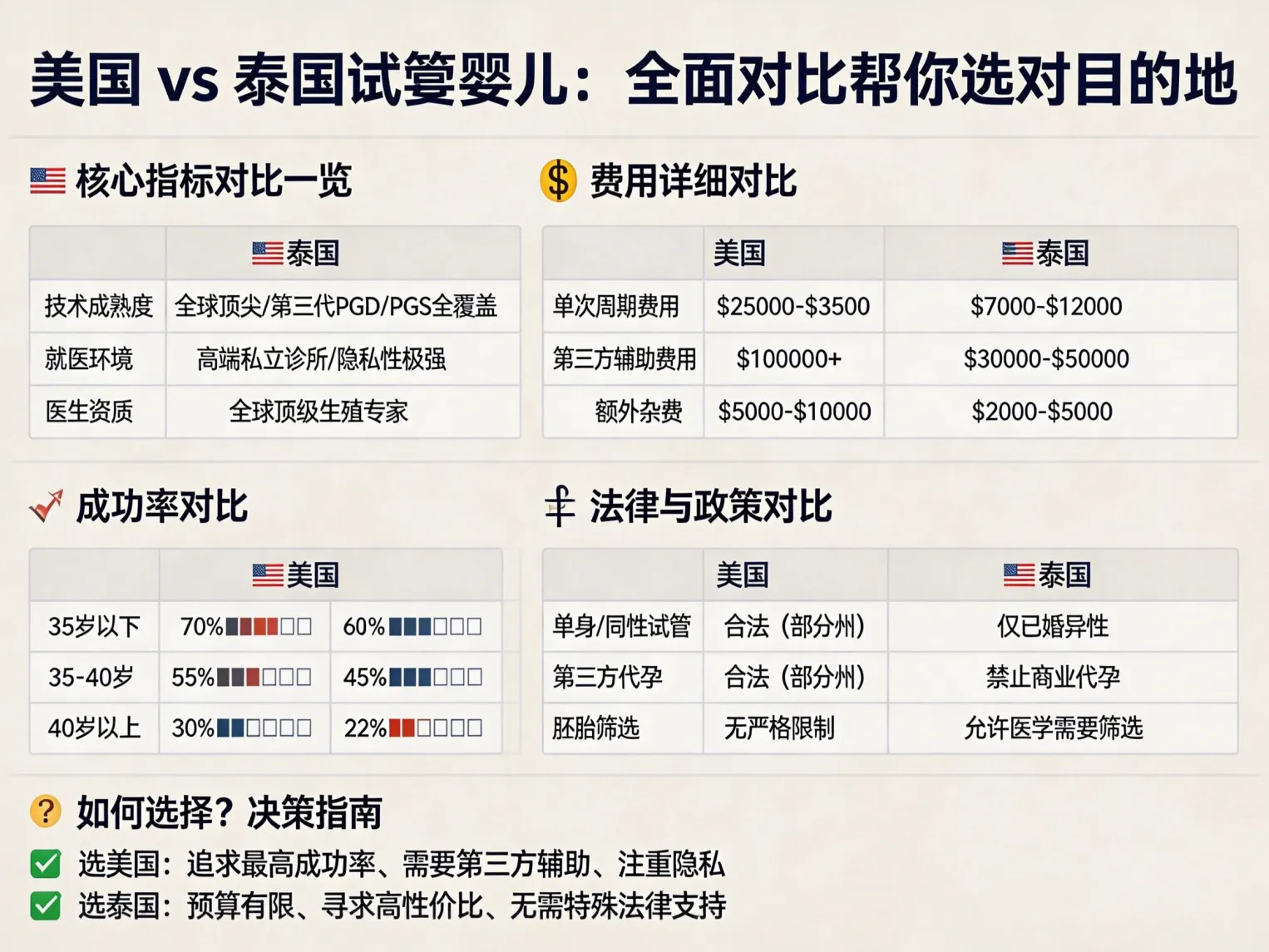
The United States and Thailand are the two most popular IVF destinations for Asian families, and they answer different needs: the US delivers world-leading technology at $15,000–$30,000 per cycle, while Thailand delivers comparable under-35 results (40–48% vs 42–50%) at $6,000–$12,000. Success rates are close for routine cases; legal access to gender selection, donor eggs, and surrogacy separates them sharply across cost, outcomes, technology, patient experience, and law.
USA vs Thailand IVF at a Glance
Thailand wins on price and proximity; the US wins on technology breadth and legal flexibility.
| Dimension | USA | Thailand |
|---|---|---|
| Total cost (incl. medication) | $15,000–$30,000 | $6,000–$12,000 |
| Success rate under 35 | 42–50% | 40–48% |
| Flight time (from China) | 12–15 hours | 3–5 hours |
| Visa difficulty | Moderate (B1/B2) | Easy (visa on arrival / visa-exempt) |
| Chinese-language service | At some hospitals | At most hospitals |
| PGT-A legality | Fully legal | Legal |
| Gender selection | Legal | Illegal (banned by law) |
| Egg donation | Legal, abundant donors | Legal but limited donors |
| Surrogacy | Legal in some states | Commercial surrogacy banned |
| Medical standard | World-leading | International standard |
How Do the Costs Compare in Detail?
Thailand’s all-in cost runs at roughly 40–50% of US pricing for comparable lab work. The line-item breakdowns below show where the difference comes from.
USA IVF Cost Breakdown
| Item | Cost |
|---|---|
| IVF base cycle | $12,000–$15,000 |
| Stimulation medication | $3,000–$6,000 |
| PGT-A screening | $3,000–$5,000 |
| ICSI | $1,500–$2,500 |
| Frozen embryo transfer | $3,000–$4,000 |
| Total (with PGT-A) | $20,000–$30,000 |
Thailand IVF Cost Breakdown
| Item | Cost |
|---|---|
| IVF base cycle | $4,000–$7,000 |
| Stimulation medication | $2,000–$4,000 |
| PGT-A screening | $1,500–$3,000 |
| ICSI | $800–$1,500 |
| Frozen embryo transfer | $1,500–$2,500 |
| Total (with PGT-A) | $8,000–$15,000 |
Cost verdict: Thailand totals about 40–50% of US cost across every line item. For a full picture of pricing in all major destinations, see our 2026 IVF cost guide.
How Do Success Rates Compare by Age?
The two countries are statistically close at every age band, and Thailand even edges ahead over 40 in reported ranges.
| Age Group | USA Live Birth Rate | Thailand Live Birth Rate |
|---|---|---|
| Under 35 | 42–50% | 40–48% |
| 35–37 | 35–40% | 33–42% |
| 38–40 | 25–30% | 24–33% |
| Over 40 | 10–18% | 12–20% |
Success verdict: The gap is small overall. Top US centers such as HRC Fertility and SCRC run slightly above Thailand’s national average, and US labs carry the deepest experience with complex cases.
US baseline outcomes are tracked in the CDC ART program:
“In the United States, the percentage of infants conceived with assisted reproductive technology (ART) increased from 1.24% in 2004 to 1.75% in 2018.” — U.S. Centers for Disease Control and Prevention (CDC), NCHS Data Brief, 2019
Which Country Has Better Technology?
The US leads reproductive research outright; Thailand’s flagship clinics cover mainstream needs to international standard.
Where the US Leads
- Global leader in reproductive medicine research.
- Most advanced embryo culture systems, including time-lapse imaging.
- The most comprehensive PGT testing platforms.
- AI-assisted embryo evaluation at select centers.
- The largest pipeline of clinical trials and novel therapies.
Where Thailand Stands
- Mainstream clinics run internationally standard equipment.
- Jetanin Hospital, BNH Hospital, and Superior A.R.T. are the best-regarded names.
- Many Thai embryologists trained overseas.
- Fully capable for the large majority of routine IVF cases.
Clinic-level US data can be explored through the Society for Assisted Reproductive Technology, SART; Thai clinics are profiled in our Thailand hospital directory.
What Is the Patient Experience Like?
Both destinations require a 2–3 week stay per treatment phase, but daily costs and language support differ sharply.
USA
- Language: English primary; some hospitals offer Chinese interpreters or Chinese-speaking doctors.
- Care model: Appointment-based with unhurried consultations.
- Facilities: Top-tier hardware.
- Stay length: About 2–3 weeks — retrieval and transfer may require two trips.
- Living costs: High at $150–$300 per day for lodging and meals.
Thailand
- Language: Most fertility centers staff dedicated Chinese interpreters.
- Care model: Streamlined workflows with deep experience serving Chinese patients.
- Facilities: Close to international standard.
- Stay length: About 2–3 weeks.
- Living costs: Low at $50–$100 per day.
Is Gender Selection Legal in Thailand or the USA?
No — Thai law prohibits non-medical sex selection, while the US allows it. The full legal matrix drives most destination decisions:
| Item | USA | Thailand |
|---|---|---|
| Gender selection | Legal | Prohibited by law |
| Egg donation | Legal, anonymous or open options | Legal but limited donor supply |
| Sperm donation | Legal | Legal |
| Surrogacy | Legal in some states (e.g., California) | Commercial surrogacy banned since 2015 |
| LGBT+ family building | Legal | Partial restrictions |
| Embryo freezing | No time limit | Regulated limits apply |
Professional guidance on the ethics of sex selection is published by the American Society for Reproductive Medicine, ASRM.
How to Choose: USA or Thailand?
Neither country is universally better — the right answer falls out of your budget, diagnosis, and legal needs.
Choose the USA If You:
- Want the highest available technology and success rates.
- Need gender selection.
- Need donor eggs.
- Need surrogacy services.
- Have a budget above $20,000.
- Have a complex infertility diagnosis that needs top specialists.
Choose Thailand If You:
- Prioritize cost-effectiveness.
- Have a routine diagnosis (tubal factor, mild male factor).
- Do not need gender selection.
- Have a budget of $8,000–$15,000.
- Prefer a 3–5 hour flight and an easy visa.
- Need Chinese-language service throughout treatment.
Other Destinations Worth Comparing
- Malaysia: even better value than Thailand, with Chinese-friendly hospitals — see IVF hospitals in Malaysia.
- Japan: refined technology, culturally familiar, and short flights.
- Spain / Czechia: European options with abundant donor-egg programs.
FAQ
Q: Is Thailand’s IVF success rate really comparable to the US?
For patients under 35 the gap is small — 40–48% live birth in Thailand versus 42–50% in the US. Over 40, reported Thai ranges (12–20%) match or slightly exceed US figures (10–18%), though top US centers retain the advantage in complex cases because of deeper experience with difficult presentations.
Q: How long do I need to stay in the USA for IVF?
Plan on 2–3 weeks per phase. If retrieval and transfer are split, that means two trips of similar length — or one trip for retrieval plus freeze-all, returning 1–2 months later for the frozen transfer.
Some protocols allow remote monitoring to shorten US time.
Q: Can I choose my baby’s gender with IVF in Thailand?
No. Thai law bans sex selection for non-medical reasons, and PGT-A there may only be used for medical screening.
If family balancing matters to you, the USA or another permissive jurisdiction is required — a full US cycle with PGT-A runs $20,000–$30,000.
Q: What is the total cost difference between USA and Thailand IVF?
A full cycle with PGT-A costs $20,000–$30,000 in the USA versus $8,000–$15,000 in Thailand, and headline package pricing runs $15,000–$30,000 versus $6,000–$12,000. Thailand’s 3–5 hour flights and $50–$100 daily living costs shrink the travel gap further.
Q: Is PGT-A screening legal in Thailand?
Yes — PGT-A is legal in both countries, priced at $1,500–$3,000 per batch of embryos in Thailand versus $3,000–$5,000 in the USA. The legal divergence is what you may use genetic screening for: PGT-A for aneuploidy screening is permitted in Thailand, but non-medical sex selection is not, whereas it is legal in the USA.
Q: How much do daily living costs differ during treatment?
Roughly 3×: accommodation and meals run $150–$300 per day in the US versus $50–$100 per day in Thailand. Over a combined 4–6 week treatment course, that alone is a $3,000–$12,000 difference before any medical fees.
Which Destination Fits Your Family?
The USA and Thailand each win a different decision: buy technology, legal flexibility, and donor access in the US for $20,000+, or buy comparable routine outcomes at 40–50% of the cost with Chinese-language care in Thailand. Match the country to your diagnosis, budget, and legal needs — then match the clinic.
Compare vetted centers in both countries in our hospital directory or contact our advisors for a personalized recommendation.
This article was compiled by the ProIVF Medical Editorial Team and reviewed by the ProIVF Medical Advisory Board — about us. It is for informational purposes only and does not constitute medical advice — consult a qualified reproductive specialist about your individual case. Last updated: 2026-09-20.