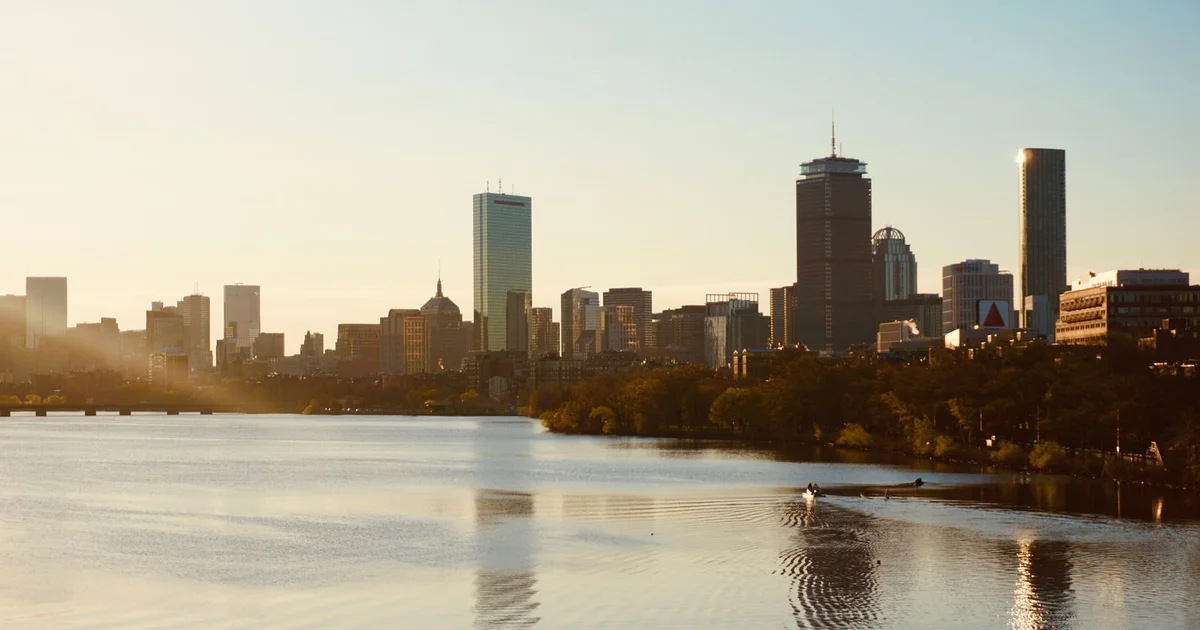
A single IVF cycle in Boston runs $18,000 to $32,000 before insurance, and most international patients spend 19 to 26 days in the United States across two trips. Boston offers something Los Angeles and most US cities do not: the density of an academic medical system — Massachusetts General and Brigham and Women’s, both Harvard Medical School teaching hospitals, sit together in the Longwood Medical Area, and Boston IVF’s flagship laboratory sits in Waltham.
What Boston asks in return is real logistics: there is no dependable nonstop from mainland China, winter storms can strand you or break a monitoring schedule, many MBTA stations still have no elevator, and Mandarin is not a standing service at most local clinics. This guide covers the ground after clinic selection: the visa, flights, Logan transfers, the 28-night rule that decides your housing options, transit, weather as a medical variable, diet, border restrictions, Massachusetts law and the timeline. For pricing see the US IVF cost overview and the IVF insurance guide; for the medical steps how IVF is done step by step, and for an introduction what is IVF.
Is Boston the Right IVF Destination for You?
Boston is not a value destination. It buys academic depth and a newly modernised parentage framework, and it costs you flight time, weather risk and language effort.
Where Boston genuinely wins
- Academic system depth. The Mass General Brigham infertility and reproductive surgery programme spans Massachusetts General Hospital and Brigham and Women’s Hospital and serves greater Boston and eastern Massachusetts. For patients over 40, repeated implantation failure, recurrent loss, PGT-M for single-gene disease, or fertility preservation before cancer treatment, multidisciplinary consultation inside one system is the point.
- One district for everything. Longwood Medical Area concentrates the hospitals, labs and specialty services, so a single trip can cover a consult, bloodwork, a scan and a surgical procedure.
- A parentage framework rewritten in 2025. The Massachusetts Parentage Act (2024 Chapter 166, effective January 1, 2025) puts donors, assisted reproduction and surrogacy into statute — donors are not legal parents, gestational surrogacy agreements are expressly permitted, and a parentage judgment can be sought before or after birth.
- Liveability. Compact, walkable, green, good air quality: a comfortable place to recover after transfer.
The downsides, stated plainly
- No reliable mainland-China nonstop. Hainan Airlines’ around-the-world Beijing-Boston rotation ends in summer 2026 (Simple Flying, 24 May 2026). Plan on one connection, 18-26 hours door to door.
- Winter is a treatment risk, not a comfort issue. A nor’easter can cancel flights and paralyse the MBTA on the same day: over 1,000-1,500 US flight cancellations during the December 2025 storm window, and near-pandemic cancellation levels in late January 2026. Monitoring appointments cannot move.
- Transit accessibility is thin. About 17 of 177 stations (9.5%) had full accessibility as of 2021; the elevator programme runs to mid-2027. Late stimulation and the 48 hours after retrieval mean taxis, not trains.
- Language. Several local practices list only English and Spanish for patients. Interpretation must be requested and confirmed in writing.
- Cost. $18,000-$32,000 per cycle, plus hotel rates averaging $311 a night.
If you are under 35 and budget-sensitive, home-country or Southeast Asian care costs a third to a fifth of Boston. If you want Mandarin at every step, shorter flights, or weather that cannot interrupt a cycle, Los Angeles is the better fit — see the US vs Thailand IVF guide and the California IVF cost guide. Choose Boston for complex-case academic care, or when the 2025 parentage framework is the decisive factor for your family-building plan.
Quick comparison
| Your situation | Better choice | Why |
|---|---|---|
| Budget-sensitive, under 35, standard IVF | Home country / Southeast Asia | A third to a fifth of Boston’s price |
| Non-medical sex selection | Thailand | US clinics refuse; see can you choose embryo gender |
| Age 40+, repeated failure, PGT-M, onco-fertility | Boston / New York | Academic multidisciplinary depth |
| Surrogacy or donation with statutory clarity | Boston (2025 Parentage Act) / California / New York | Three different frameworks; compare case by case |
| You need Mandarin routinely | Los Angeles | Consultant-level Chinese services exist there |
| You cannot do a 20-hour connection | Los Angeles | West Coast nonstops, 3-4 hours shorter |
| You will not drive and want walkable care | Boston / New York | Longwood is a walkable medical campus |
How Do You Get a US Visa for IVF Treatment?
There is no dedicated “medical visa”: IVF patients travel on the standard B1/B2 visitor visa and select Medical Treatment as the DS-160 purpose. Declare it honestly — being caught not saying so is far worse than saying it.
2026 fee breakdown
| Item | Amount | Notes |
|---|---|---|
| MRV application fee | $185 | Non-refundable |
| Visa Integrity Fee | $250 | PL 119-21, effective October 1, 2025 (FY2026); charged after issuance with no working refund path as of mid-2026 — treat as non-refundable |
| EVUS enrolment | ~$30 | New fee under H.R.1, effective September 30, 2025 (Fragomen, 28 Aug 2025; CBP FAQ, 4 Nov 2025). Litigation and adjustments have followed; confirm the live figure on evus.gov before you pay |
| Expedited interview | ~$750 | Select posts, limited slots |
So first-time application costs about $435 up front ($185 + $250). An existing 10-year visa normally needs only EVUS enrolment.
Five 2026 changes that break older itineraries
Interview-waiver (“drop-off”) eligibility was sharply narrowed from September 2, 2025: children under 14 and applicants over 79 now generally require an in-person interview, and several renewal categories lost the waiver (EY, 30 Jul 2025). Expect to be interviewed. From September 6, 2025, applicants should file in their country of residence or nationality. DS-160 must be submitted before booking and cannot be edited afterwards. Five years of social-media history must be disclosed and kept public during review. And nonimmigrant visa appointment release at US posts in China (Beijing, Shanghai, Guangzhou, Shenyang, Wuhan) has been on a limited-release basis with longer-than-usual processing since early 2025 (Boundless consulate tracker). Only the official wait-times page gives the current number — budget three to four months.
The medical-purpose document pack
Beyond passport, DS-160 confirmation, 51×51mm photo, employment letter, bank statements and asset proof, add a clinic invitation / treatment plan letter (usually issued after a $3,000-$5,000 deposit or first-visit fee), English translations of home labs (AMH, hormone panel, ultrasound, semen analysis), evidence you completed part of the workup at home, and a round-trip itinerary with lodging near the clinic. Book lodging near Longwood or Waltham — that is where the treatment happens, and it makes the file coherent.
Timing: remote consult and invitation letter at T-4 months; DS-160 and fees at T-3.5; interview at T-3 with a 2-8 week administrative buffer; flights and housing at T-1 with EVUS filed 72+ hours before departure; repeat labs at T-2 weeks.
At the border, say plainly: medical treatment, short stay. Your admitted length sits on the I-94, and a cycle needs 3-5 weeks, so explain your plan if you receive less. Never mention work. Because Boston is a university city, officers may ask about relatives studying nearby — answer truthfully, but do not signal long-term residence intent. Declare cash above $10,000, and declare every food and herbal item.
Do You Need a Connection? Flights to Boston
Plan on one connection. Realistic routings: via New York, Washington, Chicago or Atlanta (densest frequencies, most fare elasticity); via San Francisco, Los Angeles or Seattle if you are already on the West Coast (plus a 5-6 hour domestic segment and a 3-hour time change); or via Seoul (Korean Air and partners fly BOS-Incheon nonstop), Tokyo-Haneda or Taipei, which give a single connection from Asia directly into Boston.
Two planning rules matter more than the fare:
- Do not book on the assumption of a mainland nonstop. The market has no stable service, and the previously operated Hainan Airlines rotation ends in summer 2026. Verify the live timetable before building a cycle around a flight.
- A tight connection is a clinical risk, not a saving. During stimulation you may attend the clinic every 1-3 days, and one delayed inbound leg can cost you a monitoring slot, push a dose adjustment back, or end a cycle. Choose the routing with the widest buffer, and in winter buy refundable tickets.
US-China nonstop capacity remains below 2019 levels and is contested — US carriers objected to additional Air China frequencies (Reuters, 24 Sep 2026; Aviation Week, 21 Sep 2026). China-US round trips typically run RMB 8,000-15,000 in peak season, less off-peak; two round trips per cycle for one or two people is the figure to budget.
Getting in from Logan (BOS)
| Item | Detail |
|---|---|
| Terminals | A (Delta), B (American/United), C (JetBlue), E (international arrivals); A and B connect pre-security |
| Terminal E construction | Modernisation and expansion under way — walking routes and connection times shift; allow 2+ hours for a connection |
| Free rail-equivalent | Silver Line SL1 from the airport to South Station is free |
| Subway | Blue Line from Airport station into the city; 5-10 minute walk from arrivals |
| Taxi / rideshare | Pickup at Central Terminal Level 5; roughly $35 to Back Bay (peak and luggage push it higher — confirm in the app) |
| Driving in | Route 1 to Logan carries no tolls (Massport), an unusual advantage for a US airport |
Body logistics on a 20-hour trip
Long-haul economy plus a stimulated, high-oestrogen state is a venous thromboembolism stack: compression stockings, stand every 1-2 hours, ankle pumps, hydration, no alcohol or sedatives. Most stimulation medications need a 2-8°C cold chain — ice packs, hand luggage, and pack them where you can reach them at every security point on a two-leg journey. Boston runs on Eastern time, 12 hours ahead of Beijing in summer and 13 in winter: get daylight exposure on arrival and stop napping, because monitoring begins at 7:00 am regardless.
Where Should You Stay Near a Boston Fertility Clinic?
Boston’s housing decision is geographic in a way Los Angeles’ is not: the clinics are in two places. Mass General Brigham’s fertility care sits in the Longwood Medical Area (south-central, walkable, served by the Green Line D and E and eight bus routes), while Boston IVF’s flagship laboratory is in Waltham, 12 km west, on the MBTA Fitchburg commuter rail line out of North Station. Answer where your retrieval and transfer will happen before you look at a single listing.
| Area | Living | Commute to Longwood / Waltham | Asian groceries |
|---|---|---|---|
| Longwood / Fenway | Closest to MGH and Brigham, priciest | Walkable, 5-10 min / 25-40 min | Fair |
| Allston / Brighton | Cheaper, young, convenient food | 15-25 min (Green Line B or taxi) / 25-35 min | Fair (some Asian shops) |
| Back Bay / South End | Best amenities, easiest transit | 10-20 min / 25-40 min | Fair |
| Kendall Square / Cambridge | New apartments, expensive | 10-20 min / 20-35 min | Good |
| Downtown Boston | Hotels, free SL1 to the airport | 15-25 min / 30-45 min | Fair |
| Waltham / Burlington | Where Boston IVF’s lab campus sits; aparthotels and extended stay | 25-40 min / walkable or 5-15 min | Fair |
| Quincy | Residential, cheaper, Red Line to the city | 20-35 min (Red Line) | Good — 99 Ranch’s first New England store |
| Malden / Medford | Orange Line, lower rents | 25-40 min | Good — Super 88 |
Strategy A — Longwood walk zone: no morning commute at all, immediate rest after retrieval. The best clinical choice if you can pay for it. Strategy B — Waltham / Burlington extended stay: eliminates the two long trips that matter most (retrieval and transfer) and keeps other monitoring days on commuter rail or taxi. Strategy C — Quincy or Malden on a 28-night-plus lease: cheapest living and real Chinese grocery access, for a 20-40 minute commute.
The one hard lodging anchor: average Boston hotel rates run $311 a night over May 2024-April 2026 (Engine), with January the cheapest (~$166) and October the most expensive (~$458). Extended-stay lodging in the US broadly prices at $200-$1,000+ per week or $800-$6,000+ per month (Woodspring, 13 Jul 2026).
⚠️ The short-term rental rule: 28 nights is the line
Massachusetts layers a state rule over a city rule, and the practical answer is about night count.
- State level: under the 1988 Chapter 413 framework, letting a room for fewer than 30 days is limited to 30 days in total per calendar year for operators without a specific licence — and violations can be criminal (misdemeanour, fines, potentially up to two years).
- City of Boston (STRE regime): a rental of fewer than 28 consecutive nights is a short-term rental. It requires registration and a licence from the Inspectional Services Department ($25-$200 a year by unit type, not transferable on sale), the licence ID must appear in the listing, renewal and state inspection are annual, and the owner must live in the unit at least 9 of 12 months, with at most one additional adjacent unit offered and up to 365 short-term days a year. Violations suspend the licence; enforcement is largely complaint-driven, and a Boston University study (7 Nov 2025) found only 41% of listings carried a matchable licence ID.
- The conclusion for patients: 28 consecutive nights or more is not a short-term rental. A four-to-six-week stay signed as one tenancy sits outside the regime entirely — and avoids the 6% Massachusetts rooms tax.
- Neighbouring municipalities write their own rules (Cambridge requires separate registration; Brookline runs its own permitting; Waltham, Burlington and Quincy differ and are not verified here). Search ”
short term rental registration” before booking.
So: 28+ nights → sign a monthly lease and get a written contract (also your lodging proof for the visa and the border). Under 28 nights → hotel or extended-stay. If you use a platform listing, only take one showing a valid licence ID — the fines hit hosts, but the cancelled booking and the 1 am arrival with no room are yours.
Six things to verify before signing
Elevator (Boston is full of walk-up triples; climbing six floors after a retrieval is a disaster); heating and air conditioning (radiant heat and old radiators run loud; many units have no AC); a kitchen; a washer; independent bathroom and sound insulation; and the cancellation policy plus minimum term. Boston landlords routinely require 40× monthly rent in annual income, deposits of one month, and broker-fee listings are still common — confirm whether the quote includes heat, hot water, electricity and internet, because older New England buildings are not cheap to run.
Transit: Trains Reach Boston, Accessibility Does Not
MBTA fares
- Subway $2.40 per ride with a CharlieCard or contactless cap; higher with a CharlieTicket.
- Express buses $4.25 — with the free Silver Line SL1 airport segment as the one exception.
- From September 1, 2026: unlimited transfers, express-bus transfer prices cut to $1.70, the 50%-off commuter rail programme extended into November 2026, and a free-fare pilot for riders aged 75+ — while the Silver Line is excluded from the new rates (Governor Healey / MassDOT, 28 Jul 2026).
- Commuter rail is zone-priced (about $2.40-$13.25). Waltham is on the Fitchburg Line from North Station; frequencies are thin in the early morning and the last train back is early — check the timetable before relying on it for daily monitoring.
- A 7-day flex pass at roughly $25.75 beats 12 single rides by about 20%. But note: MBTA has no OMNY-style weekly free-ride cap — if you are commuting for three weeks, buy weekly passes deliberately.
Accessibility: the constraint that decides your commute
Roughly 17 of 177 stations (9.5%) were fully accessible as of 2021. The Red Line is fully accessible, Green Line East is largely so, and the Mattapan line is accessible — but the Orange Line, Blue Line and most of the Green Line still have gaps. The state’s Elevator Access 3 programme (announced December 2025) will add 23 elevators across 37 stations by June 30, 2027, which does not help you this cycle.
In practice: during late stimulation and for 48 hours after retrieval, take taxis. The ADA paratransit service The RIDE ($3.35 per trip, 365 days, roughly 5 am-1 am) requires advance eligibility registration that a visiting patient will not have time to complete — do not plan on it.
Inside Longwood Medical Area
LMA is served by MBTA routes 8, 39, 47, 60, 65, 66, CT2 and CT3 plus the Green Line D and E, and by the Longwood Collective’s medical-area shuttles (M2), some of which require an ID to board. If your clinic is in this campus, living on the Fenway or Longwood edge turns the commute into a ten-minute walk — the single highest-value housing decision in Boston.
Taxis, rideshare and whether to rent
Uber and Lyft are the workhorses: $12-$30 across the inner city, with heavy surges in rain, snow and airport peaks. Do not rent a car for downtown: metered and time-limited street parking, aggressive ticketing and towing, and parking you must rent separately at your building. A car makes sense only if you are based in Waltham or Burlington with an accompanying family member — and even then, no long drives for 48 hours after retrieval.
Apps: Google Maps (MBTA real-time and entrance data), MBTA.com / TransitApp or Citymapper, MBTA Commuter Rail timetables (mandatory, not optional), Uber, Lyft, Uber Eats / DoorDash / Fantuan / HungryPanda, Google Translate, and your clinic portal — Mass General Brigham patients use MyChart.
When Is the Best Season for IVF in Boston?
Boston’s weather is a medical variable. Four seasons, cold snowy winters, and a rigid treatment clock do not mix.
Monthly temperatures (average high / low, °C)
| Month | Jan | Feb | Mar | Apr | May | Jun | Jul | Aug | Sep | Oct | Nov | Dec |
|---|---|---|---|---|---|---|---|---|---|---|---|---|
| High | 3 | 4 | 8 | 13 | 19 | 24 | 28 | 26 | 22 | 17 | 11 | 6 |
| Low | -4 | -4 | 0 | 6 | 11 | 16 | 19 | 18 | 14 | 9 | 3 | -2 |
Snowfall concentrates in December-March — roughly 8.4 inches in January, 8.0 in February, 4.6 in March and 5.0 in December, about 43 inches a year. July is the muggiest and most thunderstorm-prone month.
- April-May — recommended. 13-19°C, no operational weather risk, though April swings 8°C to 22°C inside a fortnight and tree pollen starts.
- June-August — the most schedule-proof window. 24-28°C, up to 15 hours of daylight, and zero chance of a storm cancelling your monitoring day. Downside: this is peak hotel season, and July brings humidity and thunderstorms.
- September-November — the most beautiful, with a hard edge. 17-22°C and famously good foliage, ideal for gentle walking after transfer. But October is the most expensive hotel month (~$458/night), and from November the odds of disruptive weather climb sharply.
- December-March — think carefully. January averages -4°C at night with regular snow. A nor’easter delivers three problems at once: mass flight cancellations (1,000-1,500+ in a single day during the December 2025 storm “Devin” window; near-pandemic levels in late January 2026), MBTA breakdown (40% of buses late on 23 Jan 2025, 54% on 6 Feb 2025, Red Line suspended on 19 Jan 2026), and you, unable to reach the clinic on a day that cannot move. A single missed scan can shift dosing and end a cycle. Winter also brings under 9.5 hours of daylight, flu-season hospitals and lower mood.
If you must travel in winter: book retrieval and transfer inside a long window in mid-January to February, stay within walking distance of the clinic, hold 3-5 days of transit buffer, and buy refundable fares.
Packing (all seasons): medications in original packaging with English prescriptions, cold-chain pouch and ice packs, 110V type A/B adapters, slippers, loose clothing,卫生巾, compression socks. Winter adds waterproof grip boots (traction, not fashion), a proper down coat, hat and gloves, lip balm and heavy moisturiser (forced-air heating is extremely drying), and a change of clothes in your bag for wet commutes. Summer adds a light layer for over-air-conditioned interiors and SPF30+.
What Can You Not Bring Into the US?
Grocery access is Boston’s weakest Chinese-living variable — real, but thin compared with Los Angeles. 99 Ranch Market at 475 Hancock Street in Quincy opened in 2020 as the chain’s first New England store; Super 88 operates in Malden (188 Commercial Street) and Allston — reportedly the only two still trading as of late 2025 — with C-Mart also in Quincy. That is why Quincy (Red Line) and Malden (Orange Line) are the two credible budget neighbourhoods.
Self-catering still wins on cost: roughly $350-$650 a month versus $950-$1,500 if you eat out. Massachusetts charges 6.25% sales tax on restaurant meals, and tipping runs 18-22%, so a $45 menu meal lands near $55-$60.
Eating through stimulation and transfer
- High protein in late stimulation reduces OHSS risk; with bloating, cut sodium and take electrolytes rather than plain water.
- Caffeine under 200 mg per day, and no alcohol — for the male partner too before retrieval.
- Zero raw food: sashimi, raw oysters, runny eggs, unpasteurised cheese carry Listeria risk, highest after transfer.
- No self-prescribed tonics or high-dose vitamins. Clear every supplement with your endocrinologist; some ingredients interfere with hormone levels or clotting.
- Boston’s water comes from the MWRA’s treated supply and is drinkable and well regarded; older building piping leads many residents to use a filter. That is a conservative choice, not a safety requirement.
⚠️ Herbal medicine and animal-derived products: the real border risk
These are federal rules, enforced identically at Logan as anywhere else.
- Declare every food, meat, fruit, vegetable and herbal product. Admissibility is decided by CBP and USDA APHIS officers at the port, item by item — and failing to declare is itself the violation, regardless of whether the item would have been allowed.
- APHIS restricts animal-origin products from China, including deer antler, musk and deer bone, and swine products remain under an ongoing disease ban (APHIS guidance updated 23 May 2024). Endangered-species ingredients (pangolin, tiger bone, bear bile, rhinoceros horn) are controlled under CITES/ESA.
- FDA’s personal-importation policy for unapproved medicines generally requires a home-country prescription and up to a three-month supply; marketed prescription drugs are usually limited to five retailed packages. Ephedrine-class, strychnine-class and morphine-class patent medicines are restricted categories.
- Ejiao (donkey-hide gelatin) and bird’s nest (an avian product) — the two items fertility patients most often pack — sit squarely inside the animal-origin band. Travellers have been denied entry and barred for years over prohibited ingredients.
What to do: carry only clearly labelled Western medicines in original packaging with an English prescription, within personal-use quantity, and declare them. Buy stimulation and progesterone medication in Boston on a local prescription, or have the clinic coordinate specialty-pharmacy delivery to your address. Do not move a cold chain across an ocean.
Phones, Payments and Insurance
Travel medical insurance is the item most often botched: most policies explicitly exclude assisted-reproduction complications — OHSS admission, post-retrieval bleeding, ectopic pregnancy. Before you fly, ask the clinic what a self-pay OHSS admission costs and how emergency care routes between the ER and the fertility service, read every exclusion, and hold a separate contingency fund.
An eSIM works on landing: 1 GB / 7 days ~$4, 3 GB / 30 days ~$9, 10 GB / 30 days $14-$23, unlimited / 15 days ~$39 (Airalo, Saily, Holafly, Ubigi). A real US number is strongly advised for clinic codes and pharmacy calls — Verizon’s Visible Travel Pass runs $15 for 7 days / $25 for 14 / $35 for 30 / $45 for 45 days. Boston’s older apartment buildings and parking garages are notorious for weak indoor signal: test reception on your first night and ask the landlord which carrier works best.
Visa / Mastercard are the hard currency — carry two networks. UnionPay appears at some large merchants but cannot be relied on, and Alipay / WeChat Pay have far less coverage in Boston than in Los Angeles. Carry $200-$400 cash, tip as a fixed cost (18-22% restaurants, 15-20% drivers, 15% delivery, $2-$5 per night housekeeping), and remember mains run at 110V, type A/B.
How Long Do You Need to Stay for One IVF Cycle?
The standard two-trip plan keeps total US time at 19-26 days: 12-16 days for stimulation and retrieval, then 7-10 days for the frozen embryo transfer.
Preparing at home
Most clinics accept home labs with English translations: AMH, cycle day 2-3 hormones, ultrasound (AFC), semen analysis plus DNA fragmentation, mandatory infectious screening (hepatitis B and C, HIV, syphilis), HSG if indicated, thyroid and HbA1c. Finish dental work, start folic acid — IVF preparation checklist — and hold a video consult 4-8 weeks before departure for a preliminary protocol on landing. Ask about Chinese interpretation at that first call, and get the answer in writing.
Which trip structure?
| Phase | Content | Stay |
|---|---|---|
| Trip 1 (Plan A) | Arrive cycle day 2 → 8-12 days monitoring → retrieval → home 1-2 days later | 12-16 days (18-20 with rapid PGT) |
| Interval | Culture + PGT, results in 7-14 days, at home | — |
| Trip 2 | Oestrogen at home → US monitoring → transfer → leave 2 days after pregnancy test | 7-10 days |
| Total US time | ~19-26 days |
Boston adds a practical twist to this table: with a connection required on every leg and winter cancellation risk, many patients find a single stay of 28 nights or more cheaper in body and administration — it also moves you outside the short-term-rental definition entirely.
Plan B — one trip with a fresh transfer — takes 25-35 days, now under 20% of cycles (strict lining requirements, and no fresh transfer if OHSS risk is high). Low-AMH patients banking embryos add 10-12 days per extra retrieval.
Monitoring days and the male partner
Clinic at 7:00-8:30 am for bloodwork and a scan, 1-2 hours for results, dose adjustment, out — two or three morning hours daily, and in a teaching-hospital system, plan on a half-day rather than an hour. He must attend the first consult, the retrieval day and the transfer if required; the practical minimum is 3 days around retrieval plus 3 days around transfer.
What Does Massachusetts Law Guarantee?
Massachusetts is one of the oldest and, since January 2025, one of the clearest legal environments in the US for assisted reproduction.
The insurance mandate: 1987, still unusually broad
Massachusetts has had an infertility-insurance mandate since the 1987 “Act Providing a Medical Definition of Infertility”, implemented at 211 CMR 37, which treats IVF as a covered benefit and — unusually — imposes no statutory cycle limit and no age limit in the mandate itself. Three limits still apply:
- It does not reach self-funded ERISA plans, nor Medicare, Medicaid or TRICARE.
- It does not cover surrogacy.
- Plan-level medical-necessity review and pre-existing-condition criteria still bite: the mandate means IVF must be a covered category, not that it is paid in full without conditions.
Fertility-preservation coverage (egg, sperm and embryo freezing) was broadened by 2024 Chapter 140 §74, effective July 1, 2024, with further 2024 legislation extending endometriosis-related preservation. State statute kept moving through 2024-2025, so verify against the policy document and the state’s current regulations rather than any summary, including this one. Visiting patients cannot use the mandate — but broader local coverage tightens clinic backlogs and self-pay pricing.
Surrogacy and parentage: the 2025 rewrite
The Massachusetts Parentage Act (2024 Chapter 166, effective January 1, 2025, amending c.46 and c.209C) modernised the whole area:
- Sperm, egg and embryo donors are not legal parents.
- Surrogacy agreements are expressly permitted (c.209C §§28A-28P), and both altruistic and compensated surrogacy are lawful.
- A gestational carrier agreement must meet statutory conditions: all parties 21 or older, a mental-health consultation, the carrier having been pregnant and given birth before, the agreement signed before conception, and independent legal counsel for each side.
- Genetic surrogacy (carrier’s own egg) requires court approval before conception to be presumptively enforceable — a restriction, not a ban, and the reason most programmes use a donor egg with a carrier.
- Intended parents may seek a parentage judgment before or after birth.
See the US surrogacy process guide and IVF and surrogacy explained.
Donation, genetics and sex selection
Egg donation is legal with reasonable compensation under FDA-mandated infectious screening; Massachusetts has no statutory donation-anonymity registry or donor-number cap that we could locate in statute — practice follows FDA screening and clinic policy — donor egg IVF guide. PGT-A (preimplantation genetic testing for aneuploidy) and PGT-M (single-gene disease) are widely available — PGT genetic screening guide. Non-medical sex selection is refused: ASRM ethics guidance opposes it and most SART member clinics decline — can you choose gender with IVF.
How to read success rates, and who audits labs
US clinics report cycle and outcome data federally under the Fertility Clinic Success Rate and Certification Act of 1992, published through the CDC’s National ART Surveillance System (CDC NASS, CDC ART success rates), with clinic-level search at SART. Massachusetts does not run a New York-style separate state reporting regime, but labs must hold both a CLIA certificate and a Massachusetts clinical laboratory licence. Always check the denominator — per retrieval, per transfer and cumulative per retrieval are different numbers; our reading of the official data is in IVF success rates by age and how to read IVF success rate data.
Single women and same-sex couples face no marital-status barrier to treatment in Massachusetts, and the 2025 Act standardises who counts as a legal parent — which reduces cross-state uncertainty for intended parents. Under the 14th Amendment a US-born baby acquires US citizenship regardless of the parents’ status; Chinese families then obtain a Chinese Travel Document for the child, and hukou registration requirements vary by city — ask the local police station before you fly.
Important: mainland China bans commercial egg donation and surrogacy in all forms. This section describes Massachusetts law objectively only, not advice or encouragement; Chinese citizens must understand and comply with Chinese law before deciding.
How Much Does IVF in Boston Really Cost?
A single cycle runs $18,000-$32,000 before insurance, and reaching a live birth — often 2-3 cycles — typically costs $48,000-$90,000, plus roughly $4,500-$10,000 of non-medical costs for two trips.
Medical costs — one cycle, pre-insurance
| Item | Amount |
|---|---|
| IVF base cycle (monitoring and intake often included) | $10,000-$19,000 |
| Stimulation medications | $3,500-$8,000 |
| ICSI | $1,000-$3,000 |
| PGT-A (per cycle $4,800-$6,000; some clinics bill ~$600 per embryo) | $3,000-$6,000 |
| Anesthesia + surgery center | $500-$1,500 |
| Frozen embryo transfer (FET) | $3,000-$6,000 |
| Embryo freezing and storage (annual) | $700-$2,000 |
| Single-cycle total | $18,000-$32,000 |
| Donor-egg cycle (if needed) | $20,000-$60,000 |
| Live-birth path (2-3 cycles) | $48,000-$90,000 |
Source: national self-pay components per FertilityIQ as compiled by Carrot (20 Apr 2026) — average all-in cycle $23,474, base fee $8,000-$14,000, medications $3,000-$7,000, ICSI $1,000-$3,000, PGT-A $4,800-$6,000, cryopreservation and storage $1,000-$2,000, donor-egg cycles $20,000-$60,000, with 2-3 cycles commonly exceeding $50,000. As a local reference point, one Boston-area clinic publishes a base IVF package near $23,500 excluding ICSI, PGT-A, anesthesia, medication and storage. These are advertised self-pay bands, not individual quotes.
Non-medical costs — two trips combined
| Item | Amount |
|---|---|
| Visa, first application | $435 + EVUS (~$30, confirm live) |
| Round-trip flights (1-2 people, connections required) | RMB 10,000-30,000 |
| Housing (19-26 days) | $3,000-$7,000 |
| Food (3-4 weeks) | $700-$1,500 |
| Local transport (taxis plus weekly passes) | $300-$800 |
| Phone / eSIM | $20-$40 |
| Travel medical insurance | $200-$500 |
| Non-medical total | ~$4,500-$10,000 |
Source: housing is anchored to average Boston hotel rates of $311 per night over May 2024-April 2026 (Engine) — 24 nights is roughly $7,500 — while January averages about $166 and October about $458. A 28-day-plus lease or shared rental comes in materially lower; stays under 28 nights also carry the 6% Massachusetts rooms tax. Extended-stay lodging prices at $800-$6,000+ per month (Woodspring, 13 Jul 2026). Flight figures use 1 USD ≈ 7.2 CNY.
Three typical budgets at 1 USD ≈ 7.2 CNY
| Scenario | Medical | Non-medical | Total |
|---|---|---|---|
| Standard own-egg IVF, one retrieval + one FET, Quincy stay, self-catering | $20,000 (¥144k) | $4,500 (¥32k) | ~¥176k |
| With PGT-A, Longwood / Fenway stay, partner travelling | $29,000 (¥209k) | $8,000 (¥58k) | ~¥267k |
| Advanced maternal age, two retrievals + PGT-A | $52,000 (¥374k) | $10,000 (¥72k) | ~¥446k |
Safe to save on: a 28-night-plus lease in Quincy or Malden, self-catering, MBTA weekly passes instead of single rides, avoiding October and summer hotel peaks, multi-cycle packages. Never on: fifteen minutes of proximity to the clinic, refundable winter airfares, complication contingency, or the legal setup where third-party reproduction is involved.
Your Boston IVF Roadmap
Work the variables in this order, because Boston has two things you cannot compress: first decide where the retrieval and transfer will happen — that chooses your neighbourhood; then remote consult and treatment plan, with interpretation confirmed in writing; then start the visa the same week; then book flights and housing only after approval; then test the 7:30 am route.
Visa wait times are the first immovable variable. Weather is the second, and it is unpredictable rather than planable — which is why proximity to the clinic and refundable fares matter more here than money saved.
T-3 to 4 months: shortlist 2-3 clinics against CDC / SART data; complete home labs with English translations; remote consult, treatment plan and cost estimate; written confirmation of interpretation; request the invitation letter; file DS-160, pay fees, book the interview.
T-1 to 2 months: attend the interview; complete EVUS and print the confirmation; book flights with 2+ hour connections and refundable winter fares; book housing as either a 28-night-plus lease or a licensed hotel / extended-stay, with elevator and kitchen confirmed; measure the weekday 7:30 am route; buy an eSIM or US number; buy travel medical insurance after checking the IVF-complication exclusion; ask the clinic for the self-pay OHSS admission price, the emergency pathway, pharmacy delivery, the earliest monitoring slot.
T-2 weeks: repeat labs; audit your medicine bag for animal-origin and controlled ingredients, keep original packaging and English prescriptions; photocopy passport, visa, invitation and insurance; install Google Maps, MBTA, Uber, Lyft, a translator and MyChart; withdraw $200-$400 cash; notify your card issuers; check the long-range forecast before a winter flight.
Carry-on (never checked): passport with visa plus both old and new passports, printed EVUS confirmation, printed clinic invitation and address, all medication with English prescriptions in the most accessible pocket of the bag, flight itinerary, insurance policy, compression socks, slippers, a change of clothes.
Boston fertility centers to shortlist
Each card opens the full profile with age-banded data, doctors, pricing and booking routes:
Massachusetts General Hospital Fertility Center
★ 2.6Founded 1992 inside the Harvard Medical School teaching hospital, SART platinum-level recognition, with IVF, egg freezing, PGT, fertility preservation and LGBTQ+ family building; the centre reports patients from more than 80 countries.
Brigham and Women's Hospital Fertility Center
★ 3.3Harvard Medical School teaching hospital with a large board-certified reproductive endocrinology faculty, full ART services, minimally invasive reproductive surgery and fertility preservation, and the biggest review sample in the city.
Boston IVF — Waltham Fertility Center
★ 4.2Headquarters campus of the Boston IVF network and home to its largest IVF and embryology laboratory: retrieval, culture and transfer all happen on site, alongside donation, fertility preservation and in-house support services.
Boston IVF — Downtown Boston
★ 2.7The network's downtown monitoring site: intake consults, bloodwork, scans and saline sonograms, with the lab work done at the flagship campus — useful if you want the shortest possible daily commute in the city.
Ratings come from the review aggregate stored in each clinic profile and move with new reviews; small samples swing harder, so use the age-banded data and your own booking conversation as the deciding input. Note that Boston IVF’s parent group rebranded its US operations as Everleap Fertility in October 2026, so booking pages may show a different name. Browse the full US clinic directory.
Frequently Asked Questions
Q: How early should we start the US visa for IVF in Boston?
Three to four months minimum. Interview-waiver eligibility was narrowed from September 2025, so a first-time applicant should plan on an in-person interview; US posts in China have released appointments on a limited basis since early 2025, and administrative processing can add 2-8 weeks. DS-160 must be filed before booking and cannot be edited afterwards. Select Medical Treatment and carry the clinic invitation. Use the official wait-times page for current numbers.
Q: We already hold a 10-year visa. Is anything else required?
Yes: EVUS enrolment, filed at least 72 hours before departure and printed. A new $30 enrolment fee took effect September 30, 2025 under H.R.1, and the fee and its exemptions have been subject to change and litigation since — confirm the live requirement on evus.gov. A new passport invalidates the existing enrolment, and children need their own registration.
Q: Are there nonstop flights from mainland China to Boston?
Plan as if there are none. This market has no stable nonstop service, and the around-the-world Beijing-Boston routing previously operated by Hainan Airlines ends in summer 2026. Realistic options are one connection via New York, Washington, Chicago or Atlanta; via San Francisco, Los Angeles or Seattle if you are already West Coast-based; or via Seoul, Tokyo-Haneda or Taipei, which offer a single connection straight into Logan. Door-to-door runs 18-26 hours.
Q: How many days in total do we need to be in the US for one cycle?
Most patients use two trips: 12-16 days for stimulation and retrieval (18-20 with rapid PGT), then 7-10 days for the frozen embryo transfer — about 19-26 days. A single trip with a fresh transfer takes 25-35 days. Because every Boston trip needs a connection and winter carries cancellation risk, many patients prefer one continuous stay of 28 nights or more, which also removes the short-term-rental problem in one move.
Q: Which neighbourhood should we stay in?
Start from where the retrieval and transfer will be. Mass General Brigham patients: Longwood or Fenway on foot, or Back Bay and Kendall Square for a 10-20 minute hop. Boston IVF Waltham patients: stay in Waltham or Burlington and delete the two longest commutes, then use Fitchburg Line rail or taxis for monitoring days. Budget: Quincy (Red Line, 99 Ranch) or Malden (Orange Line, Super 88) at 20-40 minutes each morning.
Q: Is it hard to book an Airbnb in Boston?
The rules are layered, and night count decides everything. Boston treats fewer than 28 consecutive nights as a short-term rental, requiring Inspectional Services registration and a licence ($25-$200 a year), the licence ID displayed in the listing, annual renewal and inspection, and owner occupancy at least 9 months of the year with up to 365 short-term days. Above that, Massachusetts’ own 30-day framework can make unlicensed short letting a criminal matter. So: 28 consecutive nights or more is not a short-term rental — sign a monthly lease for a four-to-six-week stay, keep the written contract as lodging proof, and skip the 6% rooms tax. Under 28 nights, use a hotel or extended-stay. Cambridge, Brookline, Waltham and Quincy each run different rules, so check by municipality.
Q: Does the MBTA work for clinic commutes, and is it accessible?
Affordable, yes: subway $2.40, express buses $4.25 (the airport Silver Line SL1 segment is free), a 7-day flex pass near $25.75, and from September 1, 2026 free transfers, $1.70 express transfers and extended 50%-off commuter rail through November. But accessibility is the real constraint: about 9.5% of stations (17 of 177) were fully accessible as of 2021, best on the Red Line and Green Line East, weakest on the Orange, Blue and most of the Green lines. Use taxis in late stimulation and for 48 hours after retrieval. The RIDE paratransit service requires advance eligibility you will not have time to obtain.
Q: How do we get from Logan into the city?
The Silver Line SL1 to South Station is free, and the Blue Line runs from Airport station at $2.40; it is a 5-10 minute walk from arrivals to the platform. Rideshare picks up on Central Terminal Level 5, roughly $35 to Back Bay. If you drive, Route 1 to Logan has no tolls. And because Terminal E is under construction, international arrivals and connections move slowly — leave 2+ hours when connecting.
Q: What is the best time of year to do IVF in Boston?
June-August is the safest against weather disruption (and the priciest for hotels); April-May and September-November are comfortable, with October the most expensive hotel month at about $458 a night. December-March is the risk window: nor’easters cancel flights in the thousands, put 40-54% of buses late and have suspended Red Line service — and a monitoring appointment cannot be rescheduled. If you must come in winter, book a long window, stay within walking distance, add 3-5 days of buffer and buy refundable fares.
Q: Can we bring ejiao, deer antler or Chinese herbal medicine?
No — these are exactly the high-risk items. Everything edible must be declared, and CBP/USDA APHIS officers decide admissibility; not declaring is itself the violation. APHIS restricts animal-origin products including deer antler, musk and deer bone, keeps swine products under a disease ban, and endangered-species ingredients are CITES/ESA controlled; ephedrine-, strychnine- and morphine-class patent medicines are restricted. Ejiao (equine) and bird’s nest (avian) fall inside the animal-origin band, and travellers have been refused entry and barred for years. Bring only clearly labelled Western medicines with an English prescription, and buy stimulation drugs locally in Boston.
Q: Does Massachusetts require insurance to cover IVF, and is surrogacy legal?
Massachusetts has mandated infertility coverage since 1987 (211 CMR 37), which treats IVF as a covered benefit and sets no statutory cycle or age limit — but it excludes self-funded ERISA plans, does not cover surrogacy, and still runs through medical-necessity review. Fertility-preservation coverage expanded from July 1, 2024. On surrogacy, the Parentage Act effective January 1, 2025 expressly permits surrogacy agreements (paid and altruistic) under conditions — parties 21+, a mental-health consultation, a prior pregnancy and birth, signature before conception and independent counsel for each side — with a parentage judgment available before or after birth; genetic surrogacy needs court approval before conception. Mainland China prohibits commercial egg donation and surrogacy outright; the above is a description of Massachusetts law, not advice.
Q: Do Boston clinics offer Chinese-language services?
Do not assume it. Unlike Los Angeles, several Massachusetts practices list only English and Spanish for patients, and academic centres typically arrange interpretation on request through an international patient office. Ask at booking and get written confirmation covering the three places accuracy matters: consent and protocol conversations, embryo reports, and billing. Interpretation is not a courtesy here — stimulation dose changes, OHSS warning signs and anaesthesia consent all depend on it.
Q: Will travel medical insurance cover IVF complications?
Almost never. Standard travel policies explicitly exclude assisted-reproduction complications such as OHSS admission, post-retrieval bleeding and ectopic pregnancy. Ask the clinic what self-pay OHSS admission costs and how the emergency room coordinates with the fertility service, read the exclusions line by line, and reserve separate contingency money.
Q: Does my partner have to stay the whole time?
No. He must attend the first consult and sign-off, the retrieval (sperm collection) day, and the transfer if the clinic requires it. Most monitoring days are flexible. With limited leave, be present 3 days either side of retrieval and 3 days either side of transfer.
Boston sells academic depth and a legal framework that was rewritten in 2025 to be clearer about who a child’s parents are. It charges for that in a mandatory connection, in weather that can cancel both a flight and a bus fleet on the same morning, and in the fact that nobody here speaks Mandarin by default. If your case is complex, or if parentage certainty is the deciding factor, that is a trade worth making; if it is cost, flight time and daily life that dominate, Los Angeles is the smoother American city.
Decide in this order: where the retrieval and transfer will be, then where you sleep, then the visa, then flights and housing, and finally the 7:30 am route. For individualised assessment, contact a ProIVF advisor, or compare clinics yourself in the US clinic directory.
Last updated: October 22, 2026. Visa and border content is drawn from US Department of State, CBP, USDA APHIS and FDA publications; transport and fares from Massport, MBTA and MassDOT announcements; lodging rules from the Massachusetts short-term rental statute and the City of Boston STRE programme; legal content from M.G.L. c.209C (2024 Chapter 166), 211 CMR 37 and 2024 Chapter 140; pricing from published industry data. Policies and prices change often — verify on official channels before deciding. Lookup points: State Department visa wait times, EVUS, USDA APHIS international traveller guidance, CBP travel, MBTA fares, Logan airport, CDC ART surveillance, SART.
Medical disclaimer: This guide is informational only — it is not medical advice, a diagnosis, or a treatment recommendation. Medication, monitoring and transfer decisions must follow your own reproductive endocrinologist; for donation or surrogacy arrangements, consult licensed counsel in both jurisdictions.