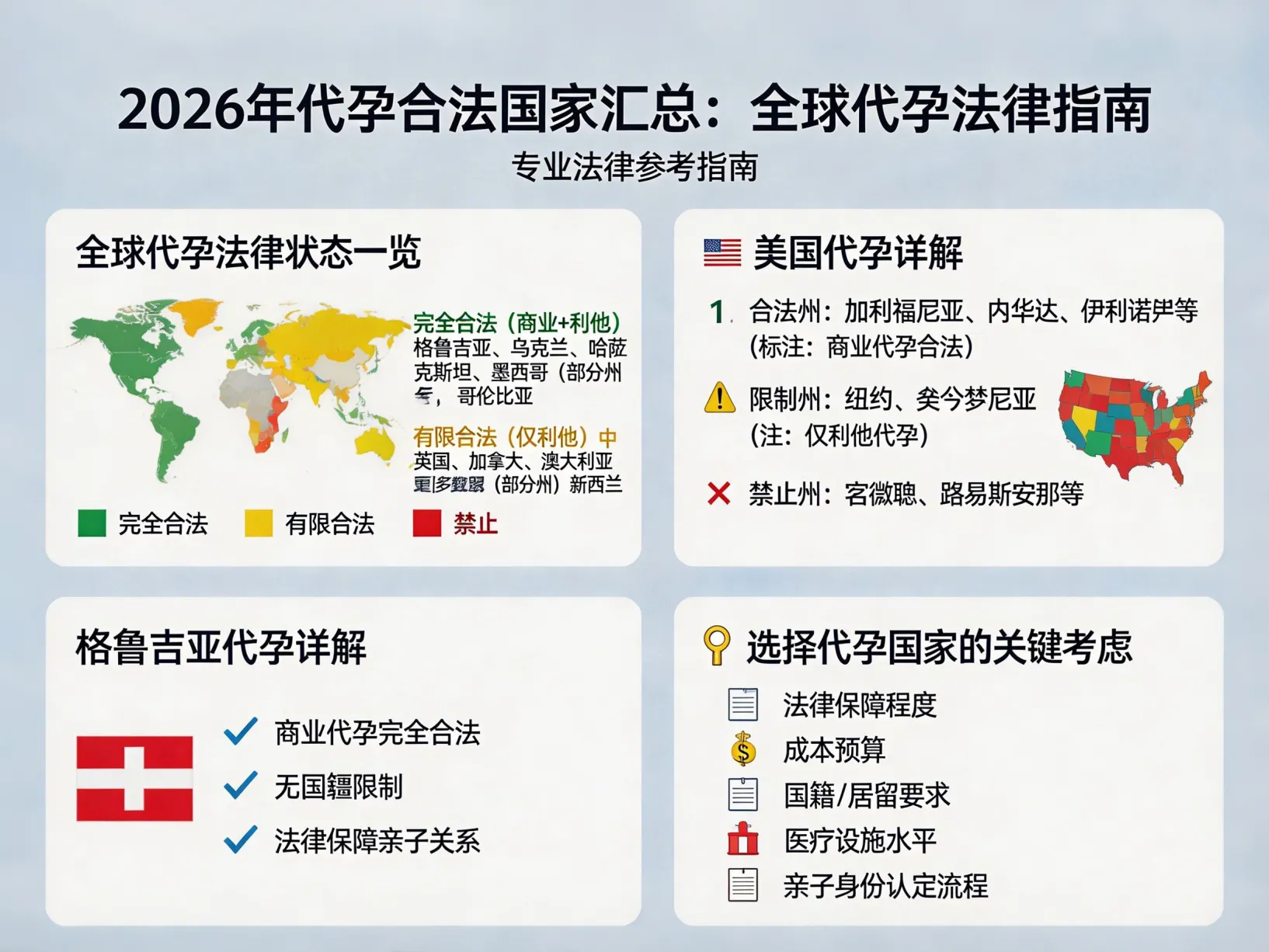
Surrogacy remains legal for intended parents in 2026 in parts of the United States, Georgia, Ukraine, and Mexico, while Canada, the UK, and Australia permit only altruistic arrangements. Total costs span a huge range — from $35,000-$60,000 in Ukraine (60-70% below US pricing) to $100,000-$180,000 in the United States — and the legal protections differ just as sharply.
This guide maps every major destination’s law, price, and eligibility rules so you can shortlist safely.
Which Countries Allow Surrogacy in 2026?
The legal landscape splits into three tiers: commercial surrogacy legal, altruistic-only, and fully banned. One table covers all eleven destinations intended parents ask about most:
| Country | Commercial Surrogacy | Altruistic Surrogacy | International Surrogacy | Notes |
|---|---|---|---|---|
| United States (selected states) | Legal | Legal | Allowed | Laws vary by state |
| Georgia | Legal | Legal | Allowed | Best value option |
| Ukraine | Legal | Legal | Allowed (married heterosexual couples only) | Marriage certificate required |
| Mexico | Legal in some states | Legal | Partially allowed | Laws still evolving |
| Canada | Illegal | Legal | Allowed | Altruistic only |
| United Kingdom | Illegal | Legal | Allowed | Altruistic only, long waits |
| Australia | Illegal | Legal | Varies by state | Altruistic only |
| Thailand | Illegal | Relatives only | Banned | Prohibited since 2015 |
| India | Illegal | Relatives only | Banned | Restricted since 2021 |
| Cambodia | Illegal | Illegal | Banned | Completely prohibited |
| China | Illegal | Illegal | — | Completely prohibited |
Regulators and professional bodies publish their own guidance — see ASRM for US practice standards and the UK’s HFEA for British rules.
Where in the US Is Surrogacy Legal, and What Does It Cost?
The United States offers the world’s most developed surrogacy jurisprudence, but state law decides everything. Five states — California, Illinois, Nevada, Oregon, and Colorado — fully embrace commercial surrogacy, with California’s framework the most established.
Each journey follows a standard IVF timeline: pregnancy is confirmed by a blood test 9-14 days after embryo transfer, and the surrogate carries to a due date at 40 weeks of obstetric gestation.
New York legalized commercial surrogacy in 2021 and Michigan followed in 2024, while some states remain restrictive or legally uncertain. For intended parents, the US route buys four things no other destination combines:
- Enforceable contracts with parental rights locked in before birth
- Automatic US citizenship for the child at birth (birthright citizenship)
- The ability to screen and select your surrogate
- Legal gender selection, plus openness to single and LGBTQ+ parents
As with any pregnancy, the carrier’s care follows the usual schedule and the due date sits near the 40-week mark — but for an ART pregnancy that date comes from the transfer record, not the carrier’s cycle — ACOG Committee Opinion No. 700, reaffirmed 2025.
Full US Cost Breakdown
| Component | Cost |
|---|---|
| Surrogate compensation | $40,000 - $60,000 |
| Medical (IVF + prenatal + delivery) | $30,000 - $60,000 |
| Legal fees | $8,000 - $15,000 |
| Agency fees | $15,000 - $30,000 |
| Insurance | $10,000 - $25,000 |
| Total | $100,000 - $180,000 |
US fertility centers that handle international patients are listed in our IVF hospitals in the USA directory.
Why Has Georgia Become a Budget Surrogacy Hub?
Georgia — the country at the edge of Europe — has emerged as the leading affordable commercial-surrogacy destination. Its framework is deliberately simple:
- Commercial surrogacy fully legal
- International intended parents accepted
- The surrogate holds no parental rights
- The birth certificate lists the intended parents directly
All-in packages run $40,000-$70,000, covering medical care, legal work, agency services, and surrogate compensation. Three cautions matter before booking: Georgia accepts only married heterosexual couples, clinic and agency quality varies widely (due diligence is essential), and your home country’s paperwork for bringing the newborn back must be researched in advance.
Is Ukraine Still an Option Despite the War?
Ukraine has permitted commercial surrogacy since 2002 and remains the cheapest legal option on the list at $35,000-$60,000 per package — 60-70% below US pricing. The legal structure mirrors Georgia’s: no parental rights for the surrogate, birth certificate in the intended parents’ names.
Eligibility is narrow, though. Only married heterosexual couples qualify, a medical infertility indication is required, and the surrogate must be a Ukrainian citizen. Practical risks are real: the ongoing conflict constrains some agencies, several in-person trips may be needed, and the newborn’s exit visa and travel documents require planning months ahead.
How Does Altruistic Surrogacy Work in Canada, the UK, and Australia?
In altruistic-only countries you may reimburse a surrogate’s medical and related expenses but cannot pay her a fee. Canada’s framework is the most mature of the three: total costs run $50,000-$80,000 CAD, mostly medical and legal fees.
The trade-off is time. Because no compensation is offered, matching with a surrogate takes 1-3 years in Canada, compared with 6-18 months in the US. The UK — regulated by the HFEA — and Australia (state-by-state) follow the same altruistic-only model with similarly long waits.
What Should Chinese Intended Parents Know Before Going Abroad?
Surrogacy is completely prohibited in China, so families pursuing it do so overseas — and the return-leg legal work is the hardest part. Three issues recur:
- The baby needs travel documents issued abroad; China does not recognize surrogacy-born children through the ordinary consular route.
- Household registration (hukou) can be difficult to obtain afterward.
- A specialist cross-border reproductive-law attorney should be engaged before any payment.
Within those constraints, the practical ranking from our case research is: the US (strongest law, citizenship at birth, highest cost), Georgia (best value, careful agency selection required), Ukraine (mid-price, geopolitically exposed).
How Do You Choose a Surrogacy Destination?
Four variables decide the fit: legal protection, the child’s nationality path, total cost, and wait time. Score each country on the same four axes before shortlisting.
- Legal protection — Does the birth certificate name you directly? Can the surrogate contest parentage? Is a court order needed?
- Child’s nationality — Birthright citizenship (US) vs home-country visa/travel-document feasibility for the newborn.
- Medical costs — Whether the package price is all-inclusive, and what complications cost extra.
- Waiting time — US: 6-18 months to match; Georgia/Ukraine: 3-6 months; Canada (altruistic): 1-3 years.
ProIVF editorial guidance (2026): Surrogacy is a decision that binds law, medicine, and ethics at once — choose a country with a clear, enforceable legal framework that protects intended parents, surrogate, and child, and consult a reproductive-law attorney before committing any funds.
FAQ
Q: Is the baby genetically related to the intended parents?
Usually yes. Gestational surrogacy uses the intended parents’ own egg and sperm — or donor gametes if needed — and the surrogate contributes 0 genetic material, only the uterine environment.
Q: Can the surrogate keep the baby?
In the 5 most established US states (California, Illinois, Nevada, Oregon, Colorado), the surrogacy contract assigns parental rights to the intended parents before birth, and the surrogate has no legal claim. Georgia and Ukraine write the intended parents directly onto the birth certificate with no surrogate rights.
Where legal frameworks are weaker, the risk rises materially.
Q: Are single parents and LGBTQ+ couples eligible?
Yes in most US states that permit surrogacy. Georgia and Ukraine restrict access to married heterosexual couples — 2 of the 4 commercial-surrogacy destinations on this page.
Canada and the UK accept intended parents regardless of marital status under altruistic rules.
Q: How much does surrogacy cost by country?
Roughly $100,000-$180,000 in the United States, $40,000-$70,000 in Georgia, $35,000-$60,000 in Ukraine, and $50,000-$80,000 CAD in Canada (altruistic). US pricing is 2-3x the Eastern European options.
Q: How long is the wait for a surrogate match?
Typically 6-18 months in the US, 3-6 months in Georgia or Ukraine, and 1-3 years in altruistic-only Canada. Adding medical and legal stages, a full journey from signing to birth commonly spans 18-30 months.
Q: Is surrogacy legal in Thailand, India, or Cambodia?
No. Thailand banned surrogacy for foreign intended parents in 2015, India restricted it to relatives in 2021, and Cambodia prohibits it entirely.
China bans it completely, at home and abroad for its citizens’ registration purposes.
Q: Does a baby born via surrogacy in the US get citizenship?
Yes — children born in the United States acquire US citizenship at birth regardless of the parents’ nationality. That birthright provision is one of the main reasons the US commands the highest prices; compare treatment costs more broadly in our IVF cost guide.
The Bottom Line on Surrogacy Laws
The US offers the strongest protections at the highest cost; Georgia and Ukraine deliver 60-70% savings with workable (but narrower) legal frameworks; Canada and the UK cut fees further but impose years-long altruistic waits. Whichever destination you shortlist, verify parentage and newborn-documentation rules with a reproductive-law attorney first — and browse fertility hospitals worldwide or contact our team if you want help evaluating clinics in your target country.
Sources
- American Society for Reproductive Medicine, ASRM — US guidance
- Human Fertilisation and Embryology Authority, HFEA — UK regulation
- Society for Assisted Reproductive Technology, SART — clinic data
This article was written by the ProIVF Medical Editorial Team and reviewed by the ProIVF Medical Advisory Board. It is for informational purposes only and does not constitute legal or medical advice; surrogacy law changes frequently — confirm current rules with a qualified reproductive-law attorney before any commitment.
Last updated: 2026-06-01.