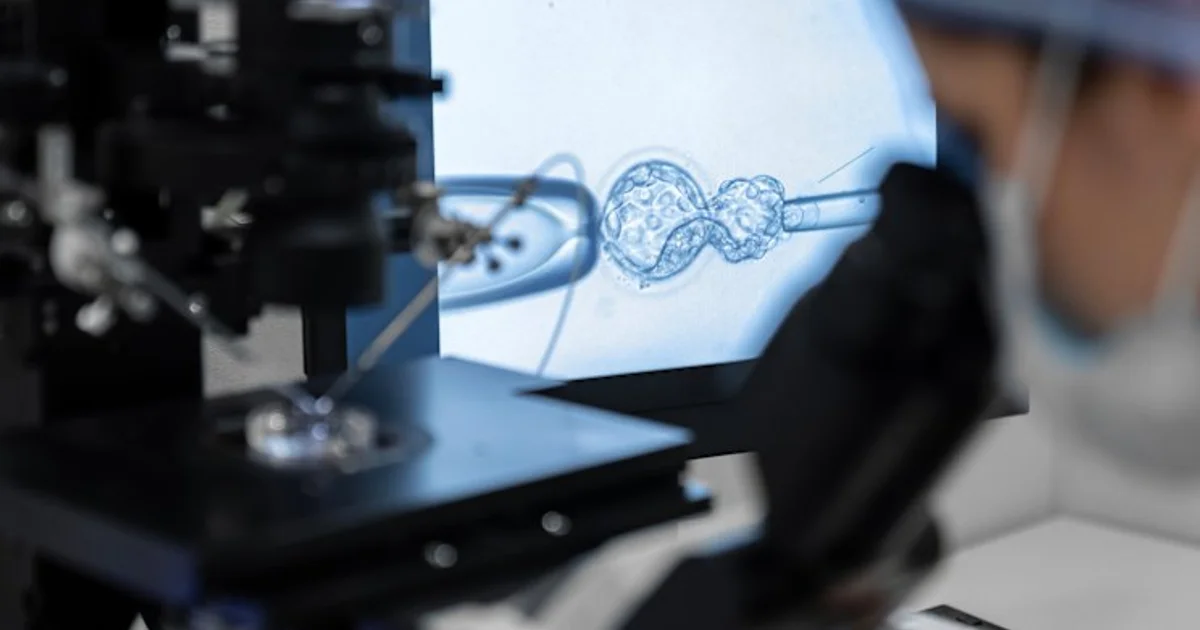
A compassionate transfer is an embryo transfer performed at a point in the menstrual cycle when pregnancy cannot occur — timed deliberately outside the implantation window so the embryo cannot implant. It costs $0 to $3,500, follows the same 10-minute procedure as a standard frozen embryo transfer, and its purpose is emotional closure rather than a baby.
What Is a Compassionate Transfer in IVF?
Compassionate embryo transfer (CET) places one or more embryos into the uterus during the luteal-follicular transition or after ovulation has passed, when the endometrium is not receptive. The goal is not pregnancy — it is a meaningful, ceremonial way for a family to honor the embryos created during their IVF journey and close that chapter.
The American Society for Reproductive Medicine, ASRM addresses the practice directly in a dedicated ethics opinion, recognizing it as a legitimate patient request for embryo transfer for nonreproductive purposes.
| Aspect | Detail |
|---|---|
| Purpose | Emotional closure, not pregnancy |
| Timing | Outside the implantation window |
| Procedure | Standard frozen embryo transfer |
| Medication | Minimal or none (natural cycle) |
| Cost | Varies — sometimes free, sometimes same as FET |
| Insurance | Typically not covered |
Roughly one in five IVF patients, by industry estimate, has surplus frozen embryos in storage. This guide explains how compassionate transfer works, who it suits, and how it compares with donation, discard, and continued storage.
Why Do Patients Choose Compassionate Transfer?
For some families, discarding embryos feels ethically or emotionally unacceptable — those embryos represent years of hope, treatment, and investment, and a transfer provides a farewell that disposal cannot.
- Avoiding the emotional weight of discard — a ritual that feels more respectful than disposal
- Sidestepping donation complexity — embryo donation involves legal agreements, screening requirements, and lingering questions about the possible existence of genetic offspring elsewhere
- Ending storage fees — annual embryo storage costs about $500-$1,000, and indefinite storage can keep a family emotionally tethered to a chapter they are ready to close
- Aligning with personal values — many patients find CET consistent with religious, cultural, or personal beliefs about embryo treatment, letting them choose actively instead of defaulting to a clinic’s abandoned-embryo policy
How Does the Compassionate Transfer Procedure Work?
The medical steps are identical to a standard frozen embryo transfer (FET), with one critical difference: the timing.
- Cycle monitoring — the patient tracks her natural menstrual cycle with ovulation predictor kits or blood tests
- Timing determination — the transfer is scheduled when the endometrium is no longer receptive, typically 3-5 days after the LH surge has passed
- Medication — most compassionate transfers use a natural cycle with no progesterone supplementation; some patients opt for a light protocol to mirror a standard FET experience
- Embryo thaw — the clinic thaws the frozen embryo(s) on the scheduled day
- Transfer — a thin catheter passes through the cervix and releases the embryo(s) into the uterine cavity
- Recovery — 20-30 minutes of rest at the clinic, the same as any standard transfer
How Does It Differ from a Standard FET?
| Factor | Standard FET | Compassionate Transfer |
|---|---|---|
| Goal | Pregnancy | Closure |
| Timing | Mid-luteal phase (implantation window) | Outside the implantation window |
| Progesterone | Required for luteal support | Not used |
| Cycle type | Medicated or natural with trigger | Natural cycle only |
| Pregnancy test | Required 12-14 days post-transfer | Not performed |
| Success measured by | Positive beta-hCG | Emotional resolution |
What Do Patients Say About the Experience?
Three scenarios, adapted from real patient accounts shared with informed consent, show how the decision feels from the inside.
Scenario 1: A complete family, two embryos remaining
Mei, 38, from Melbourne, Australia, finished her family after two IVF pregnancies and had two frozen embryos in storage.
“I knew I didn’t want to discard them, but donating felt like leaving a door open I wanted to close. My clinic mentioned compassionate transfer almost as an afterthought — I was surprised I hadn’t heard of it before. The procedure itself took maybe 10 minutes, from thaw to transfer. It felt like completing a circle — bringing them home one last time. I rested for twenty minutes afterward and chatted with the nurse about my second birth. I cried, but they were good tears. A year later, I still feel at peace with that decision.”
Scenario 2: Stopping treatment for medical reasons
Sarah, 41, from London, had three failed IVF cycles and one biochemical pregnancy. Her doctor advised against further attempts, but she had one embryo in storage.
“I couldn’t bring myself to sign the disposal form. It sat on my desk for four months — every time I saw it, my stomach dropped. When the clinic counselor explained compassionate transfer, I felt relief instantly — there was another way. The transfer was simple — no medications, just a natural cycle. I took the day off work, had the procedure in the morning, and we went for a walk in Hyde Park afterward. It was a beautiful day, and we talked about what it felt like to not have to think about the next IVF step for the first time in ten years. It sounds strange, but it felt like a proper goodbye. I don’t regret it at all.”
Scenario 3: The end of the road
Priya, 43, from Delhi, underwent 5 cycles of IVF without success. She stopped treatment with two low-quality day-3 embryos that were not suitable for freezing.
“The clinic said they would normally discard them, but I asked if we could do a transfer anyway, even if there was no chance. The doctor said no patient had ever asked that before, but she respected my wish. It was a fresh transfer — they were day-3 embryos, poor quality, not suitable for freezing anyway. I felt calm during the transfer, almost happy. I knew it wouldn’t work, but giving them that chance mattered to me. Walking out of the clinic, I felt like I could finally stop thinking about IVF. It helped me close this chapter with a clear conscience.”
What Do the Numbers Say About Surplus Embryos?
According to SART 2023 public data and industry estimates, embryo disposition is a common but under-discussed decision:
- About 20% of IVF patients have surplus frozen embryos
- An estimated 400,000 embryos are in cryostorage in the United States
- Patients take an average of 3-5 years to make a final disposition decision
- Surveys suggest only about 10% of clinics proactively mention compassionate transfer as an option
What Are the Ethics and Medical Considerations?
The ASRM Ethics Opinion
The ASRM Ethics Committee opinion (Fertility and Sterility, 2019) directs that clinics should respect a patient’s request for compassionate transfer when she understands it will not cause pregnancy, secure informed consent acknowledging the non-reproductive purpose, not demand justifications beyond a clear voluntary preference, and check whether clinic policy or local law constrains the procedure.
“When a patient requests embryo transfer for nonreproductive purposes, and the patient understands that the procedure will not result in pregnancy, the clinic should respect the patient’s autonomous decision.” — ASRM Ethics Committee opinion on compassionate transfer, Fertility and Sterility, 2019
This framing establishes the ethical basis for compassionate transfer — and means patients have the right to raise the option with their clinic even when the clinic has not offered it.
The Medical Reality
Compassionate transfer carries the same procedural risks as any standard embryo transfer: mild cramping, spotting, and rare cervical or uterine trauma. No progesterone is used and no ovarian stimulation is involved, and patients resume normal activities immediately.
The primary medical requirement is that the patient fully understands pregnancy will not occur — clinics must confirm she holds no expectation of a live birth. For that reason no pregnancy test and no prenatal follow-up follow a compassionate transfer, a key procedural difference from standard FET, where a blood test 12-14 days after transfer confirms pregnancy.
Legally, embryos transferred in a compassionate procedure leave the storage agreement behind: no further storage fees, and no more decisions about their future.
How Does Compassionate Transfer Compare with Other Options?
| Option | Description | Typical Cost | Considerations |
|---|---|---|---|
| Continued storage | Embryos stay frozen indefinitely | $500-$1,000/year | Costs accumulate; emotionally hard to fully move on |
| Donation to another family | Embryos transferred to recipients | Legal fees vary | Possible ongoing thoughts about genetic offspring |
| Donation to research | Embryos used in scientific study | No cost | Suits patients who want to advance medicine |
| Discard | Embryos removed from storage and disposed of | No cost | Emotionally the most difficult for many patients |
| Compassionate transfer | Transfer at non-viable timing | $0-$3,500 | Provides ritual and a sense of closure |
There is no “right” choice — only the choice that fits your values. RESOLVE: The National Infertility Association offers support resources for patients navigating embryo disposition decisions.
How Do You Raise Compassionate Transfer with Your Clinic?
Most clinics advertise only storage, donation, and disposal — so the conversation usually has to start with you. The SART clinic database lists clinic-level data that can help you identify centers offering a full range of disposition options.
- Ask your fertility counselor first — counselors typically know this option better than administrative staff
- Reference the ASRM ethics opinion — citing the 2019 committee opinion helps open the conversation
- Check your clinic’s policy — some perform compassionate transfers free of charge; others bill the standard FET rate
- Complete informed consent — the clinic will require documentation that you understand the non-reproductive purpose
- Verify local regulations — some jurisdictions have specific rules on embryo handling
FAQ
Q: Does compassionate transfer hurt?
The procedure is identical to a standard embryo transfer — speculum, thin catheter through the cervix, embryo released — and takes about 10 minutes at the clinic. Most patients report mild discomfort similar to a Pap smear.
Q: Is compassionate transfer legal everywhere?
Most countries that permit IVF also permit compassionate transfer, but local rules vary. In some jurisdictions a transfer timed outside the implantation window is classified differently from a reproductive transfer, so confirm with your clinic’s legal team — the 2019 ASRM ethics opinion is the reference standard most clinics work from.
Q: Can multiple embryos be transferred at once?
Yes. Some patients transfer all remaining embryos in a single procedure; others with 2 or more embryos choose separate transfers instead.
Q: Are medications required?
Usually not — most compassionate transfers run on a natural, unmedicated cycle, with a single clinic visit of about 20-30 minutes. Some clinics offer a light medication protocol for patients who want the experience to mirror a standard FET.
Q: How much does compassionate transfer cost?
Costs range from $0 to $3,500. Some clinics provide it free as a patient service, while others bill the standard frozen embryo transfer rate of $1,500-$3,500 in the US.
Insurance rarely covers it because the procedure is not intended to achieve pregnancy.
Q: How do I know if compassionate transfer is right for me?
Speak with a fertility counselor who specializes in post-IVF support — patients typically take 3-5 years to settle an embryo disposition decision, and professional guidance shortens the emotional toll. They can help you weigh all 4 disposition options against your own values.
What Should Your Next Step Be?
Compassionate transfer is one of several legitimate ways to resolve the question of unused embryos; the right choice depends on your values, emotional needs, and circumstances.
- If emotional closure matters most, a compassionate transfer may be the meaningful farewell you have been looking for
- If you are unsure, talk with a fertility counselor before deciding — they are usually more attuned to the emotional dimensions of disposition than clinicians
- If your clinic has not mentioned the option, raise it yourself — you are entitled to know every available choice
For help finding clinics that accommodate compassionate transfer, or to talk with a fertility advisor, contact the ProIVF team. Related reading:
- Embryo transfer aftercare guide — recovery after a standard transfer
- IVF procedure overview — the full process from stimulation to transfer
- Repeated implantation failure guide — why transfers fail and what comes next
- PGT genetic screening guide — how embryo screening shapes transfer decisions
How This Guide Was Created
This article was researched and written by the ProIVF Medical Editorial Team based on a systematic review of the ASRM Ethics Committee opinion, peer-reviewed literature, and international clinical guidelines, and was medically reviewed by reproductive endocrinologists. Patient scenarios are adapted from real experiences shared with informed consent.
Last updated: 2026-07-15. This article is for informational purposes only and does not constitute medical advice. Embryo disposition decisions should be made with a qualified fertility specialist and, where appropriate, a mental health professional. ProIVF recommends verifying all clinic policies directly before deciding.