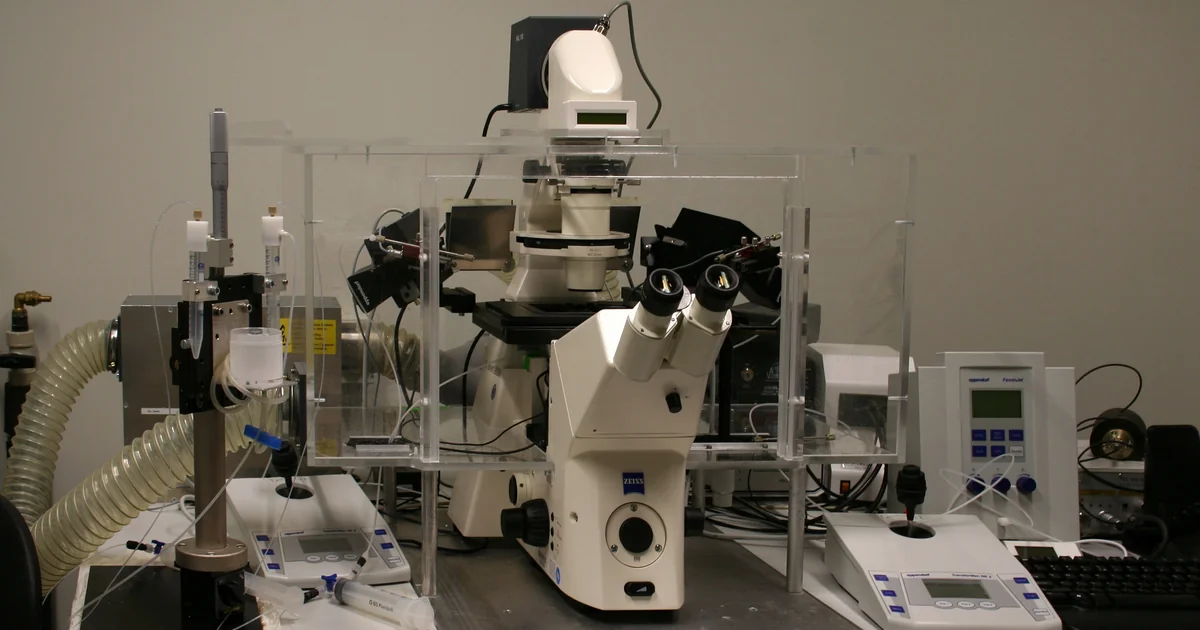
In an IVF lab, eggs are fertilized and embryos are cultured, graded and frozen — usually over 5 to 6 days — inside a windowless cleanroom most patients never see. Laboratory quality can shift outcomes between clinics by a meaningful margin, which is why asking about the lab matters more than comparing waiting rooms.
The good news: you do not need a degree in embryology to evaluate an IVF lab. You need to know what happens behind the door, which quality measures are backed by evidence, and which 7 questions separate serious clinics from marketing-led ones.
Data in this article is sourced from the TILT randomized controlled trial published in The Lancet (2024), the Cochrane Database of Systematic Reviews, the ESHRE/Alpha Vienna Consensus on ART laboratory KPIs, peer-reviewed studies in Human Reproduction and Fertility & Sterility, and treatment add-on ratings from the UK’s Human Fertilisation and Embryology Authority (HFEA). It was compiled by the ProIVF Medical Editorial Team and reviewed by the ProIVF Medical Advisory Board.
IVF Lab Benchmarks in Numbers
| Metric | Value | Source |
|---|---|---|
| ICSI (intracytoplasmic sperm injection) fertilization rate (reference population) | ~72–75% | Vienna KPI study, JARG 2022 |
| Conventional IVF fertilization rate | ~67% | Vienna KPI study, JARG 2022 |
| Good blastocyst development rate (≤39) | ~45% | Vienna KPI study, JARG 2022 |
| Blastocyst vitrification survival | ~95% | Vienna KPI study, JARG 2022 |
| Live birth, time-lapse arm vs standard care (TILT) | 33.7% vs 33.0% (adjusted OR 1.04) | Lancet 2024 |
| Live birth, undisturbed culture vs standard care (TILT) | 36.6% vs 33.0% (adjusted OR 1.20) | Lancet 2024 |
| HFEA rating for time-lapse with automated embryo selection | Black (no proven benefit) | HFEA add-on ratings |
| Time-lapse incubators and implantation rate (14 randomized controlled trials) | RR 1.10, no live birth gain | J Obstet Gynaecol Res 2023 meta-analysis |
| Air pollution (NO₂) and chance of live birth after transfer | OR 0.76 per +0.01 ppm | Hum Reprod 2010 |
Sources: TILT trial, Lancet 2024, Cochrane review, 2019, Vienna KPI by age, JARG 2022, HFEA add-on ratings, Air quality & ART, Hum Reprod 2010
Why the Lab Determines More of Your Outcome Than You Think
Every IVF cycle has two halves. The first half — ovarian stimulation and egg retrieval — happens in your body and is managed by your reproductive endocrinologist, while the second half happens in the embryology laboratory: fertilization, embryo culture, assessment, and often biopsy and freezing.
If the first half produces eggs, the second half decides how many of those eggs become embryos worth transferring.
That is why two clinics with identical patient demographics and stimulation protocols can report different success rates. Programs that consistently outperform their peers tend to share disciplined laboratory practices — strict quality control, experienced embryology teams, and standardized culture conditions — that are invisible in a marketing brochure but measurable in the lab. The national data clinics publish through SART reflects both clinical and laboratory skill, which is exactly why national registries report per-clinic outcomes rather than a single “IVF success rate.”
A Step-by-Step Tour of the IVF Laboratory
1. Egg handling and assessment
Within minutes of retrieval, the follicular fluid is handed to the lab through a pass-through window, and embryologists locate the egg–cumulus complexes under a microscope, strip away surrounding cells, and assess each oocyte’s maturity. Only mature (metaphase II) eggs can be fertilized — typically 80–90% of retrieved eggs in a good cycle.
2. Fertilization: conventional IVF or ICSI
Depending on sperm quality and previous history, the lab either places each egg with sperm in a culture dish (conventional IVF) or injects a single sperm directly into each egg (ICSI). In the reference population of the Vienna Consensus framework, ICSI fertilization rates average 72–75%, while conventional IVF runs around 67%.
Embryologists check for the presence of two pronuclei about 16–18 hours later to confirm normal fertilization.
3. Embryo culture: days 1–6
Fertilized eggs are moved into incubators that precisely control temperature, humidity, and gas concentrations (typically 5–6% CO₂ and low oxygen at around 5%). Here, embryos divide from two cells to four, to eight, to morula, and finally to blastocyst by day 5 or 6.
Culture media, incubator conditions, and the skill of the team all influence how many embryos survive this journey — see our day-by-day embryo development guide for what happens at each stage.
4. Assessment and grading
Embryologists evaluate embryos at fixed time points without removing them from the incubator whenever possible, scoring cell number, fragmentation, and — for blastocysts — the Gardner grading system. The highest-quality embryo is prioritized for transfer; others may be frozen or, if you choose, biopsied for genetic testing.
5. Vitrification and storage
Extra viable embryos are frozen using vitrification — an ultra-rapid cooling technique. In the Vienna reference population, blastocyst cryosurvival is about 95%, which is why frozen embryo transfers are now routine and often perform as well as fresh transfers.
For what happens after the lab work, see our frozen embryo transfer guide.
How Laboratory Quality Shows Up in the Numbers
The clearest way to evaluate an IVF lab is through key performance indicators (KPIs). In 2017, ESHRE and Alpha Scientists in Reproductive Medicine published the Vienna Consensus, which defines 19 laboratory indicators — 12 KPIs, 5 performance indicators, and 2 reference indicators — each with a minimum competency value and an aspirational benchmark.
The reference population is defined as women aged ≤39 using their own fresh eggs and ejaculated sperm, without PGT (preimplantation genetic testing). Important KPIs you can reasonably ask about include:
- Fertilization rate (normal fertilization per inseminated oocyte)
- Blastocyst development rate (cultured embryos reaching blastocyst)
- Cryosurvival rate (frozen embryos surviving thaw)
- Oocyte recovery efficiency and cumulative clinical pregnancy rate
“For the fertilization rate, the competency value is 65% and the benchmark value is 75%.” — ESHRE and Alpha Scientists in Reproductive Medicine, Vienna consensus report, Human Reproduction, 2017
A 2022 single-center study applied the Vienna framework to 862 cycles. Among women ≤39, the good blastocyst development rate was about 45%, blastocyst cryosurvival about 95%, and the cumulative clinical pregnancy rate 52% — the share of patients achieving at least one clinical pregnancy after one or more completed cycles. Women ≥40 dropped to about 33% blastocyst development and 24% cumulative clinical pregnancy, a reminder that lab KPIs and patient age interact and no lab can fully compensate for age-related egg quality.
That is why clinics that report transparent, age-stratified outcomes are more trustworthy than those quoting a single headline number. For context on what age-stratified success looks like, see our IVF success rates by age guide.
The physical environment matters too. A 2010 study followed 7,403 first IVF cycles in the northeastern US, measuring nitrogen dioxide (NO₂) near patients’ homes and IVF labs: higher levels were associated with lower pregnancy and live birth rates, with an odds ratio of 0.76 per 0.01 ppm increase in the post-transfer stage. An odds ratio below 1 means the outcome became less likely as exposure rose — at 0.76, roughly a 24% lower chance of live birth per 0.01 ppm.
Modern labs therefore invest heavily in HVAC systems, HEPA filtration, and volatile organic compound control. That is another reason “state-of-the-art lab” claims deserve a follow-up question about air quality monitoring.
The Marketing Trap: Is Time-Lapse Imaging Worth Paying For?
Time-lapse incubators photograph embryos every few minutes, allowing embryologists to watch development without opening the incubator. Many clinics present time-lapse (with or without AI selection software) as a premium add-on — but the evidence does not support the premium.
The TILT trial, published in The Lancet in 2024, was a multicenter double-blind RCT that randomized 1,575 IVF/ICSI patients to three arms: time-lapse imaging with embryo selection, undisturbed culture in a time-lapse incubator without selection, or standard care. Live birth rates were 33.7%, 36.6%, and 33.0% respectively, with no statistically significant difference between any arms (adjusted OR 1.04 for time-lapse vs standard care).
The Cochrane review, 2019 reached the same conclusion: insufficient evidence of a difference in live birth, miscarriage, stillbirth, or clinical pregnancy between time-lapse and conventional incubation. Consistent with this, the UK regulator HFEA rates time-lapse imaging with automated embryo selection as “black”, meaning no proven benefit for improving the chances of a baby for most patients.
A 2023 meta-analysis of 14 RCTs found time-lapse incubators increased implantation rate modestly (RR 1.10, where RR is the relative risk against a baseline of 1) but did not improve live birth, ongoing pregnancy, or miscarriage outcomes.
What does this mean for you? If a clinic charges extra for time-lapse or AI embryo selection, the surcharge is not backed by evidence of better live birth rates. Some patients value the undisturbed culture and the “window into the lab” that time-lapse provides — a legitimate preference, but it should be a free or low-cost option, not a marketed upgrade. Ask directly: “Is time-lapse included, or is it an add-on fee? What is the evidence at your clinic for the extra cost?“
7 Lab Questions to Ask Before Choosing a Clinic
When you compare clinics, add these laboratory questions to your list; for the wider picture on treatment steps, see our IVF procedure guide.
- “Is your embryology laboratory accredited?” In the US, labs should be CLIA-certified and often CAP-accredited; in the UK, the clinic must hold an HFEA license covering its lab; in the EU, labs operate under tissue-directive oversight. Accreditation is the baseline, not a differentiator.
- “Who runs the lab, and what are their qualifications?” Ask about the lab director’s certification (e.g., HCLD/ELD in the US) and the embryologists’ experience. Embryology is skilled labor — team stability and training matter more than equipment brand names.
- “Can you share your laboratory KPIs — fertilization rate, blastocyst rate, and cryosurvival rate?” Serious labs track these against the Vienna Consensus benchmarks and can discuss them. A clinic that cannot quote its own fertilization or cryosurvival numbers is telling you something.
- “Do you publish age-stratified success rates?” Compare like with like using SART (US) or the national registry where you are treated, not a single marketing percentage.
- “Is time-lapse included or an extra fee?” Given the evidence above, time-lapse should not be a significant surcharge.
- “How many embryos do you freeze per cycle on average, and what is your vitrification survival rate?” Cryosurvival of about 95% is the modern benchmark; lower numbers may indicate older equipment or technique.
- “Can I see the lab or meet the embryology team?” Many centers offer lab tours or consults with the embryologist. A transparent lab says yes more often.
Patient Stories: Three Different Ways of Vetting a Clinic
The following patient stories are shared with consent. Names and identifying details have been changed to protect privacy.
Emma, 37 — first cycle, chose a clinic for its lab transparency
Emma compared three clinics in her city before her first IVF cycle. Two quoted impressive “headline” success rates, but the third sent her a one-page lab summary — its fertilization rate, blastocyst rate, and cryosurvival numbers — and offered a call with the senior embryologist.
“I asked all three the same question — ‘what is your blastocyst survival after thaw?’ — and only one had the number on hand,” she recalls. “That told me more than any brochure.”
Her cycle produced two blastocysts; one fresh transfer did not implant, but the frozen transfer succeeded. “It took two transfers, but I never doubted the lab knew what it was doing with my embryos.”
Priya, 41 — second cycle, added lab KPIs to her checklist
After a first cycle at another clinic ended with no embryos suitable for transfer, Priya made lab quality part of her re-evaluation. “I asked about the embryologist-to-case ratio, their day-5 blastocyst rate for women over 40, and how they handled air quality,” she says.
She chose a center that openly discussed its numbers, including a lower blastocyst rate for her age group, and found that conversation more honest than reassuring.
Her second cycle produced two blastocysts, one of which became her daughter. “The numbers were sobering, but they helped me set realistic expectations and pick the lab I trusted most.”
Sophie, 30 — chose between two clinics offering time-lapse
Sophie’s two shortlisted clinics both offered time-lapse incubators, but only one charged extra for “AI-assisted embryo selection.” “I read the HFEA rating and the TILT trial summary before my consultation,” she says.
“I asked the charging clinic what evidence justified the fee. They couldn’t really answer.”
She chose the clinic where time-lapse was included at no extra cost, and her first frozen transfer resulted in a healthy pregnancy. “The equipment is nice to have, but the embryologists’ skill and honest pricing mattered more to me.”
FAQ
Q: What is an IVF lab, and why does it matter?
An IVF lab (embryology laboratory) is the facility where eggs are fertilized and embryos are cultured, assessed, and frozen during an IVF cycle, typically spending 5 to 6 days there before transfer or freezing. It matters because fertilization success, embryo development and cryosurvival depend heavily on laboratory technique and conditions — in the Vienna Consensus reference population (≤39), the good blastocyst development rate is about 45%, and real gaps between labs and age groups show up in clinic-specific success rates.
Q: How do I know if a clinic’s IVF lab is good?
Ask for accreditation (CLIA/CAP in the US, HFEA license in the UK, EU tissue-directive oversight in Europe), the lab director’s and embryologists’ qualifications, and the lab’s own KPIs — fertilization rate, blastocyst development rate, and cryosurvival rate — using the 19 Vienna Consensus indicators as a benchmark checklist. Then compare age-stratified outcomes on the relevant national registry rather than a single headline rate.
Q: Is a time-lapse incubator worth the extra money?
Based on current evidence, no. The TILT trial (Lancet 2024, n=1,575) found live birth rates of 33.7%, 36.6% and 33.0% across time-lapse with selection, undisturbed culture, and standard care — no significant difference; Cochrane (2019) agreed, a 2023 meta-analysis of 14 RCTs found only RR 1.10 for implantation with no live birth gain, and the UK’s HFEA rates time-lapse with automated embryo selection as “black.” If it is offered free or included, it is harmless; as a large surcharge, it is not evidence-based.
Q: What is a normal fertilization rate in an IVF lab?
In the Vienna Consensus reference population, ICSI fertilization rates average roughly 72–75% and conventional IVF around 67%. Fertilization rate is one of several KPIs; a single low cycle does not indicate a bad lab, but a clinic should be able to quote its own average.
Q: What is the blastocyst survival rate after freezing?
With modern vitrification, blastocyst cryosurvival is about 95% in the Vienna reference population. If a clinic’s thaw survival is meaningfully below 90%, ask how long their freezing protocols have been in place and whether they use vitrification or older slow-freezing methods.
Q: Does the IVF lab affect success more than my age or egg quality?
Neither factor works alone — patient age and egg quality remain the dominant drivers of IVF success. The age-stratified data cited here shows it: under the same lab conditions, cumulative clinical pregnancy was about 52% in women ≤39 but about 24% in women ≥40.
Laboratory quality is best understood as the variable that determines how much of the potential in your eggs is realized, which is why age-stratified lab outcomes are the honest comparison.
Q: Can I visit the IVF lab before treatment?
Many clinics offer lab tours or a consultation with the embryology team, and even without a physical tour you can ask for a lab information sheet with KPIs and request a call with an embryologist. Serious clinics accommodate both — if a clinic cannot produce its own cryosurvival number (modern benchmark: about 95%), its transparency deserves a question mark.
Q: What is the difference between an embryologist and a reproductive endocrinologist?
A reproductive endocrinologist (REI) is the physician who manages your stimulation, monitoring, and transfer, while an embryologist is the scientist inside the lab who handles eggs, sperm and embryos. Embryos spend 5–6 days in the lab from fertilization to a transferable blastocyst, and embryologists perform the day-to-day assessment of that entire stage — both roles are central to your cycle, and you are entitled to know the qualifications of both.
How to Plan Your IVF Journey
Start by understanding the two halves of your cycle: the clinical half you experience and the laboratory half you cannot see. When you shortlist clinics, ask the laboratory questions above, compare age-stratified outcomes on the relevant national registry, and treat premium add-ons like time-lapse with healthy skepticism.
The best lab for you is transparent about its own numbers, honest about how your age and diagnosis shape expectations, and staffed by embryologists who treat your embryos as carefully as you would. Browse ProIVF’s directory of vetted fertility clinics to compare centers across countries, or contact us if you need help evaluating a specific clinic’s laboratory credentials.
This article was written by the ProIVF Medical Editorial Team, reviewed by the ProIVF Medical Advisory Board, and is based on the primary sources linked throughout — peer-reviewed clinical trials, systematic reviews, professional consensus documents, and regulator ratings — to provide objective, accurate information for patients.
Last updated: September 9, 2026
Medical disclaimer: This article is for educational purposes only and does not constitute medical advice. IVF outcomes vary by individual diagnosis, age, and clinic. Always consult a qualified fertility specialist about your specific situation.