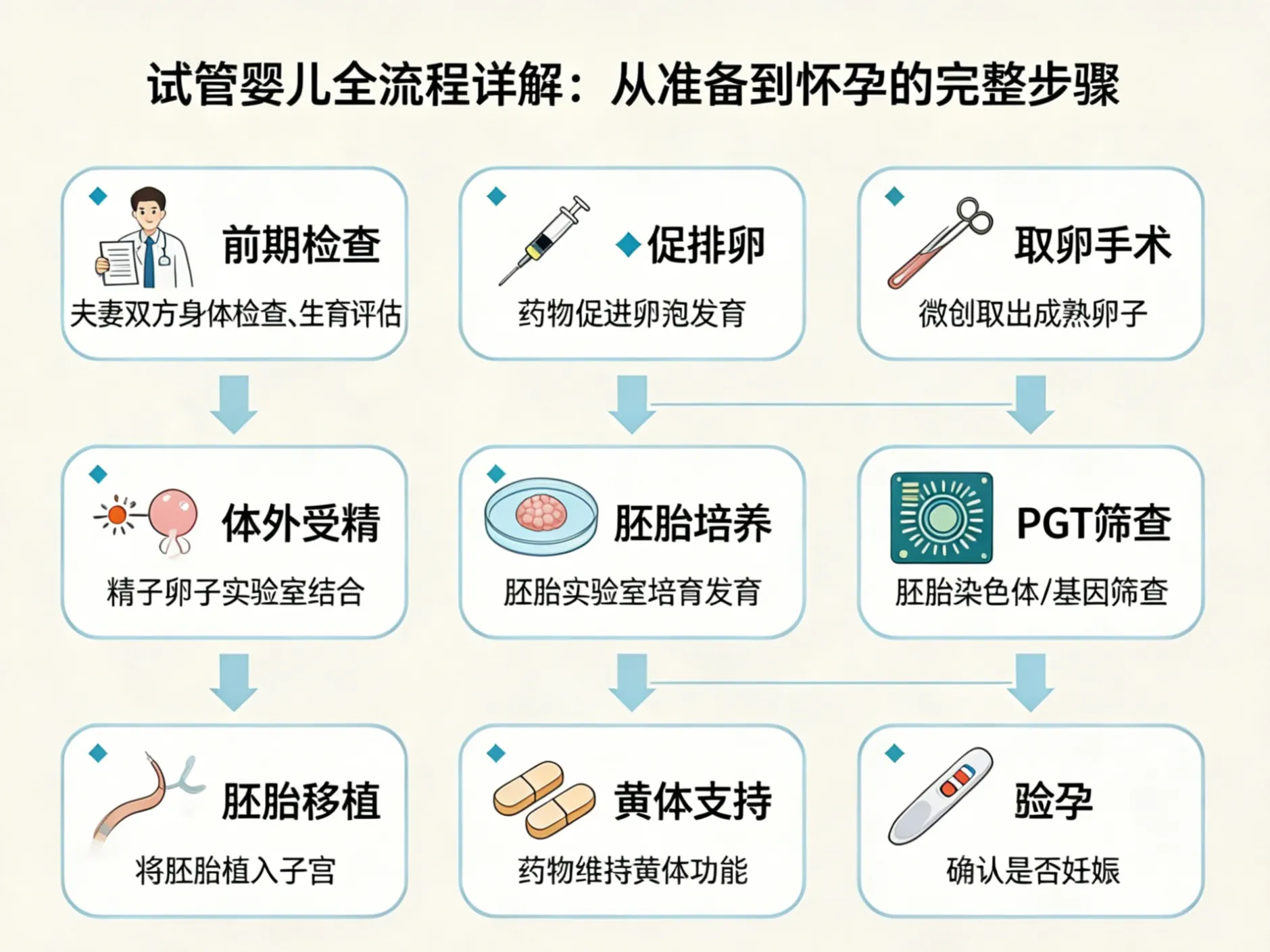
In vitro fertilization (IVF) is a mature assisted reproductive technology, and one complete IVF cycle takes about 4–6 weeks — from pre-cycle testing all the way to the pregnancy confirmation. This guide walks through every stage in order: baseline testing, ovarian stimulation, egg retrieval, fertilization, embryo culture, optional PGT genetic screening, embryo transfer, and luteal support.
What Does the Full IVF Process Look Like?
The sequence below shows the standard path of a complete IVF-ET (in vitro fertilization and embryo transfer) cycle, including the optional genetic screening step.
Pre-cycle testing (1-2 weeks) → Ovarian stimulation (8-14 days) → Egg retrieval (1 day)
→ Fertilization (same day) → Embryo culture (3-5 days) → [PGT screening (7-14 days)]
→ Embryo transfer (1 day) → Luteal support (14 days) → Pregnancy test
Step 1: Pre-Cycle Testing — What Tests Do You Need?
Both partners complete a baseline fertility workup before any medication starts, usually within 1–2 weeks.
What Tests Does the Female Partner Need?
- Hormone panel (6 markers): FSH, LH, E2, P, T, PRL — blood drawn on day 2–3 of the menstrual cycle
- AMH (anti-Müllerian hormone): assesses ovarian reserve
- Transvaginal ultrasound: baseline antral follicle count (AFC)
- Hysterosalpingography (HSG): evaluates the uterine cavity and fallopian tubes
- Thyroid function, blood glucose, and coagulation tests
- Infectious disease screening: hepatitis B, hepatitis C, HIV, syphilis
What Tests Does the Male Partner Need?
- Semen analysis: sperm count, motility, and morphology
- Sperm DNA fragmentation test
- Infectious disease screening
How Is Your Stimulation Protocol Chosen?
Based on the results, the doctor designs an individualized stimulation plan:
- Long protocol — normal ovarian reserve; requires down-regulation first
- Short / antagonist protocol — advanced maternal age or diminished ovarian reserve
- Mild stimulation protocol — very poor ovarian responders
Each option has distinct trade-offs; see our full guide to IVF stimulation protocols and the IVF preparation checklist for the pre-cycle workup.
Step 2: Ovarian Stimulation — How Does It Work?
Stimulation uses injectable hormones to mature multiple follicles at once, with a typical target of 8–15 eggs.
Which Medications Are Used?
| Medication | Type | Function |
|---|---|---|
| Gonal-F | FSH | Promotes follicle development |
| Puregon | FSH | Promotes follicle development |
| Cetrotide | GnRH antagonist | Prevents premature ovulation |
| Trigger shot (Ovidrel / hCG) | Ovulation trigger | Final egg maturation |
How Is the Cycle Monitored?
During stimulation you return to the clinic every 2–3 days for:
- Ultrasound — tracking follicle size and number
- Blood tests — monitoring estradiol (E2) levels
The doctor adjusts medication doses based on these results.
What Should You Watch Out For During Stimulation?
- Inject medication at the same time every day
- Avoid vigorous exercise — enlarged ovaries risk torsion
- Increase protein intake
Step 3: Egg Retrieval — What Happens on the Day?
The retrieval itself takes only about 20–30 minutes and is done under anesthesia as an outpatient procedure.
The Procedure
- Eggs are collected through the vaginal wall under ultrasound guidance
- The procedure runs under general IV anesthesia or local anesthesia
- The surgery itself takes about 20–30 minutes
- After 1–2 hours of observation, you go home the same day
After the Retrieval
- Rest for 1–2 days
- Mild abdominal bloating is normal
- Avoid vigorous exercise and intercourse
- Seek immediate care for severe abdominal pain or heavy bleeding
Step 4: Fertilization and Embryo Culture — Days 1–6
On retrieval day, the embryologist fertilizes the eggs using one of two methods.
Conventional IVF or ICSI?
| Method | When It Is Used | How It Works |
|---|---|---|
| Conventional IVF | Normal sperm quality | Sperm and egg combine naturally in the lab |
| ICSI (intracytoplasmic sperm injection) | Poor sperm quality | A single sperm is injected into each egg under a microscope |
Embryo Culture Timeline
- Day 1: fertilization is confirmed
- Day 3: cleavage-stage embryos (6–8 cells) — transfer or biopsy possible
- Day 5–6: blastocyst stage — higher implantation rate, ideal for PGT testing
Step 5: PGT Genetic Screening — Is It Necessary?
Preimplantation genetic testing is optional and adds 7–14 days, because embryos are biopsied, frozen, and screened before transfer.
Who Should Consider PGT?
- Women aged 35 and above
- Recurrent miscarriage or previous IVF failure
- Family history of genetic disease
- Sex selection where legally permitted
The Screening Process
- Embryo biopsy — a few trophectoderm cells are removed
- Samples are sent to a genetics laboratory
- Results arrive in 7–14 days
- Chromosomally normal embryos are frozen for transfer
How Are Results Reported?
- Euploid — normal chromosomes, suitable for transfer
- Aneuploid — chromosomally abnormal, transfer not recommended
- Mosaic — partially abnormal, requires doctor evaluation
Step 6: Embryo Transfer — Fresh or Frozen?
The transfer takes about 15 minutes, is painless, and needs no anesthesia.
Fresh Transfer vs Frozen Embryo Transfer
| Type | Timing | Best For |
|---|---|---|
| Fresh transfer | 3–5 days after retrieval | Good endometrial lining, no PGT performed |
| Frozen embryo transfer (FET) | 1–2 months after retrieval | PGT cycles, or when the lining needs preparation |
The Transfer Procedure
- Arrive with a comfortably full bladder (drink water beforehand)
- Under ultrasound guidance, the embryo is placed into the uterus
- The process is painless and takes about 5–15 minutes
- Lie down and rest for 20–30 minutes afterwards
What to Do After Transfer
- Resume normal activity — bed rest is not required
- Avoid heavy labor and vigorous exercise
- Use luteal support medications on schedule
- Keep your mood relaxed
Step 7: Luteal Support and the Pregnancy Test
After transfer, progesterone supports the uterine lining until the pregnancy test.
Luteal Phase Support Options
- Vaginal progesterone suppositories or softgels
- Intramuscular injections
- Oral medication
When Is Pregnancy Confirmed?
- Day 10–14 after transfer: blood test for β-hCG
- hCG above 50 mIU/mL indicates pregnancy
- 4–5 weeks after transfer: ultrasound confirms the fetal heartbeat
“The best predictor of the chance of success using IVF with one’s own eggs is the woman’s age.” — CDC, ART Success Rates report
This is why clinics tailor protocols and transfer timing to each patient — the Society for Assisted Reproductive Technology, SART publishes clinic-level, age-stratified outcomes so patients can benchmark expectations, and the American Society for Reproductive Medicine, ASRM sets the practice standards those reports follow.
How Long Does a Complete IVF Cycle Take?
| Phase | Duration | Clinic Visits |
|---|---|---|
| Pre-cycle testing | 1–2 weeks | 2–3 |
| Ovarian stimulation | 8–14 days | 4–6 |
| Egg retrieval | 1 day | 1 |
| Embryo culture | 3–5 days | None |
| PGT screening | 7–14 days | None |
| Frozen embryo transfer | 1 day | 1 |
| Pregnancy test | 14 days after transfer | 1 |
FAQ
Q: Is the IVF process painful?
Egg retrieval is performed under anesthesia and is essentially painless. The transfer feels like a routine gynecological exam — mild discomfort, not pain.
During the 8–14 days of stimulation you may notice some bloating.
Q: Does IVF require a hospital stay?
No. Both the retrieval and the transfer are outpatient procedures, and you go home the same day — typically after 1–2 hours of observation following retrieval.
Q: Can I keep working during IVF?
Yes during stimulation and after transfer. Plan to rest on the retrieval day and the 1 day after it, and avoid heavy physical labor throughout the cycle.
Q: How many clinic visits does one IVF cycle take?
A complete cycle requires roughly 8–12 visits, most of them during the 8–14 day stimulation phase when follicles are monitored every 2–3 days.
Q: How many eggs are typically retrieved?
The stimulation goal is 8–15 mature eggs per cycle, though the actual number depends on your age and ovarian reserve.
Q: When can a heartbeat be confirmed?
Blood β-hCG confirms biochemical pregnancy on day 10–14 after transfer, and the ultrasound check for a fetal heartbeat happens 4–5 weeks after transfer.
Know the Steps, Reduce the Stress
The IVF process looks complex, but under an experienced medical team every stage follows a clear, scheduled plan — and understanding it is the best way to prepare mentally and logistically. Compare accredited clinics in our IVF hospital directory, or contact our team for a personalized treatment plan.
This article was researched and written by the ProIVF Medical Editorial Team and reviewed by the ProIVF Medical Advisory Board. It is for informational purposes only and does not constitute medical advice; always confirm your individual plan with a qualified fertility specialist.
Last updated: 2026-09-20