Most men with Klinefelter syndrome have no sperm in their ejaculate, yet about 44% of testicular sperm extraction attempts do find sperm, and pooled ICSI data show a live birth rate near 43% per cycle.
This guide was prepared by the ProIVF medical editorial team from peer-reviewed meta-analyses, cohort studies and international guidance, and reviewed by the ProIVF Medical Advisory Board. It explains what the numbers mean for a real decision about surgery, hormones and fatherhood.
What is Klinefelter syndrome?
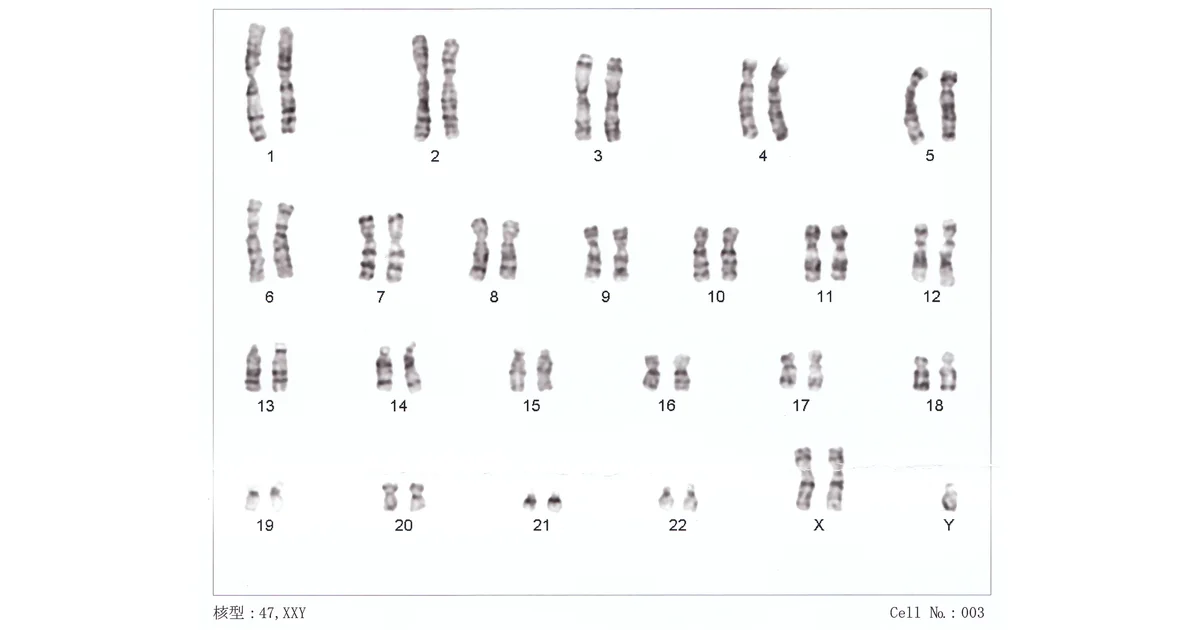
Klinefelter syndrome is a chromosomal condition in which a male has an extra X chromosome (47,XXY), occurring in about 1 in 600 male births.
| Feature | Typical finding |
|---|---|
| Karyotype | 47,XXY in most cases; mosaic forms exist |
| Prevalence | About 1 in 600 male births |
| Testes | Small, firm testes with progressive hyalinisation of tubules |
| Hormones | Low or low-normal testosterone, high FSH and LH |
| Sperm in ejaculate | Absent in most men; present in a minority, more often in mosaic forms |
What the extra X chromosome does to the testis
The additional X chromosome impairs spermatogenesis in the seminiferous tubules, which become progressively fibrotic. Testosterone production also falls in many men, which is why the condition sits at the crossroads of endocrinology and reproductive medicine.
Why many men are diagnosed only during an infertility workup
Historically only about 25% of people with Klinefelter syndrome came to medical attention, often for infertility rather than for the classic signs. With wider use of non-invasive prenatal testing, more cases are now identified before birth, which changes the counselling conversation.
Can men with Klinefelter syndrome have biological children?
Yes — biological fatherhood is possible for a substantial minority, usually through testicular sperm extraction combined with ICSI.
The three realistic routes
The first step is a semen analysis, because a small number of men, especially those with mosaic Klinefelter syndrome, do have sperm in the ejaculate. If no sperm are found, micro-TESE can be performed with a fresh ICSI cycle, or sperm can be cryopreserved for later use.
Sperm found at surgery can also be frozen before cancer treatment or testosterone therapy.
What “no sperm” on a semen analysis does and does not mean
Azoospermia on the ejaculate confirms that sperm are not leaving the body naturally; it does not confirm that the testis contains no sperm. That distinction is the whole reason micro-TESE exists, and it is the single most important thing to understand after a diagnosis.
How successful are sperm retrieval and ICSI?
Pooled data put sperm retrieval at roughly 40–50% per attempt, with live birth around 40–50% among couples who reach ICSI.
| Study | Patients | Sperm retrieval | Pregnancy or live birth |
|---|---|---|---|
| Corona et al., 2017 (37 studies) | 1,248 men | 44% per TESE cycle (95% CI 39–48%) | ICSI pregnancy 43%; live birth 43% |
| Baeck et al., 2023 (two centres) | 118 men | 49.2% with micro-TESE | Live birth in 53.4% of retrieval-positive men |
| Barros et al., 2022 (single centre) | 76 men, 77 cycles | 40.3% | Live birth 65.2% with fresh vs 23.8% with frozen sperm |
| Feng et al., 2025 (single centre) | 260 men | 47.7% | No significant difference between fresh and frozen sperm |
Is micro-TESE better than conventional TESE?
In the largest meta-analysis, micro-TESE and conventional TESE performed similarly (45% versus 43%), with no statistical difference. Micro-TESE remains preferred in many centres because it removes less tissue and may reduce testosterone loss, but the retrieval rate itself is not clearly superior.
Does fresh or frozen sperm give better results?
The evidence conflicts. One Portuguese cohort reported much higher live birth with fresh testicular sperm (65.2% versus 23.8%), while a 2025 Chinese cohort of 170 ICSI cycles found no difference in pregnancy, live birth or miscarriage.
The safer conclusion is that freezing does not clearly reduce your chances.
“The present data suggest that performing TESE/micro-TESE in subjects with KS results in SRRs of close to 50%, and then PRs and LBRs of close to 50%, with the results being independent of any clinical or biochemical parameters tested.” — Corona et al., Human Reproduction Update, 2017
Which factors predict whether sperm will be found?
The honest answer is that no single factor reliably predicts success in an individual man, and the published predictors disagree with each other.
What the largest meta-analysis found
Meta-regression across 37 studies found that age, testis volume, FSH, LH and testosterone did not affect retrieval rates. That is why a high FSH or a very small testis should not be used to deny a man the chance of surgery.
What single-centre studies add
A Korean series of 118 men found that total testicular volume above 3.93 mL, left testis volume above 1.79 mL and a neutrophil-to-lymphocyte ratio of 1.82 or lower predicted success. A separate meta-analysis of 53 studies reported that younger age and higher testosterone favoured retrieval with micro-TESE, while lower LH and FSH favoured aspiration.
Why the disagreement matters
These findings are drawn from retrospective cohorts with different surgical techniques and definitions, so they describe group averages rather than your own odds. Use them to set expectations, not to rule the operation in or out.
Does testosterone treatment reduce the chance of fatherhood?
Yes, exogenous testosterone suppresses sperm production, and men who are trying to conceive should generally avoid it.
“Men with hypogonadism seeking fertility should avoid exogenous testosterone; alternatives such as selective estrogen receptor modulators, aromatase inhibitors, or gonadotropins may be considered.” — ICSM 2024 recommendations, Sexual Medicine Reviews, 2026
The adolescent dilemma
Testosterone is often needed for bone health, puberty and body composition, yet starting it may reduce future fertility. In a 2026 Copenhagen series of 48 adolescents with Klinefelter syndrome, 14.6% had sperm in their ejaculate, while earlier reports ranged from 3.4% to 8.5%; most of those with sperm were already on testosterone.
A practical sequence
Semen analysis and sperm cryopreservation should be offered before testosterone is started, and any decision to stop testosterone before surgery belongs with an endocrinologist. Recovery of spermatogenesis is slow and unpredictable, so the plan should be made months ahead rather than in the week before micro-TESE.
Will the baby inherit the extra X chromosome?
The risk is low: published estimates put the transmission risk at about 0.63%, compared with 0.5–1% in the general population.
What the follow-up data show
In one cohort of 76 men, chromosome analysis of 21 newborns was normal. That is reassuring but small, and it is the reason genetic counselling is recommended rather than assumed.
Is PGT-A required?
No. Preimplantation genetic testing for aneuploidy is an option to discuss, not a mandatory step, and it does not change the embryo’s underlying biology.
Couples should weigh the extra cost and the possibility of having no transferable embryo against a transmission risk that is close to the background rate.
What should you do in the first three months after diagnosis?
Ask for a reproductive urology referral and a semen analysis with cryopreservation before any hormone treatment, because the first three months set up every later option.
The sequence below follows the AUA/ASRM guideline on male infertility and the ICSM recommendations on hormones, adapted to a Klinefelter diagnosis.
- Semen analysis and freezing: do this before testosterone, surgery or cancer treatment if there is any sperm at all.
- Hormone panel: testosterone, LH, FSH and oestradiol give the baseline for later decisions.
- Genetic counselling: confirms the karyotype, discusses mosaic forms and explains the 0.63% transmission estimate.
- Metabolic and bone health: screen for diabetes, lipids and bone density, which are part of the syndrome rather than the fertility problem.
- Mental health: anxiety and depression are common and treatable; ask for support early rather than after a failed cycle.
Three patients, three paths
The accounts below are anonymised composites based on patient-reported experiences; names, amounts and some clinical details have been changed.
”The first doctor told me I would never be a father”
A 29-year-old in Guangzhou was diagnosed during an infertility workup and was initially told that fatherhood was impossible. He switched to a hospital with a reproductive urology team, paid about 30,000 yuan (roughly US$4,200) for micro-TESE and about 40,000 yuan for the ICSI cycle, had sperm found on the first attempt, and now has a daughter: “What changed was not my chromosomes, it was the doctor I was sitting in front of."
"I had been on testosterone since I was sixteen”
A 34-year-old in Manchester was diagnosed in childhood and started testosterone at 16 for bone health and puberty. He stopped six months before micro-TESE on his endocrinologist’s advice, had no sperm found, and is considering a second attempt: “Nobody told me at sixteen that the injection might cost me this."
"Mosaic meant we had a different conversation”
A 38-year-old in Chicago with mosaic Klinefelter syndrome had sperm in his ejaculate and banked it before starting testosterone. One ICSI cycle using frozen sperm, costing about US$18,000 including medication, produced a live birth.
His advice: “Ask for the karyotype in writing and ask whether it is mosaic — the answer changes the plan.”
Frequently Asked Questions (FAQ)
Q: Can a man with Klinefelter syndrome conceive naturally?
Rarely. Sperm in the ejaculate is reported in about 3.4–8.5% of men in older series and 14.6% in one 2026 adolescent cohort, so natural conception is possible but uncommon.
Q: What are the chances of finding sperm with surgery?
About 44% per TESE cycle across 37 studies and 1,248 men, and about 49% in a more recent two-centre series of 118 men.
Q: How many micro-TESE attempts are reasonable?
There is no fixed limit, but about 44% of attempts find sperm on average, so a second try is a real option rather than a certainty. Each attempt carries anaesthetic and tissue-loss risks, and success on a repeat attempt is lower than on the first.
Q: Does testosterone replacement end any chance of fatherhood?
It can reduce it: sperm production usually falls within about 3 months of starting testosterone, and it should be avoided while trying to conceive. Sperm cryopreservation before starting testosterone is the safest way to protect the option.
Q: Will my son inherit Klinefelter syndrome?
The estimated transmission risk is about 0.63%, close to the 0.5–1% background rate, and genetic counselling is recommended before treatment.
Q: Is ICSI the only way to have a child?
For men with non-obstructive azoospermia, ICSI using sperm from the roughly 44% of retrieval attempts that succeed is the only route to a biological child. Donor sperm and adoption remain valid alternatives and should be discussed without stigma.
Q: Does Klinefelter syndrome affect the child’s health?
The follow-up data are limited, but 21 newborns in one cohort had normal karyotypes. Long-term paediatric follow-up is still recommended because the syndrome affects metabolism, bone and development.
Q: When should fertility preservation be discussed?
At diagnosis, ideally in adolescence; in one 2026 cohort of 48 adolescents, 14.6% already had sperm in the ejaculate. Guidelines disagree on routine surgery in teenagers, but semen analysis and counselling before testosterone are widely recommended.
How to plan your fertility care
Start with a reproductive urologist who performs micro-TESE regularly, and ask for the clinic’s own retrieval and live birth rates rather than general success claims.
If you are at the beginning of the workup, read our guides to azoospermia, male-factor infertility and IVF and how to read a semen analysis. Couples moving toward treatment can compare ICSI with standard fertilisation, and anyone offered chromosome testing should read genetic testing for infertility and PGT genetic screening. Men considering hormone treatment can review testosterone, hCG and male fertility, and the CDC national ART data gives context for clinic claims.
To find centres with male-fertility and micro-TESE experience, browse the ProIVF hospital directory or contact our editorial team for help comparing protocols.
Medical disclaimer: This article summarises published evidence and does not replace individual medical advice. Sperm retrieval, hormone management and genetic counselling decisions must be made with your own clinical team.
How this article was created: The ProIVF medical editorial team reviewed the 2017 and 2023 meta-analyses, recent cohort studies, the AUA/ASRM male infertility guideline and the 2024 ICSM recommendations, then checked every number against the published abstracts. The draft was reviewed by the ProIVF Medical Advisory Board before publication. Read more about ProIVF.
Last updated: 7 November 2026.





