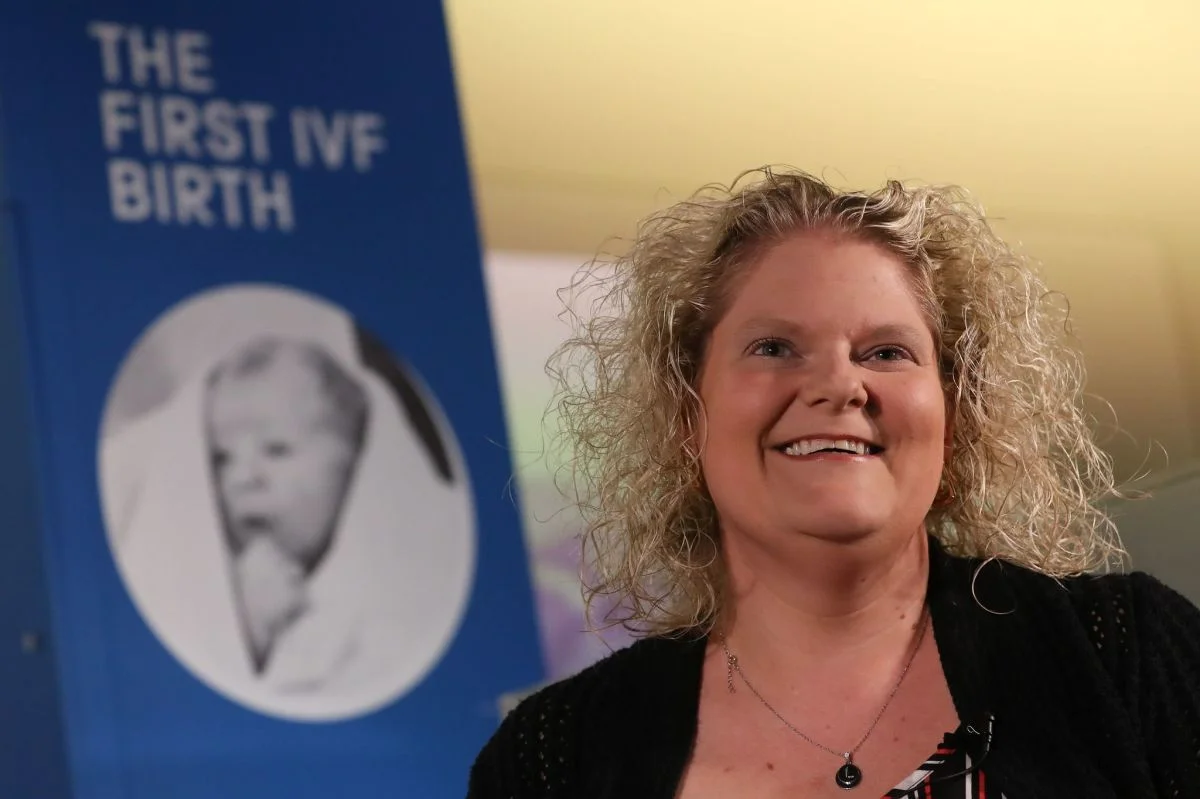
Louise Joy Brown — born at 11:47 PM on July 25, 1978 at Oldham General Hospital in England, weighing 2.608 kg (5 lb 12 oz) — was the first human ever conceived through in vitro fertilization (IVF). Her birth made front-page news worldwide, settled a decades-long scientific dispute over whether lab fertilization could produce a healthy baby, and opened the door to the more than 12 million children now born through IVF globally.
Louise Brown IVF at a Glance: Key Facts
| Fact | Detail |
|---|---|
| Full name | Louise Joy Brown |
| Date of birth | July 25, 1978, 11:47 PM |
| Place of birth | Oldham General Hospital, England |
| Birth weight | 2.608 kg (5 lb 12 oz) |
| Parents | Lesley and John Brown |
| Conception method | In vitro fertilization (laparoscopic retrieval, natural cycle) |
| Doctors | Patrick Steptoe (surgeon) and Robert Edwards (scientist) |
| Cycle type | Natural cycle — no stimulation drugs |
| Embryo stage at transfer | 8-cell (about day 2.5) |
| Nobel Prize for IVF | Robert Edwards, 2010 |
| IVF babies born since | 12+ million worldwide (source: ICMART) |
Who Was Louise Brown, the World’s First IVF Baby?
Louise Brown was born to Lesley and John Brown after Lesley’s blocked fallopian tubes left the couple 9 years of unsuccessful attempts to conceive naturally.
The Browns were referred to Patrick Steptoe, a gynecologist and laparoscopy pioneer, and Robert Edwards, a physiologist who had been researching human fertilization outside the body since the late 1960s despite persistent rejection by the medical establishment. Lesley Brown’s successful pregnancy proved, for the first time, that fertilization could occur outside the human body and result in a healthy live birth.
Why Does the Name “Louise Brown” Still Matter to Infertility Patients?
Before 1978, couples facing blocked tubes, low sperm counts, or unexplained infertility had almost no effective treatment options — a tubal infertility diagnosis meant virtually no chance of a natural pregnancy. Louise’s birth proved fertilization could succeed outside the body and created the entire field of assisted reproduction.
Her name topped world headlines within days, and the breakthrough moved into clinical practice with striking speed: IVF clinics followed in Australia (1980) and the United States (1981).
Where Is Louise Brown Now? Her Own Fertility Story
Louise Brown is alive and well — 48 years old as of 2026, living in England with her family, including 2 sons she conceived naturally without any fertility treatment.
She has appeared in documentaries and interviews about her unique place in medical history, expressing pride at being the first IVF baby and advocating for access to fertility treatment. Her natural motherhood directly answered early critics who had questioned whether IVF-conceived children would face reproductive problems. According to Britannica’s biography of Louise Brown, her birth “opened a new era in reproductive technology.”
Who Created the First Test-Tube Baby? The Two Pioneers
Louise Brown was the product of a decade-long partnership between a laboratory scientist and an operating surgeon — Robert Edwards and Patrick Steptoe — who worked through scientific skepticism, ethical condemnation, and chronic underfunding.
“[Robert Edwards’] work has enabled millions of infertile couples to have children.” — Nobel Assembly citation, 2010
Robert Edwards: The Scientist Who Made IVF Possible
Edwards, a British physiologist, successfully fertilized human eggs in laboratory glassware as early as 1969 and received the Nobel Prize in Physiology or Medicine in 2010 for developing IVF.
The UK Medical Research Council repeatedly denied his funding applications, and many scientific journals refused to publish his results on ethical grounds. He persisted anyway, and his 1969 breakthrough became the scientific foundation of the 1978 birth.
Patrick Steptoe: The Surgeon Who Retrieved the First IVF Egg
Steptoe’s laparoscopic technique was the only safe way at the time to remove a mature egg from Lesley Brown’s ovary without open surgery.
The two men met at a scientific conference in 1968 and formed a perfectly complementary team: Edwards provided the laboratory expertise in gamete handling and fertilization, while Steptoe contributed the surgical skills for egg retrieval and embryo transfer.
The Ethics Battle That Nearly Stopped the First IVF Birth
Britain’s Medical Research Council refused to fund the pair’s work and explicitly called it unethical, and the British medical establishment condemned them in journals and public statements. A private donor’s critical funding is what kept the research alive at all.
After Louise was born, the UK government established the Warnock Committee to examine the ethics and law of IVF, and its recommendations led to the Human Fertilisation and Embryology Authority, HFEA in 1990 — the world’s first statutory regulator of IVF and embryo research, later a template for regulatory frameworks in other countries.
How Was the First Test-Tube Baby Conceived? The 1978 Procedure
The procedure that created Louise Brown looks almost primitive by today’s standards: no stimulation drugs, a single egg, and pure natural-cycle monitoring.
| Step | What Happened | Key Detail |
|---|---|---|
| 1 | Natural cycle monitoring | Lesley’s menstrual cycle was tracked with no hormonal drugs |
| 2 | Laparoscopic egg retrieval | Steptoe located and removed 1 mature egg from her ovary |
| 3 | In vitro fertilization | Edwards placed the egg with John Brown’s prepared sperm in a glass dish |
| 4 | Embryo culture | The fertilized egg divided to the 8-cell stage over about 2.5 days |
| 5 | Embryo transfer | The 8-cell embryo was returned to the uterus through a thin catheter via the cervix |
That simplicity shows how far the technology has traveled. Modern IVF retrieves 8-15 eggs per stimulated cycle, uses ICSI to fertilize even with severe male factor, screens chromosomes with PGT-A before transfer, and freezes surplus embryos by vitrification — lifting success rates from roughly 5-10% per cycle in the early 1980s to 40-50% live birth per transfer for women under 35 at leading clinics today, per CDC ART data.
How Did Louise Brown Change the World?
Within 3 years of July 25, 1978, the first IVF babies had been born in Australia (1980) and the United States (Elizabeth Carr, 1981), with Europe and Asia following quickly; China’s first IVF baby, Zheng Mengzhu, arrived at Peking University Third Hospital in 1988.
IVF by the Numbers Today
- More than 12 million babies born through IVF and related technologies since 1978 (source: ICMART)
- Over 2% of all babies born in developed countries are conceived through IVF
- In Denmark and Finland, IVF accounts for 5-6% of all births
- The global IVF market was worth roughly $20 billion in 2025
- More than 2,500 fertility clinics operate across 70+ countries
The 2010 Nobel Prize: Recognition 32 Years in the Making
Robert Edwards received the 2010 Nobel Prize in Physiology or Medicine for developing IVF — 32 years after Louise’s birth.
Patrick Steptoe had died in 1988, and Nobel statutes bar posthumous awards, but Edwards credited his partner’s contribution in the Nobel lecture. Today both men are counted among the most consequential figures in 20th-century medicine.
How Has IVF Evolved Since 1978?
Seven milestones turned Lesley Brown’s single-egg natural cycle into today’s high-precision treatment.
| Technology | Introduced | Impact on Success and Access |
|---|---|---|
| ICSI (intracytoplasmic sperm injection) | 1992 | 1 sperm is enough to fertilize an egg, solving severe male factor infertility |
| Blastocyst culture | Late 1990s | Embryos grown to day 5-6 improve selection and implantation rates |
| PGT-A (chromosome screening) | Early 2000s | Transferring only chromosomally normal embryos lowers miscarriage rates |
| Egg freezing (vitrification) | 2005 onward | Fertility preservation for medical and social reasons, with >90% egg survival |
| Frozen embryo transfer (FET) | 2010s | Better endometrium-embryo synchrony and no ovarian hyperstimulation risk |
| Time-lapse embryo imaging | 2010s | Continuous development monitoring without removing embryos from the incubator |
| AI-assisted embryo selection | 2020s | Machine-learning models predict embryo viability with rising accuracy |
Compare what these advances cost around the world in our 2026 IVF cost guide, or browse the global fertility clinic directory to compare services and success rates.
FAQ
Q: Is Louise Brown still alive?
Yes. Born July 25, 1978, she is 48 as of 2026 and lives in England with her family.
She has given numerous interviews and documentary appearances about her story and continues to advocate for access to fertility treatment, saying she is “proud” to be the first IVF baby.
Q: Did Louise Brown have children naturally?
Yes — she conceived and delivered 2 sons without any fertility treatment or medical assistance. This helped silence early critics, including some medical professionals, who had doubted whether IVF-conceived children would have normal reproductive function as adults.
Q: How many attempts did Steptoe and Edwards need before success?
Their partnership ran from 1968 to Louise’s birth in 1978 — 10 years and roughly 100 failed attempts, including several early pregnancies lost to miscarriage, before the Browns’ success.
Q: How many babies have been born by IVF since Louise Brown?
More than 12 million worldwide, according to the International Committee for Monitoring Assisted Reproductive Technology (ICMART) — a number still growing by about 500,000 births per year.
Q: Was Louise Brown really a “test-tube baby”?
Not literally: even in the 1978 procedure, Edwards fertilized the egg in a flat glass petri dish, not a test tube — and modern IVF laboratories still use dishes for fertilization and embryo culture. The “in vitro” in in vitro fertilization is Latin for “in glass.”
Q: Who won the Nobel Prize for IVF?
Robert Edwards alone, in 2010. Patrick Steptoe died in 1988, and Nobel rules bar posthumous awards — but the medical and scientific consensus is that without Steptoe’s surgical skills there would have been no Louise Brown.
Q: How do early and modern IVF success rates compare?
Success ran at roughly 5-10% per cycle in the years after 1978; today, women under 35 achieve about 40-50% live birth rates per transfer according to CDC and SART data. Age remains the single most important factor — see our IVF success rate data guide.
Q: When was China’s first IVF baby born?
On March 10, 1988, at Peking University Third Hospital — Zheng Mengzhu, delivered through the work of Professor Zhang Lizhu’s team. China now completes more than 1 million IVF cycles per year across hundreds of licensed centers.
Why the First Test-Tube Baby Still Matters
Louise Brown’s arrival on July 25, 1978 proved that IVF could produce a healthy baby despite decades of scientific doubt and ethical opposition. The field her birth created has since delivered more than 12 million children — and her story remains both a history lesson and a reassurance for anyone considering treatment today.
Explore your options in our global fertility clinic directory, read the step-by-step IVF process guide, or contact the ProIVF team for personalized guidance.
Last updated: July 2, 2026. This article is for general education only and does not constitute medical advice. Data sources include ICMART, CDC ART, the Nobel Foundation, Britannica, and HFEA; consult a licensed fertility specialist for personal guidance.
Content Authorship
Written by the ProIVF Medical Editorial Team and reviewed by the ProIVF Medical Advisory Board, based on public records from the Nobel Foundation, Britannica, ICMART, the US CDC ART program, and the UK HFEA.
Sources
- Nobel Prize — Robert Edwards, Prize in Physiology or Medicine 2010
- Encyclopaedia Britannica — Louise Brown biography
- Centers for Disease Control and Prevention (CDC) — ART success rates
- Human Fertilisation and Embryology Authority (HFEA) — regulation and statistics