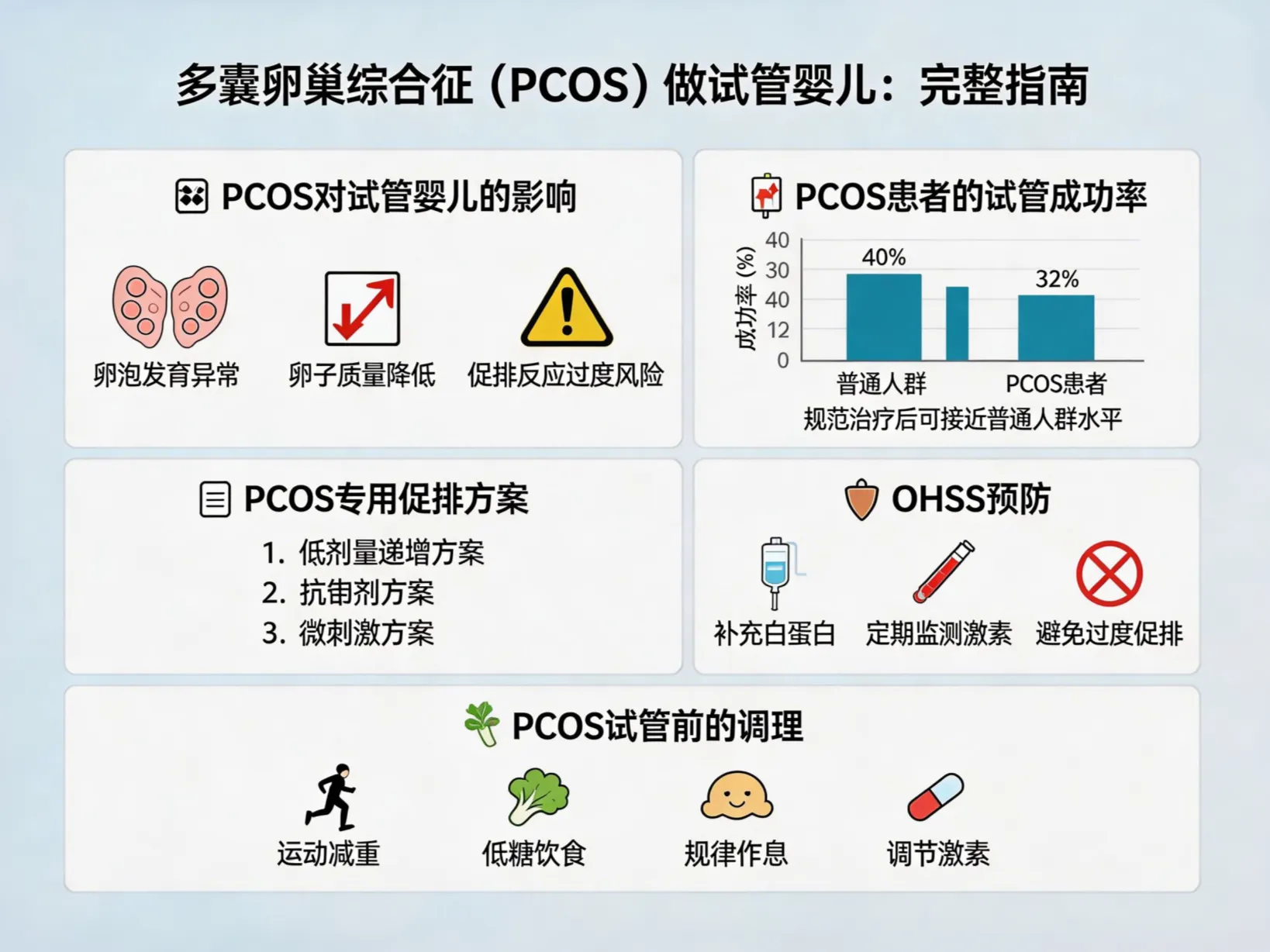
PCOS patients actually achieve above-average IVF success — 40-50% live birth rates with normal weight — because their ovarian reserve is abundant, but they carry the highest OHSS risk of any patient group. This guide covers PCOS-specific stimulation protocols, OHSS prevention, and the 1-3 month preparation plan that moves the odds further in your favor.
Why Does PCOS Change Your IVF Plan?
Polycystic Ovary Syndrome (PCOS) affects 10-15% of women of reproductive age, making it the most common female endocrine disorder. In IVF it brings both an unusual advantage and a serious risk.
The Advantages
- Rich ovarian reserve: PCOS patients typically show antral follicle counts (AFC) above 20.
- High egg yields: each stimulation cycle retrieves more eggs than average.
- Younger starting age: PCOS patients often begin fertility treatment earlier.
The Challenges
- OHSS risk: PCOS is the single strongest risk factor for Ovarian Hyperstimulation Syndrome.
- Variable egg quality: more eggs does not automatically mean more mature, high-quality eggs.
- Endocrine disruption: high androgens and insulin resistance can impair implantation.
- Weight: approximately 50-70% of PCOS patients are overweight.
What Are the IVF Success Rates with PCOS?
PCOS patients with normal weight and controlled insulin resistance outperform non-PCOS patients on both pregnancy and live birth rates. Rates below are per transfer; national baselines are published in the CDC ART success rates report and by SART.
| Patient Profile | Clinical Pregnancy Rate | Live Birth Rate |
|---|---|---|
| PCOS + normal weight | 45-55% | 40-50% |
| PCOS + overweight | 35-45% | 30-40% |
| PCOS + controlled insulin resistance | 40-50% | 35-45% |
| Non-PCOS (control group) | 35-45% | 30-40% |
The conclusion is direct: with a normal weight and well-managed endocrine profile, PCOS raises rather than lowers your IVF odds.
Which Stimulation Protocol Works Best for PCOS?
The PCOS stimulation target is a moderate yield of 8-15 eggs, not the maximum possible count — chasing higher numbers mainly raises OHSS risk.
| Protocol | Medications | Why It Works |
|---|---|---|
| GnRH antagonist | FSH + GnRH antagonist | First-line choice; lower OHSS risk |
| Letrozole + FSH | Letrozole + low-dose FSH | Gentle stimulation suited to PCOS |
| GnRH agonist trigger | Agonist instead of hCG | Drastically reduces OHSS risk |
Letrozole-based protocols have strong trial support in PCOS:
“As compared with clomiphene, letrozole was associated with higher live-birth and ovulation rates among infertile women with the polycystic ovary syndrome.” — Legro RS et al., New England Journal of Medicine, 2014 (PPCOS II trial)
What Should PCOS Patients Avoid?
- High-dose stimulation protocols
- hCG triggers, which carry high OHSS risk in PCOS
- Fresh embryo transfer when OHSS risk is elevated
How Can OHSS Be Prevented?
OHSS (Ovarian Hyperstimulation Syndrome) is a dangerous over-reaction of the ovaries to fertility drugs, causing bloating and abdominal pain, nausea and vomiting, and in severe cases fluid accumulation in the abdomen or chest that can threaten life. Prevention is built into every step of a well-run PCOS cycle.
- Low starting dose: begin FSH at 100-150 IU rather than 225-300 IU.
- Antagonist protocol: GnRH antagonist cycles carry lower OHSS risk than long agonist protocols.
- Agonist trigger: use a GnRH agonist instead of hCG for final maturation.
- Freeze-all strategy: skip fresh transfer so the ovaries recover — see our OHSS prevention guide.
- Metformin: starting it before the cycle lowers OHSS risk.
- Cabergoline: given after the trigger, it reduces OHSS incidence.
How Should You Prepare Before a PCOS IVF Cycle?
Lifestyle intervention is the most powerful preparation step — a 5-10% weight loss alone measurably improves PCOS IVF outcomes.
Weight, Diet, and Exercise
- Weight management: overweight patients who lose 5-10% of body weight see better ovulation rates, insulin sensitivity, IVF success, and lower OHSS risk.
- Low-GI diet: whole grains, vegetables, and legumes; high protein from fish, eggs, and lean meat; less refined sugar and processed carbohydrate; more fiber.
- Exercise: 150 minutes of moderate aerobic activity weekly plus strength training improves insulin sensitivity.
Which Medications Help Before Transfer?
| Medication | Purpose | Timing |
|---|---|---|
| Metformin | Improves insulin resistance | Start 1-3 months before IVF |
| Inositol (myo-inositol) | Supports egg quality | Start 3 months before |
| Folic acid | Prevents neural tube defects | Start 3 months before |
| Vitamin D | Supports endocrine function | Guided by blood test results |
What Does a PCOS IVF Journey Look Like?
A PCOS-optimized pathway front-loads preparation and freezes embryos before any transfer.
- Pre-treatment (1-3 months): weight management, metformin, inositol.
- Antagonist stimulation (8-12 days): low starting dose.
- GnRH agonist trigger: avoids the main OHSS switch.
- Freeze all embryos: lets the ovaries recover from stimulation.
- Frozen embryo transfer (1-2 months later): performed once hormones are stable.
- Single embryo transfer: PCOS patients face elevated multiple-pregnancy risk.
Why Freeze Embryos Instead of Doing a Fresh Transfer?
After stimulation, hormone levels in PCOS ovaries are abnormal and can impair implantation, so a freeze-all approach gives the ovaries recovery time and dramatically lowers OHSS risk. Frozen transfer success rates equal or exceed fresh transfer in PCOS patients — details in our frozen embryo transfer guide.
Is IUI or Natural Conception an Option First?
For mild PCOS, ovulation induction with letrozole plus timed intercourse or IUI is a reasonable first step, and many clinics try 3-6 IUI cycles before recommending IVF. Our IUI procedure guide and letrozole for fertility explain when to move on.
FAQ
Q: Do I have to lose weight before IVF with PCOS?
If your BMI is above 25, weight loss is strongly recommended — even a 5% reduction significantly improves IVF outcomes. Over age 35, you can begin the IVF process in parallel with lifestyle changes rather than delaying treatment.
Q: Is IVF more expensive for PCOS patients?
Not necessarily: PCOS patients often need lower medication doses because their ovaries respond well — starting FSH is typically just 100-150 IU — though OHSS-prevention measures and frozen embryo transfer add costs. Overall spending is comparable to the average IVF cycle.
Q: Does PCOS affect the health of the baby?
PCOS itself does not damage embryo health. Pregnancies do need closer monitoring because gestational diabetes and hypertension risks are higher, and clinics limit transfers to 1 embryo to avoid the multiple-pregnancy risks of transferring two.
Q: Can PCOS patients try natural conception or IUI before IVF?
Yes — for mild PCOS, letrozole ovulation induction with timed intercourse or IUI comes first, with IVF typically considered after 3-6 failed IUI cycles.
Q: How many eggs should a PCOS stimulation aim for?
The safe target is 8-15 retrieved eggs. PCOS ovaries can produce far more, but higher yields correlate with OHSS rather than better outcomes.
Q: Why do PCOS patients get an agonist trigger instead of hCG?
A GnRH agonist trigger clears the stimulation signal quickly instead of sustaining it like hCG, which sharply lowers OHSS risk in high-response ovaries (AFC above 20). That is why it is standard in antagonist PCOS cycles.
The Bottom Line for PCOS IVF
PCOS is one of the few infertility diagnoses where IVF outcomes beat the average — 40-50% live birth at normal weight — provided the protocol is gentler and OHSS prevention is strict. Weight management, an antagonist protocol, an agonist trigger, and a freeze-all single-transfer plan carry most of the benefit.
If you want a second opinion on your PCOS protocol, browse clinics in our IVF hospital directory or contact our team for guidance.
About this article: Researched and written by the ProIVF Medical Editorial Team based on published reproductive medicine literature, including the PPCOS II randomized trial (New England Journal of Medicine, 2014) and ASRM guidance on PCOS and OHSS, and reviewed by the ProIVF Medical Advisory Board. Learn about our editorial standards on our About page.
Last updated: 2026-09-20. This article is for informational purposes only and does not constitute medical advice. Individual outcomes vary with age, BMI, and clinic protocol — consult a qualified reproductive endocrinologist about your own treatment plan.