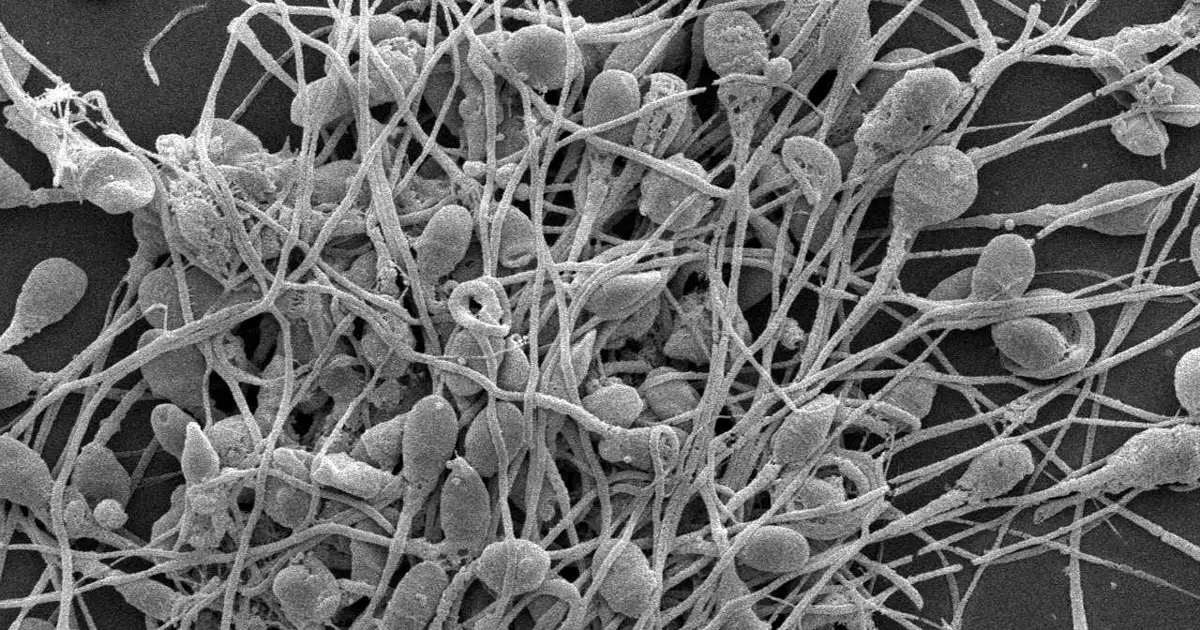
Sperm morphology asks how many sperm in a sample keep a normally shaped head, midpiece and tail: an embryologist reads 200 individual cells under strict (Kruger) criteria, and the WHO 6th edition decision limit is 4% — eight passing cells in two hundred. It is the least useful standard semen parameter for predicting IVF and ICSI outcomes and rarely changes the treatment a clinic offers.
What Does a Sperm Morphology Test Actually Measure?
The test measures shape: a stained semen smear is read cell by cell and 200 sperm are classified as normal or as carrying a head, midpiece or tail defect (Boitrelle et al., Life, 2021). The share passing every rule at once is your morphology score.
Where Did the 4% Cut-Off Come From?
The 4% line is a percentile statistic from fertile men, not a trial result; Kruger’s 1986 IVF series put the break point at 14%. “Probability models indicated that there was a clear threshold in normal sperm morphologic features at 14%” (Kruger et al., Fertility and Sterility, 1986).
In that lowest group (0–14% normal forms), “104 oocytes were obtained, of which 37% fertilized, but no pregnancy resulted”, while in the highest group 91% of 69 oocytes fertilized. The 4% figure arrived later, from comparing 107 proven-fertile men with 103 subfertile men and taking the fifth percentile of the fertile group, alongside an acrosome-index cut-off of 8% (Menkveld et al., Human Reproduction, 2001).
So 4% marks a statistical boundary among fertile men, not a level below which conception stops.
What Counts as a Normal Sperm?
Strict criteria test five features at once, and the definition is worth reading in the researchers’ own words.
“Smooth and oval-shaped head, an acrosome covering 40%–70% of its head, the absence of large and multiple small vacuoles, a slender midpiece with an equal length to the head without cytoplasmic residues axially attached to the head, and a lengthy tail lacking any sharp bends.” — Wyns et al., Therapeutic Advances in Reproductive Health, 2024 (PMID 39651461)
One slightly long head or one sharply bent tail and the cell fails, even if the other 199 look perfect.
What Are the WHO Reference Values for Semen Analysis?
The 2021 manual kept morphology at 4% and changed very little else that patients ask about. The larger change was conceptual: “this latest edition abandons the notion of reference thresholds, suggesting instead to replace them with ‘decision limits’” (Boitrelle et al., Life, 2021).
| Parameter | 6th edition (2021) | 5th edition (2010) |
|---|---|---|
| Semen volume | 1.4 mL | 1.5 mL |
| Sperm concentration | 16 million/mL | 15 million/mL |
| Total sperm number | 39 million | 39 million |
| Total motility (progressive + non-progressive) | 42% | 40% |
| Progressive motility | 30% | 32% |
| Vitality (live sperm) | 54% | 58% |
| Normal forms (strict criteria) | 4% | 4% |
| pH | ≥ 7.2 | ≥ 7.2 |
Values as printed in the 5th-versus-6th comparison table in Boitrelle et al., 2021 (PMID 34947899).
Does 4% Mean 96% Abnormal Is Normal?
Yes — 96% abnormal is the expected result, because the 4% line sits at the fifth percentile of men who conceived naturally, so roughly one in twenty fertile men falls below it.
Boitrelle’s authors add: “no decision limits are proposed for either basic semen parameters, or for extended or advanced parameters” — the table describes a population, not a patient.
Does Low Morphology Reduce IVF or ICSI Success?
Usually not: the largest pooled analysis — 17 studies and 17,348 ART cycles — put impaired morphology at an odds ratio of 0.88 (95% CI 0.75–1.00) for clinical pregnancy, indistinguishable from no effect (Del Giudice et al., Andrologia, 2022).
That analysis found no IVF-versus-ICSI difference (p = 0.14) and no trend as laboratories raised their thresholds (coefficient −0.02, p = 0.38). Its conclusion: “no association between semen quality (as measured by concentration, motility or morphology) and clinical pregnancy rates utilizing ART.”
The earlier review reached the same place: screening 1986–2009 it found 31 studies and included 4, concluding that isolated teratozoospermia (the label for morphology under 4%) “was not associated with a statistically significantly decreased probability of pregnancy with assisted reproduction” (Hotaling et al., Fertility and Sterility, 2011).
“The prognostic value of sperm morphology for pregnancy rates remains poor in ICSI.” — Wyns et al., Therapeutic Advances in Reproductive Health, 2024 (PMID 39651461)
In 537 ICSI cycles below 4% and 118 at or above it, fertilization rates were 72.0% and 70.8% — the lower-morphology group fertilized marginally better (Demir et al., Clinical and Experimental Obstetrics & Gynecology, 2012).
Where Morphology Does Predict: IUI
IUI is the one setting where the score predicts, because sperm still do the work themselves: in 244 IUI cycles across 209 patients, pregnancy per cycle tracked normal forms (Lee et al., International Journal of Andrology, 2002).
| Normal forms | Cycles | Pregnancy per cycle |
|---|---|---|
| Below 4% | 26 | 3.8% (1 of 26) |
| 4–9% | 54 | 18.5% (10 of 54) |
| Above 9% | 164 | 29.9% (49 of 164) |
That eight-fold spread is the strongest reason a clinic may move a couple straight to IVF when morphology is very low. Even here, “pregnancies have been achieved through IUI in cases of isolated teratozoospermia, even with very low percentages of normal morphology (0%–1%)” (Wyns et al., 2024).
Why the Two Answers Disagree
The 72.0%-versus-70.8% ICSI result is that flip: injecting one sperm per egg bypasses the steps shape defects impair — cervical mucus migration, binding to the zona pellucida (the egg’s outer shell), and the acrosome reaction (the enzyme release that lets sperm enter an egg).
Confounding does the rest: low morphology travels with low count and low motility, so studies that do not separate the three credit the shape score with effects belonging elsewhere.
Why Do Two Laboratories Report Different Numbers for the Same Sample?
Morphology is the least reproducible line on the report: reading 5,296 sperm cells with three evaluators gave a coefficient of variation (how far repeat readings scatter) of 4.80% for normal forms but 4.80%–132.97% for recognizing individual defects, with agreement coefficients of 0.387–0.607 (Wang et al., Fertility and Sterility, 2014).
That study concluded “the sperm head is more difficult to evaluate than the other parts using the criteria recommended by the World Health Organization in 2010”. Laboratory variation ran wider: a Belgian external quality-control program observed “a median coefficient of variation as high as 79.4% among an average of 120 laboratories over a 10-year period” (Wyns et al., 2024).
A result that moves from 2% to 5% between two laboratories may describe two readers rather than two patients.
What Do Specific Shape Defects Mean?
Head, midpiece and tail failures mean different things, and two grouping patterns change management: monomorphic, where nearly every sperm shares one abnormality, and polymorphic, where many different abnormalities appear across the sample.
Globozoospermia and Large Heads
Round-headed sperm with no acrosomal cap — globozoospermia — “occur in less than 0.1% of infertile patients worldwide” (Wyns et al., 2024). They need a distinct approach: ICSI plus artificial oocyte activation, because the signal that normally starts fertilization is missing.
Offspring series stay small: among 86 live births, one cardiofaciocutaneous malformation (a heart, face and skin defect) was reported in a patient with complete globozoospermia and ZPBP mutation.
Macrocephaly raises a genetic rather than a mechanical question: “a sperm aneuploidy (wrong chromosome count) rate of ~98% has been reported in sperm macrocephaly syndrome (SMS), compared to 1.3% in fertile control patients” (Wyns et al., 2024).
Tail and Midpiece Defects
Four tail patterns — short, bent, coiled and multiple — with very low motility point toward flagellar disorders such as MMAF (multiple morphological abnormalities of the flagella), linked to genes such as DNAH1, CFAP43 and FSIP2. Where the cause is primary ciliary dyskinesia (faulty airway cilia) or Kartagener syndrome, ICSI is described as “very important and even indispensable”, and “there was no increase in birth abnormalities among 13 singletons” (Sha et al., Asian Journal of Andrology, 2014; Wyns et al., 2024).
What About Head Vacuoles and Cytoplasmic Droplets?
Vacuoles are the most over-read finding: on transmission electron microscopy, about 50% of 1,908 sperm cells from 17 normozoospermic (normal count and motility) donors carried them, mostly at the head tip; the authors proposed reading them as “nuclear invaginations”, not nuclear defects (Gómez-Torres et al., International Journal of Molecular Sciences, 2023).
Cytoplasmic droplets (residual cytoplasm near the head) sit in the WHO manual’s midpiece-abnormality group; no human study attaches an outcome percentage to them, so none is quoted here.
Can You Improve Sperm Morphology?
Partly, and on a fixed timetable: “One cycle of the seminiferous epithelium lasts 16 days, and the whole of spermatogenesis is estimated to consume approximately 64 days” (Heller and Clermont, Science, 1963), so a change today appears in the ejaculate roughly three months later.
| Lever | What the evidence shows | Source |
|---|---|---|
| Stopping smoking | Smokers’ normal forms 1.37 percentage points lower (MD −1.37%, 95% CI −2.63 to −0.11) across 20 studies and 5,865 men | Sharma et al., European Urology, 2016 |
| Varicocele repair | Normal morphology improved by SMD 1.673 (95% CI 0.876–2.470) in 16 studies and 2,420 men, with very high heterogeneity (I² = 98.5%) | Agarwal et al., World Journal of Men’s Health, 2023 |
| Antioxidant therapy | Normal morphology and pregnancy rate higher than placebo or no treatment in 45 RCTs and 4,332 men; no live-birth or miscarriage benefit shown | Agarwal et al., World Journal of Men’s Health, 2023 |
| Abstinence interval | Short abstinence “could be more beneficial for infertile men, especially within the first 4 days of abstinence”; DNA fragmentation index fell 5.63% in unexplained infertility | Du et al., Andrology, 2024 |
Note that a standardized mean difference is not the share of men who improve, and the varicocele result’s I² = 98.5% heterogeneity bars any personal promise. On antioxidants, evidence and guidance diverge — the WHO’s 2025 infertility guideline states that “the GDG did not make a recommendation for or against the use of antioxidant supplements in males” (Fertility and Sterility, 2026).
Should You Test Sperm DNA Fragmentation Instead?
Ask which threshold your laboratory applies, since 15%, 25% and 30% all circulate. In 14,775 SCSA tests (a flow-cytometry assay of sperm DNA damage) across 70 clinics, IVF pregnancy rates fell from 45.1% to 24.6% once the DNA fragmentation index (DFI) passed 15% (OR 2.58, p = 0.004), and ICSI rates from 48.6% to 29.6% above 25% (OR 2.00, p = 0.032) (Christensen et al., Andrology, 2025).
A global survey found 30% the most-selected cut-off, chosen by only 33.7% of respondents; 62.7% cited no society guideline and 50.3% no accepted reference values (Agarwal et al., World Journal of Men’s Health, 2024). The semen analysis guide covers what the test adds beyond a standard sample.
What Should You Do With a Low Morphology Result?
Five steps, in the order most clinics use them.
- Repeat the sample: the WHO’s 2025 guideline covers “when a semen test should be repeated (n=2)”; one result has never been a diagnosis. The same guideline records that “globally one in six people experience infertility in their lifetime.”
- Ask which criteria and how many cells were read: 200 cells under strict criteria is the standard; a lab reading fewer or using looser rules reports a different number for the same man.
- Get an andrology or urology review if count or motility is also low: varicocele (a dilated vein around the testicle), hormonal and genetic causes are treatable or diagnosable, and the male infertility guide maps that pathway.
- Choose the route on the whole sample, not the shape score: if everything else is normal, an IUI attempt may still be reasonable. Below 4% forms the per-cycle rate is 3.8% versus 29.9% above 9%, and how IUI is performed explains that trade-off.
- Give any lifestyle change one spermatogenesis cycle before judging it: 64 days of production plus transit make a three-month retest the earliest fair comparison.
When no sperm appear in the ejaculate, morphology cannot be assessed and the pathway shifts to surgical sperm retrieval, covered in the azoospermia guide.
Patient Stories: Three Morphology Results, Three Different Plans
Patient stories are shared with consent; names and identifying details are changed. Clinical figures reflect the sources cited above.
Case 1: Marta and Jordi, 34 and 37 — 2% Forms, Everything Else Normal
Marta, 34, and Jordi, 37, live in Valencia, where his first analysis showed 2% normal forms with 48 million/mL and 46% total motility. Their clinic read the shape score as the only abnormality and recommended three IUI cycles at about €980 each.
None resulted in pregnancy, consistent with the 3.8% per-cycle figure below 4%. “The clinic kept saying the shape was fine because the count was good,” Marta said. “Nobody explained that IUI was the part where shape actually mattered.”
They moved to IVF with ICSI at a private clinic in Valencia for about €5,600 with medication. One blastocyst (a day-5 embryo) transferred, one pregnancy, a daughter born in 2025.
Case 2: Kevin, 41 — 1% Forms With Low Count, Then Varicocele Repair
Kevin, a 41-year-old project manager in Singapore, had 1% normal forms alongside 8 million/mL and a palpable left varicocele. Two analyses and a hormonal workup cost about SGD 3,200 at a private andrology clinic.
Microsurgical repair cost roughly SGD 9,500. A retest four months later — one full spermatogenesis cycle — showed 3% normal forms and 15 million/mL, both still below the WHO lines but roughly double the count.
“I was told to expect a bigger jump,” Kevin said. “The surgeon’s honest answer was that the numbers move, they don’t reset.” He and his wife proceeded to ICSI rather than wait for a natural pregnancy.
Case 3: Amira and Youssef, 30 and 35 — 0% Normal Heads
Amira, 30, and Youssef, 35, in Dubai were told his morphology read 0% normal forms: nearly every head was round, with no acrosomal cap. The diagnosis was globozoospermia, a condition reported in less than 0.1% of infertile patients worldwide.
Their plan was ICSI with artificial oocyte activation, quoted at about AED 42,000 (roughly $11,400). Eleven mature eggs were injected, eight fertilized, and three reached blastocyst; the single transfer produced an ongoing pregnancy.
“When the report said zero, I heard zero,” Youssef said. “The embryologist had to explain that zero normal shapes is not zero usable sperm — the head still carries the DNA, it just cannot open on its own.”
FAQ
Q: What is a normal sperm morphology percentage?
4% or higher under strict (Kruger) criteria, measured on 200 counted sperm cells, per the WHO 6th edition. That line is the fifth percentile of proven-fertile men, so most sperm in any sample look abnormal.
Q: Is 1% sperm morphology a cause for IVF?
Not automatically: in 17 studies and 17,348 ART cycles impaired morphology carried an odds ratio of 0.88 (95% CI 0.75–1.00) for clinical pregnancy, and ICSI fertilization was 72.0% below 4% versus 70.8% at or above it. Decisions turn on count, motility, female age and prior attempts.
Q: Can I improve sperm morphology in three months?
Partly, and three months is right because spermatogenesis takes approximately 64 days. Stopping smoking is tied to a 1.37-percentage-point difference in normal forms; varicocele repair improved morphology by SMD 1.673 (95% CI 0.876–2.470) across 2,420 men.
Q: Why did my morphology drop from 4% to 2% at a different lab?
Reader variation is the likely answer: agreement coefficients between evaluators run 0.387–0.607, defect-specific coefficients of variation reach 132.97%, and one quality-control program recorded a median coefficient of variation of 79.4% across about 120 laboratories.
Q: Does abnormal sperm morphology mean my baby will have birth defects?
The defect-specific data are limited but reassuring in small series: no increase in birth abnormalities among 13 singletons after ICSI for flagellar disorders, and one cardiofaciocutaneous malformation among 86 live births in globozoospermia. Site-wide IVF outcomes, including congenital heart defects, are covered in our IVF risks guide.
Q: Should we skip IUI if morphology is below 4%?
It is the one setting where the number predicts — 3.8% per cycle below 4%, 18.5% at 4–9% and 29.9% above 9% across 244 IUI cycles — so ask the question explicitly. Pregnancies have still been reported through IUI at 0%–1% normal forms.
Q: How many sperm cells are counted in a morphology test?
200 per replicate under the WHO 6th edition method, so one cell is worth 0.5%: a score of 4% means eight normal cells. Counts below 200 make the percentage less stable.
How to Plan Your Next Step
Morphology is one line on a report that should be read whole, and the same sample can move across the 4% line for reasons that have nothing to do with you. Compare andrology and IVF laboratories through verified hospital profiles, see how ICSI handles sperm selection, or contact our team if you want help interpreting a specific report before your next consultation.
About this article: Researched and written by the ProIVF Medical Editorial Team from the WHO 6th edition laboratory manual as tabulated in Boitrelle et al. (Life, 2021), the Kruger (1986) and Menkveld (2001) threshold studies, the 2011 and 2022 teratozoospermia-and-ART systematic reviews, the 2002 IUI prognostic study, the 2014 reproducibility analysis, the 2024 morphology review, the 2016 smoking and the 2023 varicocele and antioxidant meta-analyses, the 2024 abstinence meta-analysis, the 2025 DNA-fragmentation cohort, the 2023 vacuole imaging study and the WHO 2025 infertility guideline, with AI-assisted tools used only for literature organization and initial drafting under editorial direction. Reviewed by the ProIVF Medical Advisory Board; our editorial standards are on our About page.
Last updated: October 15, 2026. Informational only, not medical advice: a semen analysis is one measurement on one day, and interpretation belongs to the andrologist, urologist or fertility specialist who has your full history and repeat sample.