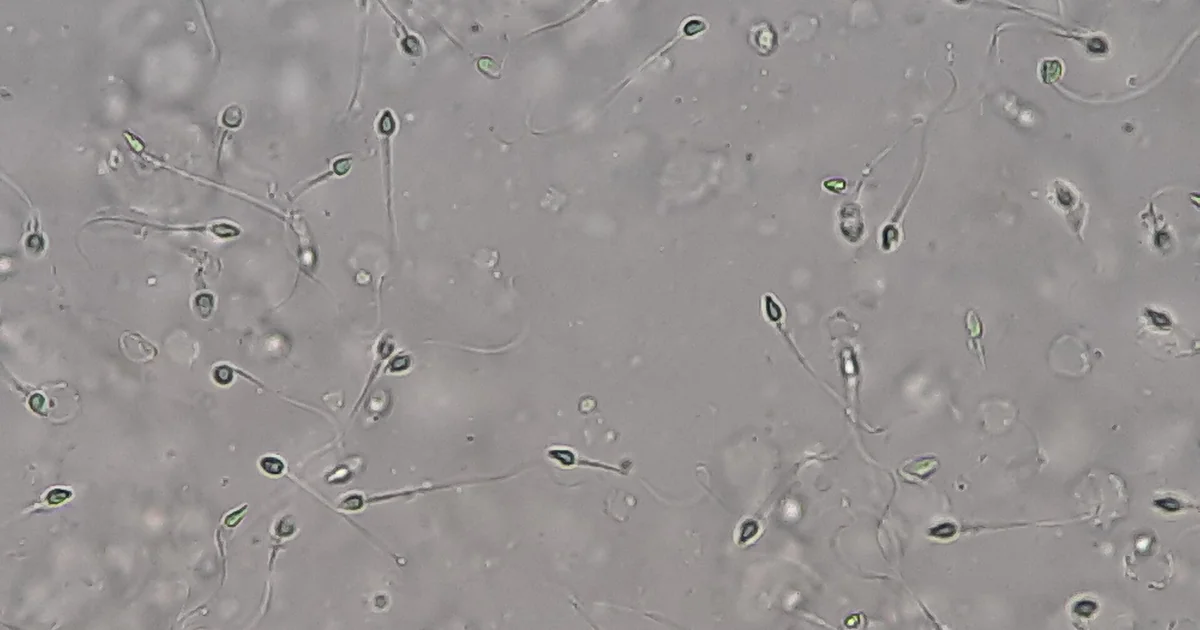
“What does sperm look like” and “is yellow semen an infection” are searched tens of thousands of times a day, and most answers online are folklore: yellow means infection, clear means infertility, clumps mean trouble. Almost none survives contact with an andrology laboratory.
Here is the honest starting point: normal semen is not one thing. It ranges from whitish to pale yellow and from watery to gel-like, and it changes within minutes of ejaculation through a normal process called liquefaction. Most one-off variations are harmless and say nothing reliable about sperm count, because the three things that decide fertility — concentration, motility and morphology — are invisible: one millilitre can hold anywhere from almost zero to over 100 million sperm.
What is visible does occasionally carry real information: a uniform reddish-brown tint, semen that never liquefies, or consistently watery fluid after an illness. This guide separates what you can read from an ejaculate from what only a semen analysis can tell you, using WHO 6th edition standards — PMID 34986984 — and recent viscosity studies.
How this article was researched: the ProIVF Medical Editorial Team reviewed the WHO Laboratory Manual for the Examination and Processing of Human Semen (6th edition, 2021), the PubMed studies linked throughout, and the WHO infertility fact sheet; our Medical Advisory Board then checked the draft.
What Normal Semen Actually Looks Like
Healthy ejaculate has a characteristic profile that most men never hear described:
- Color: greyish-white to opalescent; a faint yellow tint is also normal (see below).
- Texture at ejaculation: thick, gel-like, sometimes with jelly-like clumps — a temporary clot (semenogelin from the seminal vesicles) that keeps the ejaculate near the cervix.
- After 15–30 minutes: prostate enzymes — chiefly PSA (kallikrein-3) and KLK14 — dissolve the clot into a free-flowing liquid — PMID 18482984. WHO 6th edition sets ≤60 minutes as the upper limit of normal.
- Volume: the WHO 6th-edition (2021) lower limit is 1.4 mL (range 1.3–1.5), slightly below the 2010 5th edition’s 1.5 mL — PMID 34947899 — about a quarter teaspoon.
- Consistency after liquefaction: slightly sticky, forming a thin filament of a couple of centimetres in a pipette; a much longer, thicker filament signals hyperviscosity (see below).
One more normal detail: odor. Seminal plasma is slightly alkaline (WHO pH ≥7.2) and contains putrescine, so a chlorine-like smell is expected chemistry, not a hygiene problem.
Why semen changes appearance within minutes
The coagulate-then-liquefy sequence is evolution working: the gel clot shields sperm from the acidic vaginal environment until prostate enzymes dissolve it so they can swim out and up.
A sample examined at 2 and at 30 minutes should look like two different fluids; one that stays liquid from the start or stays gelled at an hour is the deviation.
The difference between sperm and semen
“Sperm” are the cells; “semen” (seminal plasma) is the fluid carrying them. Sperm cells are 50–60 µm long, about 1/20th of a human hair’s width, and visible only in bulk: the whitish opacity of semen is the sperm population suspended in seminal vesicle fluid (~65–70% of volume) and prostate secretions (~20–25%).
What Different Semen Colors Mean
Color is the most Googled feature and the least diagnostic: treat this table as triage, not diagnosis.
| Color / appearance | Most common benign cause | When it can mean something |
|---|---|---|
| Greyish-white, opalescent | Normal baseline | — |
| Pale to deep yellow | Urine traces, longer abstinence, B vitamins, garlic or turmeric, mild dehydration | Persistently dark yellow plus burning, fever, pelvic pain or foul odor → possible infection or leukocytospermia (white cells in semen) |
| Clear / very watery | Short abstinence, frequent ejaculation, normal variation | Consistently clear and low-volume across samples → may accompany low concentration; only a lab count settles it |
| Brown, pink, or red-tinged | Minor irritation after vigorous sex or prolonged abstinence | Uniform red/brown in several consecutive samples = hematospermia, usually benign under 40 but needing urological review if recurrent, painful or with urinary symptoms — PMID 29184797 |
| Yellow-green with foul odor | — | Classic sign of genital-tract infection; see a doctor. White cells above 1×10⁶/mL damage sperm via oxidative stress — PMID 39434388 |
| Clumps / jelly-like globules | Normal coagulum before liquefaction completes | Clumps persisting after 60 minutes, especially with discomfort → see a clinician |
Is yellow semen a problem?
Occasional yellow tint is almost always diet, vitamins, urine residue or a longer abstinence gap. The exception is persistent yellow with pain, burning, fever or bad odor: that fits leukocytospermia, an elevated white-cell count usually from accessory gland infection.
Leukocytes release reactive oxygen species that attack the sperm acrosome (the cap that penetrates the egg), midpiece, tail and DNA (PMID 39434388, PMID 32577619). A peroxidase stain in a routine analysis measures it, and it is treatable once the cause is found.
Red or brown semen: hematospermia
Blood in semen sounds alarming and is usually not. In men under 40, most cases are self-limited inflammation or minor vessel rupture.
Evaluation matters when it recurs, is painful or persists beyond a handful of ejaculations; the workup runs from history, examination, urinalysis and semen analysis to imaging in refractory cases — PMID 29184797. Hematospermia itself rarely affects sperm, but the infections behind it do.
Semen Texture: Clumps, Thick Semen, and “Non-Breaking” Strands
Texture says more than color, which diet and urine confound: it reflects whether the seminal vesicles and prostate are coordinating.
Jelly-like clumps are part of normal chemistry
The globules in a fresh ejaculate are semenogelin protein nets spun by the seminal vesicles; they trap sperm in place and should dissolve within an hour, so a sample with visible clumps that fully liquefies by 45–60 minutes is behaving normally.
When thick semen is not normal: hyperviscosity
Seminal hyperviscosity (SHV) is not “a bit thick” — it is a failure to degrade the clot: a nominally liquefied sample still strands into long, gooey threads (a pipette filament over ~2 cm).
A 2025 study of 2,345 infertile men measured SHV in 12.4% of samples (mild 7.7%, moderate 4.1%, severe 0.6%), clustering with lower volume, lower total count, reduced progressive motility and viability, impaired acrosome function and weaker mitochondrial membrane potential — PMID 40555948. A separate 2025 genetics study linked SHV to variation in the kallikrein (KLK) gene cluster that governs clot breakdown — PMID 27827323.
Hyperviscosity does not mean you are infertile, but it is a real mechanical drag on sperm movement — and labs measure it in the macroscopic examination, so a standard analysis costs nothing extra.
Watery or thin semen
Watery fluid after frequent ejaculation is normal — the seminal vesicles need 2–3 days to refill their fructose- and protein-rich contributions. Persistent low-volume watery samples (well under 1 mL) can point to ejaculatory duct issues, retrograde ejaculation (fluid entering the bladder) or hormone deficiency, and deserve a workup.
The counter-intuitive finding from the 2026 PRESTO cohort: men with semen volume ≤1.5 mL had higher fecundability (ratio 1.48, 95% CI 1.05–2.08), the only one of five low-value parameters pointing the other way — PMID 40646671.
Liquefaction Time and pH: What the Lab Checks
“A basic semen investigation has established principles that are necessary for ascertaining reliable and internationally comparable results.” — Lars Björndahl and John Kirkman Brown, editors of the WHO Laboratory Manual 6th edition, in their 2022 editorial, PMID 34986984
Two of the macro-parameters WHO 6th edition requires in every basic examination are exactly the ones the naked eye cannot judge:
- Liquefaction time (normal ≤60 min): delayed liquefaction is not cosmetic — in a 2025 study of 152 infertile men, samples taking ≥60 minutes had worse progressive motility, worse morphology and a higher sperm DNA fragmentation index (DFI), each extra minute tracking with a DFI rise of 0.13 — PMID 40417007; a second 2025 study found lower FSH and testosterone in men liquefying over 60 min, suggesting a hormone-linked glandular component — PMID 40340744.
- pH (normal ≥7.2): acidic semen with low volume hints at ejaculatory duct obstruction or absent seminal vesicles, and high pH often flags inflammation. WHO standardizes pH measurement on liquefied samples because timing changes the reading — PMID 34986984.
Can You Tell Sperm Count From Appearance?
No — the most important line in this article, for three hard reasons:
- The arithmetic. A normal sample contains ≥16 million sperm/mL (WHO 2021 lower limit), so 40–100 million sperm hide in a bottle-cap of fluid — the gap between 5 million/mL and 50 million/mL is an ocean of biology and almost no visible difference.
- The trend data. A 2022 meta-analysis of 7,517 studies documented a 51.6% decline in sperm concentration between 1973 and 2018, accelerating after 2000 — PMID 36377604 — appearance has not kept pace as a signal.
- The failure modes. Azoospermia (zero sperm in the ejaculate), present in about 1% of all men and 10–15% of infertile men — PMID 39268812, typically produces normal-looking semen, since sperm are under 5% of seminal volume.
The 2026 PRESTO cohort adds nuance: only total sperm count ≤39 million (fecundability ratio 0.58) and concentration ≤16 million/mL (0.74) reliably predicted slower conception; motility ≤42% did not (0.98, not significant) — PMID 40646671.
The only visual proxy with laboratory backing is microscope-grade: at 400× magnification a healthy sample shows unmistakable swarming motion, which is what a “wet prep” estimates.
What Your Ejaculate Can and Cannot Tell You
Can tell you (grossly): whether liquefaction happens at all over an hour; whether there is blood; whether a color-plus-odor-plus-pain cluster suggests infection; whether volume collapsed after a fever.
Cannot tell you: sperm count, motility, morphology, DNA integrity, hormone status, blockages, or whether conception happens this cycle — all below the resolution of the human eye, down to a 5 µm cell whose head shape alone decides its morphology grade.
Decision rule: benign single-sample variations (one yellow day after curry, one watery week after frequent activity) need no action. Anything persistent across 2–3 samples over weeks, anything with blood, pain or fever, and everything if you have been trying for 12 months (6 if your partner is 35 or older) belongs in front of a clinician. See our semen analysis guide for what the test measures and how to prepare (WHO 6th edition: 2–7 days of abstinence, the same interval before every sample).
Lifestyle Factors That Change Semen Appearance
Appearance tracks hydration, abstinence interval and gland health more faithfully than fertility:
- Hydration: dehydration concentrates seminal plasma into a yellower, thicker sample; normal water intake shifts it back within a couple of days.
- Abstinence interval: the WHO standard is 2–7 days before a test — shorter intervals give more watery, lower-volume samples, longer ones yellower fluid with more clot and older non-viable cells. Clinics therefore ask for a consistent interval and judge fertility from two samples matched that way (3,456 men, PMID 36908159).
- Diet and supplements: B vitamins turn semen yellow — harmless; heavy garlic, turmeric and asparagus tint fluids too.
- Smoking: a 2026 controlled study documented delayed liquefaction and increased turbidity in smokers’ samples, independent of count — PMID 42174758.
- Heat and recent illness: a fever above 38.5°C can suppress spermatogenesis for ~3 months (one sperm production cycle), thinning the cellular fraction without changing color — so mention that timing at testing.
No supplement, diet or hydration trick changes what your sperm are; only a lab baseline shows whether lifestyle changes work. Our review of fertility supplements covers what moved numbers in trials.
When to See a Doctor About Semen Appearance
Make an appointment — typically with a urologist/andrologist or your fertility clinic — for:
- Blood-colored semen in 2+ consecutive ejaculations, or any hematospermia with pain, urinary symptoms, or age over 40 — PMID 29184797.
- No liquefaction after 60 minutes, repeatedly.
- Yellow-green color with foul odor, burning, or pelvic pain — leukocytospermia above 1×10⁶/mL damages sperm through oxidative stress — PMID 39434388.
- Consistently very low volume (well under 1 mL) across samples.
- Twelve months of unprotected trying (six if the female partner is 35 or older), regardless of what the cup looks like. WHO estimates infertility affects 17.5% of adults — WHO infertility fact sheet, with male factor in about half of those couples.
- Any sperm-banking plan, before chemotherapy or an overseas IVF cycle where you produce the sample in unfamiliar conditions.
If testing reveals a problem, options run from lifestyle and medication review through IUI and IVF to surgical retrieval plus ICSI (one sperm injected into an egg under the microscope) for severe male factor.
Patient Stories: Three Cups, Three Different Answers
Patient stories are shared with consent. Names and identifying details have been changed to protect privacy, and the clinical figures match the sources cited in this article.
Marco, 34 — “the panic buyer.” He searched “yellow semen infection” at 1 a.m. after starting a B-complex vitamin and booked a fertility workup for himself and his wife. Concentration (48 million/mL), progressive motility 52%, morphology 6% and liquefaction at 35 minutes were all normal: the tint was the vitamins. “That night, I nearly ordered everything on my phone that claimed to boost fertility,” Marco recalled.
Danish, 39 — “the non-liquefier.” Two samples stayed gel-like past an hour, with viscosity filaments 2.5× normal length. His hormone panel showed low-normal testosterone; his andrologist treated subclinical accessory gland inflammation and told him to stop smoking. Liquefaction then completed at 50 minutes, progressive motility climbed from 24% to 37%, and the couple conceived naturally within eight months. “The plainest advice my doctor ever gave — quit smoking, then retest — was also the one that worked,” Danish said.
Ethan, 31 — “watery after fever.” After a dengue-fever hospitalization his samples looked “clear and thin” for months. Two analyses at 3-month intervals showed concentration dipping to 11 million/mL, then rebounding to 32 million/mL — exactly the roughly 74-day sperm production cycle. His urologist’s advice was boring but correct: wait one full cycle, then retest. “I finally slept through the night once I’d waited the full cycle and saw the numbers climb back,” Ethan recalled.
FAQ
Q: What does healthy sperm look like?
Healthy semen is greyish-white to pale yellow, thick and gel-like at ejaculation, then liquefies within 60 minutes (WHO 6th edition), from the 1.4 mL volume limit up — while the sperm cells stay invisible: a normal count starts at 16 million/mL.
Q: What color is healthy sperm?
Greyish-white with an opalescent sheen. Faint yellow is normal — vitamins, urine residue, diet and longer abstinence all tint it.
Seek evaluation for red/brown persisting across ejaculations, or yellow-green with odor, burning or pain, which fits infection or leukocytospermia (white cells >1×10⁶/mL, PMID 39434388).
Q: Should sperm be thick or watery?
Thick and gel-like for the first few minutes, then liquid within 60 minutes — both phases are normal. Persistent thickness after that signals hyperviscosity — 12.4% of infertile men’s samples in a 2025 study, with lower motility and viability — PMID 40555948 — while consistently watery plus very low volume deserves a workup.
Q: Does yellow semen mean infection?
No, not by itself. Occasional yellow tint is usually diet, vitamins, urine residue or abstinence length.
Infection belongs on the list only when yellow-green color comes with foul odor, pain, burning or fever — or when a lab confirms leukocytospermia (white cells above 1×10⁶/mL), mostly from treatable genital-tract inflammation — PMID 32577619.
Q: Can you see sperm with the naked eye?
Not individual cells — each is 50–60 µm, about 1/20th the width of a hair; millions in aggregate create the whitish opacity of semen.
And you cannot rule it out visually: azoospermia in 1% of all men and 10–15% of infertile men presents with normal-looking semen — PMID 39268812.
Q: Why does semen come out with clumps?
Jelly-like clumps are coagulum — semenogelin proteins from the seminal vesicles that temporarily gel the ejaculate, which is why WHO 6th edition allows up to 60 minutes for full liquefaction. Clumps still present after that belong in a lab report as a viscosity finding.
Q: How long does semen take to liquefy?
Typically 15–30 minutes; the WHO upper boundary is 60. Slower matters: a 2025 study of 152 men tied ≥60-minute liquefaction to worse motility, morphology and DNA fragmentation — PMID 40417007.
Q: Does semen appearance change with age or fertility?
With abstinence interval, hydration, illness and gland function — yes, noticeably; with fertility potential, mostly no: appearance correlates weakly with count and motility, which is why guideline committees have insisted on measurement over inspection since the 1995 Human Reproduction Update review — PMID 9080212.
How to Plan Your Next Step
What is actionable: book a semen analysis (2–7 days abstinence, the same interval on the second sample, liquefaction and viscosity reported — WHO 6th edition parameters) and read the numbers with a specialist.
ProIVF’s semen analysis guide covers costs and interpretation; if counts or motility come back abnormal, our male factor infertility and IVF guide maps the ladder to ICSI, and the hospital directory lists verified labs. One laboratory hour replaces a year of 1 a.m. searching.
Disclaimer: Educational only, not medical advice. Semen appearance is never a diagnosis — results must be interpreted by a licensed urologist, andrologist or reproductive specialist, and population reference values do not predict an individual’s outcome. Questions? Contact our team.
Written by the ProIVF Medical Editorial Team and reviewed by the ProIVF Medical Advisory Board, based on WHO 6th edition laboratory manual data, PubMed studies and the WHO infertility fact sheet.
Last updated: September 17, 2026