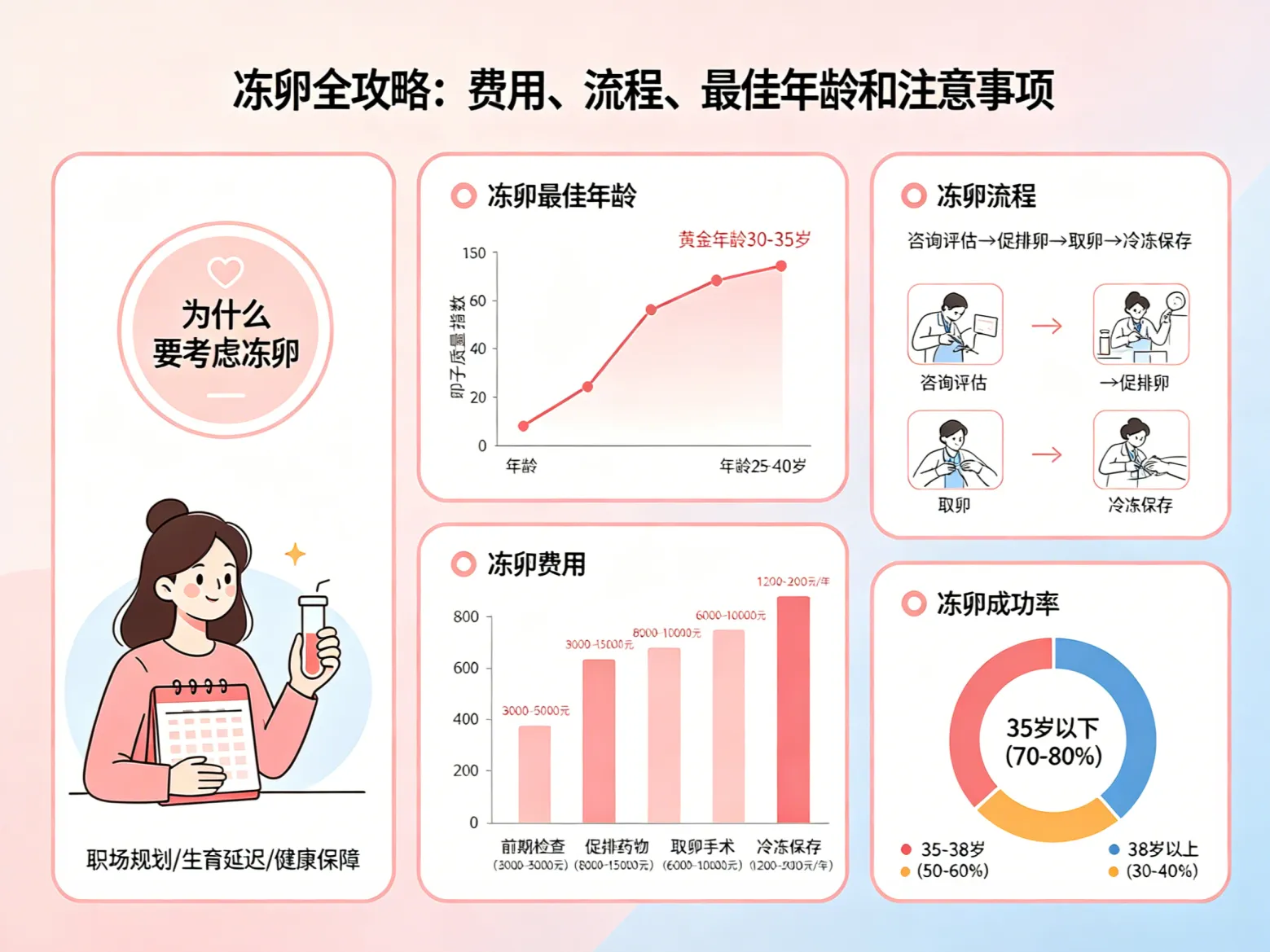
Egg freezing preserves your eggs at today’s quality — frozen before 35, each egg carries roughly 6–8% live-birth potential, and 15 eggs banked under 35 translate to an estimated 70–85% cumulative chance of a live birth when used later. A first cycle costs $4,500–$17,000 depending on country, plus $200–$1,000 a year in storage.
Why Do Women Freeze Their Eggs?
Elective egg freezing pauses the clock on egg quality, and the reasons split into four practical categories.
- Career or education — children are not on the near-term plan, but age-related decline is a worry
- No suitable partner yet — keeping the option of future biological children open
- Medical reasons — upcoming chemotherapy, radiation or surgery that could damage ovarian function
- Financial timing — current circumstances are not right for raising a child
The core value is a quality freeze-frame: eggs frozen at 30 are still 30-year-old eggs when used at 40. Unlike a full IVF cycle, egg freezing stops at retrieval — nothing is fertilised or transferred until you decide.
What Is the Best Age for Egg Freezing?
Age determines both egg quality and how many cycles you will need, which is why completing freezing before 35 is the single best decision in this process.
| Age Range | Egg Quality | Recommendation |
|---|---|---|
| 25–30 | Optimal | Ideal window — best quantity and quality |
| 30–35 | Good | The “sweet spot” for cost-effectiveness |
| 35–38 | Moderate | Still worthwhile; expect multiple stimulation cycles |
| 38–40 | Lower | More cycles needed to bank enough eggs |
| 40+ | Low | Weigh carefully — cost-benefit drops sharply |
Bottom line: if egg freezing is on your roadmap, aim to finish it before 35. Readers also evaluating reserve should see our low-AMH IVF guide.
How Much Does Egg Freezing Cost?
Total first-year cost ranges from about $4,500 in Malaysia to $17,000 in the US, and the gap persists across every line item.
| Country | Stimulation + Retrieval | Medication | Annual Storage | First-Year Total |
|---|---|---|---|---|
| United States | $8,000–$12,000 | $3,000–$5,000 | $500–$1,000 | $11,000–$17,000 |
| Thailand | $3,500–$6,000 | $2,000–$3,500 | $300–$500 | $5,500–$9,500 |
| Malaysia | $3,000–$5,000 | $1,500–$3,000 | $200–$400 | $4,500–$8,000 |
| Japan | $4,000–$7,000 | $2,000–$4,000 | $300–$600 | $6,000–$11,000 |
When you later use the frozen eggs, budget a further $4,000–$8,000:
- Thawing and ICSI fertilisation: $2,000–$4,000
- Embryo culture and transfer: $2,000–$4,000
At that point the eggs enter a standard IVF programme whose national outcomes are published by the CDC and SART. Compare destinations in our IVF cost guide 2026.
How Does the Egg Freezing Process Work?
The whole cycle takes roughly 2–4 weeks from blood tests to frozen eggs, in five steps.
Step 1: Initial Assessment — 1–2 Weeks
Baseline testing confirms what one cycle is likely to yield:
- Hormone panel including AMH, FSH and estradiol
- Transvaginal ultrasound for antral follicle count
- Infectious disease screening
- Physician estimate of expected egg yield
Step 2: Ovarian Stimulation — 8–14 Days
Daily hormone injections grow multiple follicles at once, with an ultrasound check every 2–3 days. A trigger injection finishes maturation when follicles are ready.
Step 3: Egg Retrieval — About 30 Minutes
A transvaginal ultrasound-guided aspiration collects the eggs under IV sedation, so the procedure itself is painless. You are observed at the clinic for 1–2 hours before going home.
Step 4: Vitrification
Eggs are flash-frozen by vitrification and stored in liquid nitrogen at −196°C, where they can technically be kept indefinitely.
“Evidence indicates that oocyte vitrification and warming should no longer be considered experimental.” — Practice Committees of the American Society for Reproductive Medicine, ASRM, and the Society for Assisted Reproductive Technology, Fertility and Sterility, 2013
Step 5: Recovery and Storage
Rest 1–2 days after retrieval, resume normal life after your next period, and pay the annual storage fee — $200–$1,000 depending on country — to keep the eggs banked.
How Many Eggs Should You Freeze?
One number decides your future odds: the count of frozen eggs, which is why the retrieval target rises with age.
| Age at Freezing | Recommended Number | Likely Cycles Needed |
|---|---|---|
| 25–30 | 15–20 | 1–2 |
| 30–35 | 20–25 | 2 |
| 35–38 | 25–30 | 2–3 |
| 38+ | 30+ | 3–4 |
Research-based live-birth estimates:
- Frozen under 35: roughly 6–8% chance of live birth per egg
- 15 eggs frozen under 35: about 70–85% cumulative live-birth rate
- 20 eggs frozen at 35–37: about 60–75% cumulative live-birth rate
What Are the Pros and Cons of Egg Freezing?
Freezing buys time, but it is neither free nor guaranteed — weigh both columns honestly.
Advantages
- Locks in egg quality from the age you freeze
- Relieves biological-clock pressure while life settles
- Strong outcomes later if frozen young and in sufficient numbers
- Vitrification is now a mature, established technology
Disadvantages
- Real cost: $4,500–$17,000 upfront, plus annual storage, plus $4,000–$8,000 to use
- No guarantee of a future baby
- Physical burden of 8–14 days of injections and a sedated procedure
- Higher ages often require 2–4 stimulation cycles to bank enough eggs
FAQ
Q: How long can eggs stay frozen?
Technically indefinitely — the longest successful storage-to-birth case on record exceeds 20 years. Legal limits differ by country: the UK’s HFEA standard storage period is 10 years, extendable up to 55.
Q: Does egg freezing reduce my natural fertility?
No. Retrieval collects only the follicle cohort already selected for that cycle — eggs that would have been lost anyway — so your reserve is untouched.
Eggs frozen at 30 remain 30-year-old eggs at 40, and natural conception chances are unaffected.
Q: Is the process painful?
The 8–14 days of stimulation can bring bloating and mood swings, but the retrieval itself is painless under sedation. Most women keep working normally throughout the cycle.
Q: Can single women freeze their eggs?
Yes. The US, Thailand, Malaysia and Japan — the 4 destinations in our cost table — place no restrictions on single women freezing eggs.
China currently restricts elective egg freezing for unmarried women, which is why many patients travel.
Q: How many eggs do I need at 32?
Plan on 20–25 eggs at 30–35, typically from 2 stimulation cycles. At that count, if frozen under 35, the estimated cumulative live-birth rate is roughly 70–85%.
Q: What does it cost to actually use the frozen eggs?
Budget $4,000–$8,000 on top of storage: thawing and ICSI fertilisation run $2,000–$4,000, and embryo culture plus transfer another $2,000–$4,000.
Is Egg Freezing Worth It?
Egg freezing is one of the most reliable ways to protect future fertility, and the economics favour early action: younger freezing means better egg quality, fewer stimulation cycles and a lower total bill. If you are 35 or older, or your AMH is low, pair this guide with our IVF over 35 guide before deciding.
Compare fertility clinics in our hospital directory or contact our advisory team for a personalised freezing assessment.
About this article: researched and written by the ProIVF Medical Editorial Team following Google E-E-A-T health content guidelines and reviewed by the ProIVF Medical Advisory Board, using clinic-published pricing and peer-reviewed ASRM/SART literature. Success estimates are population-level figures and do not guarantee individual outcomes. This article is for informational purposes only and is not medical advice. Editorial standards: ProIVF About page. Last updated: 2026-09-20.